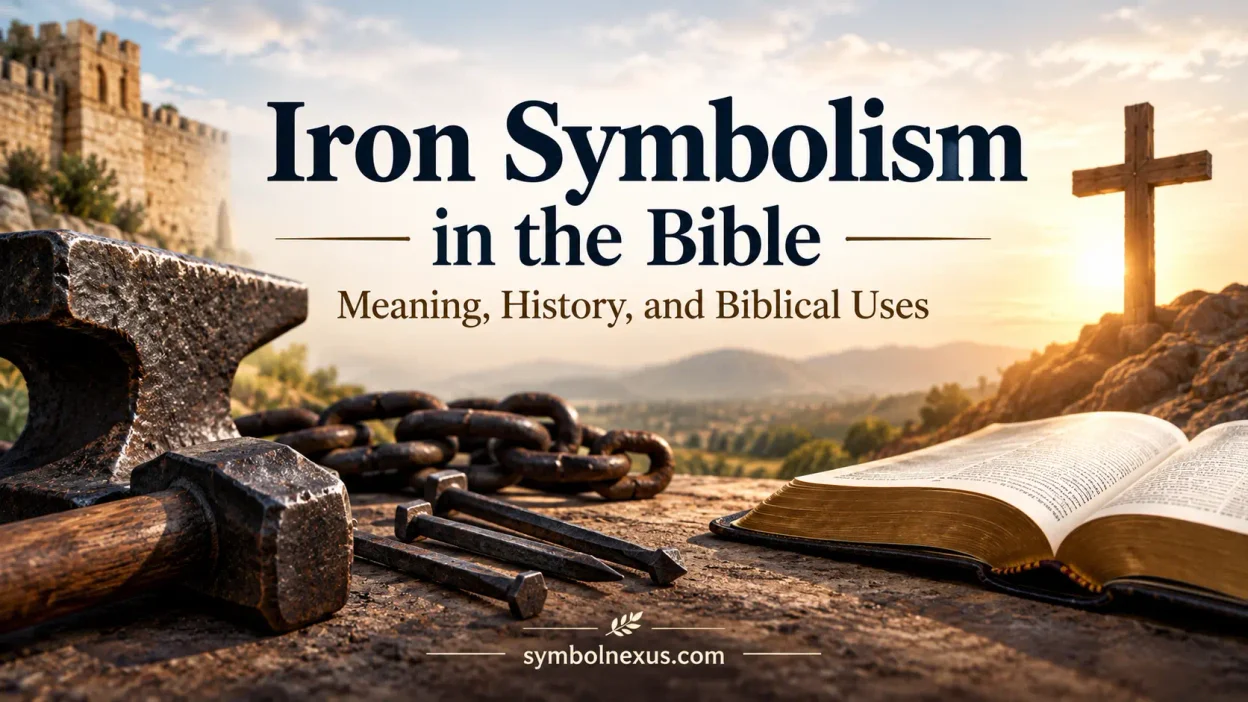
Iron symbolism in the Bible often points to strength, firmness, authority, oppression, and the ability to endure hardship. Biblical writers used iron to describe everything from tools and weapons to rigid rule and difficult circumstances. Its meaning depends on the passage: iron can represent practical strength and stability, but it can also describe cruelty, captivity, or a power that feels impossible to resist.
Iron mattered in the ancient world because it could be shaped into tools, agricultural equipment, and weapons. These everyday uses gave biblical writers familiar images for explaining spiritual truths, political power, and human suffering. Readers did not need to see iron as mysterious to understand its force. They knew that it could build, cut, protect, and injure.
For modern American readers, these passages can offer a useful way to think about resilience, discipline, authority, and freedom. The key is to read each reference in context rather than assign one fixed meaning to every mention of iron.
Quick Answer
Iron symbolism in the Bible commonly represents strength, firmness, endurance, and authority, but it can also symbolize oppression, harsh judgment, and captivity. Its meaning varies by passage, from iron tools and weapons to the iron rod in biblical imagery and the iron yoke used to describe severe hardship.
TL;DR
- Iron often represents strength, firmness, and the ability to withstand pressure.
- Iron weapons can symbolize military power, conflict, and human vulnerability.
- An iron yoke represents harsh oppression and burdensome control.
- Iron imagery in prophecy can describe powerful kingdoms and rigid authority.
- Biblical iron symbolism depends on the passage, not a universal spiritual code.
- Modern readers often connect iron with resilience, discipline, justice, and endurance.
What Iron Represents in the Bible
Iron is a material with practical strength, which makes it a natural image for power and firmness in biblical writing. It appears in descriptions of tools, weapons, gates, agricultural equipment, and symbolic objects. Each use draws on what iron could do in ordinary life.
In a positive or neutral sense, iron can suggest durability, reliability, and the ability to withstand force. In a negative sense, it can describe something hard, unyielding, or oppressive. A strong object may protect people, but a strong weapon may threaten them. A firm authority may provide order, but an inflexible ruler may cause suffering.
This range matters because the Bible does not present iron as automatically good or evil. The material itself does not determine the lesson. The surrounding words, the people involved, and the purpose of the image shape its meaning.
For example, iron tools help people work the land, while iron weapons appear in accounts of warfare. In prophetic passages, iron can represent a kingdom’s strength or the harshness of its rule. In passages about bondage, it helps communicate the severity of suffering.
Iron in the Ancient Biblical World
Iron had practical and economic value in the ancient Near East. It could be worked into tools and weapons, although its availability, quality, and production methods changed across different periods. Biblical references to iron therefore reflect a material that people associated with labor, military capability, and useful equipment.
The Bible mentions iron in settings such as farming, construction, warfare, and metalworking. Deuteronomy 19:5, for example, describes a person cutting wood with an iron tool when its head slips from the handle and strikes another person. The passage concerns accidental death and legal responsibility, not a hidden spiritual meaning. Yet the example shows how familiar iron tools were in daily work.
Joshua 17:16 and Judges 1:19 refer to iron chariots in accounts of conflict and territorial control. These references present iron as part of a military advantage that could make an opponent seem difficult to overcome. The point is not that iron was unbeatable, but that superior equipment could create a real obstacle.
The material’s practical role helps explain why biblical writers could use it in figurative language. Iron had recognizable qualities: it was hard, useful, and capable of causing serious harm. Those qualities gave it a clear place in images of strength, pressure, and control.
Iron as a Symbol of Strength and Endurance
One of the clearest symbolic uses of iron is its association with strength. Because iron could withstand considerable force and serve in demanding work, it offered a familiar comparison for something firm or difficult to break.
Jeremiah 1:18 uses this imagery when God tells Jeremiah that he has been made like a fortified city, an iron pillar, and bronze walls against the people he must face. The image communicates steadfastness in the face of opposition. Jeremiah’s strength does not mean he will avoid hardship; it means he must remain committed to his calling despite resistance.
This distinction is important. Biblical endurance is not always physical toughness or emotional silence. It can mean continuing to act faithfully when a task becomes difficult, speaking honestly when doing so brings opposition, or refusing to abandon a responsibility simply because the outcome is uncertain.
For modern readers, an iron pillar can serve as a metaphor for dependable character. A person may show this kind of strength by keeping a promise, protecting someone vulnerable, or remaining principled under pressure. The comparison works best when it points to steady commitment rather than an expectation that people should never feel pain or ask for help.
The Iron Yoke: Oppression and Heavy Burdens
Iron takes on a darker meaning when the Bible uses it to describe a yoke. A yoke is a device placed across animals to help control or direct their work. As a metaphor, it can describe forced service, subjection, or a burden imposed by another person or power.
Deuteronomy 28:48 describes an iron yoke in a passage about the consequences of covenant disobedience for ancient Israel. The image presents subjection as severe and difficult to escape. In Jeremiah 28, the prophet Jeremiah uses a wooden yoke to represent subjection to Babylon, while the prophet Hananiah breaks it as a sign of his opposing message. Jeremiah later speaks of an iron yoke, intensifying the image of Babylonian domination.
These passages use the physical weight and hardness of iron to communicate a political and social reality. The yoke is not merely a personal inconvenience. It represents a condition in which another power restricts a people’s freedom.
Readers today may connect the image with abusive control, exploitation, unjust systems, or responsibilities that have become crushing. However, modern applications should not erase the original setting. Biblical references to the iron yoke often concern specific covenant warnings and the historical experience of national subjection. They should not automatically be used to claim that every personal difficulty is divine punishment.
The image can still prompt an important question: does a form of authority help people live responsibly, or does it become a means of domination?
Iron Weapons and the Reality of Conflict
Iron weapons in the Bible commonly point to military power, danger, and the unequal resources available to opposing groups. Swords, spearheads, and other metal equipment could shape the outcome of a battle, so iron often appears in accounts where physical force is central.
In 1 Samuel 13:19–22, the narrative describes the Philistines’ control over blacksmithing in a way that leaves the Israelites poorly equipped with swords and spears at the time of conflict. The passage emphasizes a practical disadvantage, not a symbolic secret. Access to metalworking and weapons affected a community’s ability to defend itself.
Iron weapons can therefore symbolize the visible tools of power. They remind readers that conflict is not fought only through courage or conviction; resources, technology, and strategic advantage also matter. A group may be determined and still face serious material disadvantages.
At the same time, biblical narratives do not consistently treat superior weaponry as proof of moral superiority or guaranteed victory. The presence of iron weapons does not settle the theological meaning of a battle. The narrative’s wider message, including its treatment of human choices and divine action, must be considered.
For contemporary readers, this distinction discourages a simplistic lesson that strength always wins. Iron can represent force, but force alone does not establish justice.
Iron in Biblical Prophecy: Kingdoms and Authority
Iron becomes especially significant in biblical prophecy and apocalyptic literature, where physical materials help describe kingdoms, rulers, and political power. Daniel 2 presents a statue in King Nebuchadnezzar’s dream, with different parts made from different materials. Its legs are iron, and its feet combine iron and clay.
Within Daniel’s interpretation, the iron represents a kingdom characterized by strength. The feet’s mixture of iron and clay introduces an image of division and instability: elements that do not hold together well are joined in one structure. The passage is about kingdoms and their limits, not simply about an individual’s personality or spiritual condition.
Daniel 7 also uses iron in a vision of a terrifying beast whose great iron teeth devour and crush. Here, iron conveys destructive force and the frightening power of an oppressive political order. The image is much harsher than the iron pillar in Jeremiah.
Revelation 2:27 and 12:5 use the image of ruling with an iron rod, drawing on earlier biblical language, especially Psalm 2. The rod communicates firm authority and decisive rule. Interpreters differ on details of how these prophetic images relate to historical kingdoms, future events, and theological ideas, so readers should be cautious about treating any modern political prediction as settled fact.
Across these passages, iron can signal power that is formidable, rigid, or destructive. The context determines which aspect matters most.
The Iron Rod: Firm Rule and Judgment
The phrase “iron rod” is often associated with authority that cannot easily be resisted. In Psalm 2, the ruler is pictured as breaking opposition with an iron rod, an image later echoed in Revelation. The language is royal and judicial: it concerns the exercise of authority over rebellious nations.
Iron contributes the idea of firmness. Unlike a fragile object, it suggests a rule capable of imposing consequences. Depending on the passage and interpretation, the image can communicate legitimate authority, judgment against opposition, or the severity of a ruler’s power.
It is important not to reduce the iron rod to a general symbol of anger. Its biblical setting involves kingship, divine authority, and the fate of nations. The image also belongs to poetic and prophetic language, which uses vivid physical objects to express political and theological claims.
In modern discussions, someone might use “iron rule” to describe a strict leader or a government that exercises tight control. That expression carries a similar association with inflexibility. Still, a biblical image of divine rule should not automatically be used to justify every human leader who demands obedience. Human authority remains subject to moral evaluation.
Iron as a Sign of Difficulty and Restriction
Iron can also describe a condition that feels difficult to escape. The metal’s hardness makes it useful for depicting barriers, restraints, or circumstances that limit movement. When the Bible uses iron in connection with bondage or confinement, the image makes restriction feel concrete.
In Psalm 107:10, people are described as sitting in darkness and the shadow of death, prisoners in affliction and iron. The verse presents suffering as a condition of confinement. The following verses connect this distress with rebellion and the consequences of rejecting God’s words, while the wider psalm later describes deliverance for those who cry out to God.
The iron imagery helps readers picture captivity as more than a passing inconvenience. It suggests a state in which people lack freedom and need help beyond their own resources.
Modern readers may find the image relevant when thinking about addiction, abusive relationships, unjust imprisonment, or circumstances that narrow a person’s choices. These are applications rather than direct equivalents of the ancient passage. Not every modern struggle fits the biblical setting, and the verse should not be used to blame people for suffering they did not choose.
The central idea is the weight of restriction and the longing for release.
Iron and God’s Judgment in the Bible
Some biblical passages use iron in settings of judgment, punishment, or severe consequences. The material’s hardness makes it an effective image for a condition that feels strict and unyielding. Yet iron is not a universal biblical code for judgment; its role depends on the passage.
Deuteronomy 28 includes the iron yoke within a series of covenant curses describing what would happen if Israel abandoned its covenant obligations. The passage belongs to the ancient covenant framework of Deuteronomy and should be read in that context. It is not a general formula that allows readers to identify every hardship as punishment from God.
Other texts use iron to describe destructive kingdoms or the force of judgment against opposition. Daniel’s iron imagery, for instance, emphasizes the strength and crushing power of a political order. The focus differs from the covenant warnings in Deuteronomy.
For readers today, the most responsible approach is to distinguish the literary function of the image from assumptions about personal circumstances. A biblical passage may use iron to portray judgment without authorizing readers to declare that a neighbor’s illness, financial trouble, or loss is a divine sentence. Careful interpretation considers the text’s audience, genre, and surrounding message.
Iron in Biblical Poetry and Everyday Life
Not every mention of iron is figurative. Many biblical passages refer to it as an ordinary material used for work, building, or equipment. This practical side is essential because it explains how the material acquired its symbolic associations.
Ecclesiastes 10:10 uses a blunt iron tool to illustrate the value of skill and preparation: when an iron tool is dull, more effort is required, while wisdom can help a person succeed. The point is practical and reflective. Preparation and good judgment can reduce unnecessary labor.
Job 19:24 refers to writing with an iron stylus and lead, evoking a durable inscription. Here, iron is associated with the means of making words last. The image depends on the tool’s material function rather than on a broad doctrine about iron.
These examples show that biblical symbolism often grows from ordinary experience. Iron could cut, shape, record, or build. It could also injure, restrain, and destroy. Its symbolic range reflects the range of human uses to which the material was put.
For modern readers, this is a useful interpretive rule: before asking what iron means spiritually, first ask what it is doing in the passage. Sometimes the material is simply part of the scene; sometimes its qualities help carry the message.
Iron Symbolism Compared Across Biblical Contexts
Iron does not carry one fixed meaning in every biblical passage. The following table summarizes common contexts and the ideas they communicate.
| Biblical context | Main symbolic meaning | Example | Interpretive note |
|---|---|---|---|
| Iron pillar | Steadfastness and resilience | Jeremiah 1:18 | Strength to face opposition |
| Iron yoke | Oppression and subjection | Deuteronomy 28:48 | A burden imposed by a stronger power |
| Iron weapons | Military force and danger | 1 Samuel 13:19–22 | Equipment affects power and vulnerability |
| Iron kingdom | Political strength and crushing authority | Daniel 2 and 7 | Prophetic imagery requires contextual interpretation |
| Iron rod | Firm rule and judgment | Psalm 2; Revelation 2:27 | Royal authority and consequences |
| Iron tool | Work, skill, or practical durability | Ecclesiastes 10:10 | May be literal rather than symbolic |
The table is a guide, not a codebook. A reader should not decide what a passage means from the word “iron” alone. The surrounding narrative or poem supplies the necessary context.
What Iron Symbolism Can Mean for Christians Today
Christians today may use biblical iron imagery to reflect on perseverance, moral firmness, authority, and the dangers of oppression. These applications can be helpful when they grow naturally from the passage rather than replacing its original meaning.
Jeremiah’s iron pillar can encourage a person to remain faithful during opposition. Ecclesiastes’ iron tool can prompt reflection on preparation, wisdom, and the value of developing practical skills. The iron yoke can help people name oppressive conditions instead of treating every burden as normal or deserved.
Iron imagery can also challenge the assumption that toughness is always virtuous. A person who refuses to reconsider a harmful decision may be rigid rather than steadfast. A leader who demands unquestioning obedience may be controlling rather than just. Biblical images of iron allow readers to distinguish resilience from cruelty and firmness from inflexibility.
In a U.S. setting, these themes may appear in sermons, Bible study groups, devotional writing, or personal reflection. They can also inform discussions about leadership, justice, and the responsible use of power. However, no modern political figure or institution should be labeled the fulfillment of a prophetic iron image without careful argument and acknowledgment of interpretive differences.
The practical lesson is to ask what kind of strength a passage commends and what kind it warns against.
Common Misunderstandings About Iron in the Bible
One common misunderstanding is that iron always represents strength in a positive sense. Some passages use iron to describe steadfastness, but others associate it with crushing force, captivity, or severe domination. The same material can communicate protection in one context and danger in another.
Another mistake is to treat every mention of iron as a coded spiritual message. Biblical writers frequently name real tools, weapons, and objects. A reference to an iron axe does not automatically predict hardship, and a mention of iron weapons does not necessarily imply a personal battle in the reader’s life.
Readers can also misapply prophetic imagery by identifying a modern country, leader, or event with a biblical kingdom too quickly. Daniel and Revelation have been interpreted in different ways across Christian traditions. Their images deserve serious study, but confidence should not exceed what the passage and its interpretive framework support.
Finally, iron symbolism should not be used to tell suffering people that their hardship proves God is punishing them. Some biblical texts connect particular circumstances with covenant judgment, but that does not give readers permission to make sweeping claims about other people’s lives. Context, humility, and compassion are necessary parts of responsible interpretation.
Frequently Asked Questions
What does iron symbolize in the Bible?
Iron commonly represents strength, firmness, endurance, and authority. Depending on the passage, it can also represent oppression, military power, judgment, or a kingdom that crushes its opponents.
Is iron a positive or negative symbol in the Bible?
Iron can carry either positive or negative associations. It represents steadfastness in Jeremiah 1:18, while the iron yoke in Deuteronomy 28:48 portrays severe subjection and hardship.
What does an iron yoke mean in the Bible?
An iron yoke symbolizes harsh control, forced service, or a burden that is difficult to escape. In its original biblical context, the image appears in passages about Israel’s covenant obligations and political subjection.
What does an iron rod represent in Scripture?
An iron rod represents firm rule and the exercise of authority, especially in royal and prophetic imagery. Psalm 2 and Revelation use the image in discussions of rule over nations and the consequences of opposition.
Does iron symbolize spiritual strength?
Iron can serve as an image of spiritual steadfastness when a passage emphasizes firmness under pressure. Jeremiah 1:18 provides an example, but readers should distinguish this figurative meaning from passages where iron represents oppression or destruction.
What does iron mean in a biblical dream?
The Bible does not provide one universal interpretation for every modern dream involving iron. Because biblical iron can represent several different things, a dream should not automatically be treated as a divine message or prediction; personal associations and the dream’s context also matter.
Why does iron appear in Daniel’s visions?
Iron appears in Daniel’s visions as part of imagery describing powerful kingdoms and destructive political authority. In Daniel 2, iron represents strength within the statue’s interpretation, while Daniel 7 uses iron teeth to portray a terrifying beast that crushes and devours.
Conclusion
Iron symbolism in the Bible reflects the material’s familiar qualities: strength, hardness, durability, and its capacity to restrain or injure. Biblical writers use iron to describe steadfastness, practical work, military power, oppressive burdens, firm rule, and kingdoms that wield destructive authority. Its meaning becomes clear only when readers consider the passage in which it appears.
For Christians and other readers today, iron imagery can encourage perseverance while also warning against rigid control and the misuse of power. Understanding iron symbolism in the Bible means recognizing both sides of the material: strength can protect and sustain, but it can also dominate and destroy. The surrounding text determines which lesson the image is meant to convey.