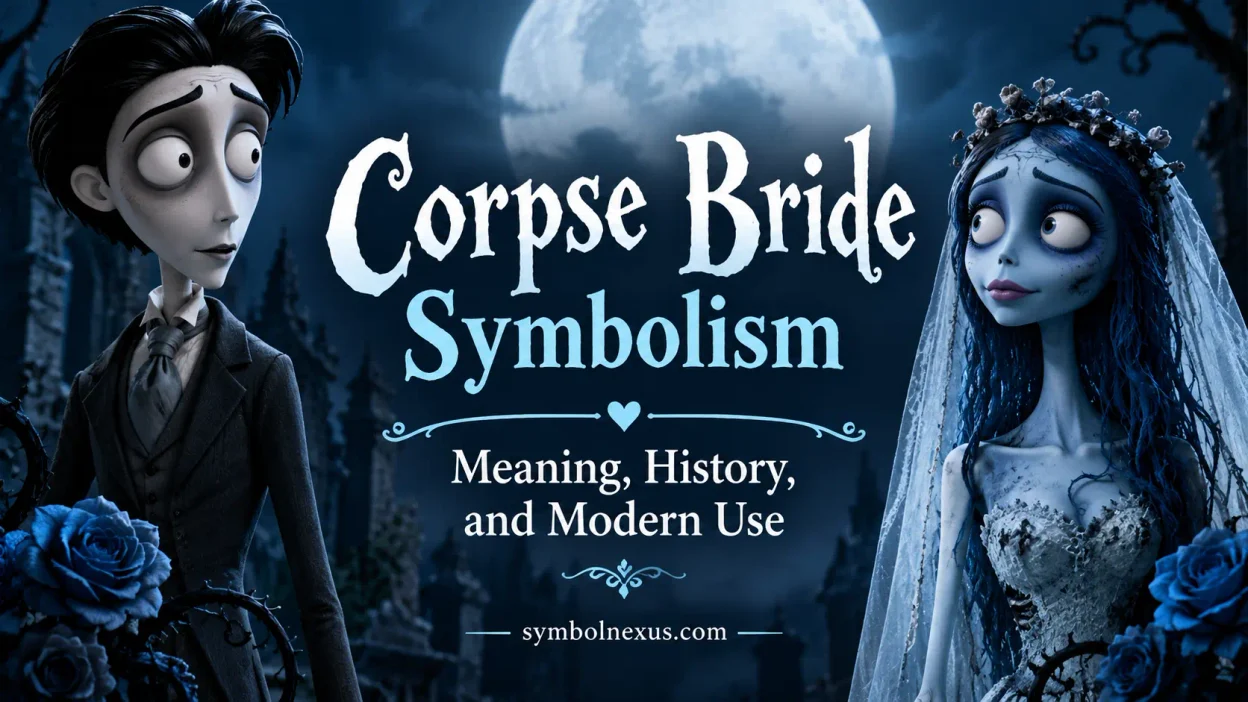
Corpse bride symbolism is most widely associated with tragic love, betrayal, unfinished promises, and the struggle to find peace after loss. In modern American culture, the phrase usually brings to mind Tim Burton’s 2005 stop-motion film Corpse Bride, especially Emily, the murdered woman who rises from her grave in a wedding dress. Her story blends gothic imagery with an emotional question: what happens when a person’s hopes for love are destroyed before they can be fulfilled?
The film’s setting, characters, and visual contrasts give the bride more than a frightening appearance. Emily represents someone who has been wronged but still longs for affection, recognition, and a meaningful ending. Her journey also challenges the idea that love means possessing another person or holding them to a promise forever.
The symbolism extends beyond the movie. Folklore about dead brides, traditional wedding imagery, mourning customs, and modern gothic fashion all provide ways to understand why a bride associated with death can represent both grief and release.
Quick Answer
Corpse bride symbolism commonly represents tragic love, betrayal, grief, and the need for emotional closure in modern American pop culture, especially through Tim Burton’s Corpse Bride. In folklore and gothic storytelling, a dead bride can also represent broken promises, the boundary between life and death, and the hope of release from an unfinished past.
TL;DR
- Emily represents love interrupted by betrayal and an unresolved past.
- The wedding dress contrasts the promise of marriage with death and abandonment.
- The film reverses expectations by making the underworld more welcoming than the living world.
- Folklore about supernatural brides connects romance with mortality and broken vows.
- Emily’s final transformation represents release rather than punishment.
- Modern gothic style uses corpse bride imagery to express individuality and bittersweet romance.
1. What the Corpse Bride Represents as a Symbol
At the center of the symbol is a contradiction: a bride traditionally represents the beginning of married life, while a corpse represents death and the end of physical life. Combining the two creates an image of a future that was cut short. Instead of beginning a shared life, the bride remains connected to the moment when her hopes were destroyed.
In Corpse Bride, Emily embodies this contradiction. She was preparing to marry someone she trusted, but her intended groom betrayed and murdered her. Her wedding clothes preserve the image of the life she expected to have, while her skeletal appearance reveals the violence that prevented it.
This makes the corpse bride a symbol of love interrupted before it could become reality. She can also represent the lasting effects of betrayal, particularly when a person never receives an explanation, apology, or chance to move forward.
The symbol is not entirely negative. Emily is expressive, funny, compassionate, and capable of making difficult choices. Her story suggests that suffering does not have to become a person’s permanent identity. The bride’s final act matters because she chooses to release someone she loves rather than repeat the harm done to her.
2. The Wedding Dress as a Sign of Lost Possibility
A wedding dress normally signals a major transition. It can represent commitment, hope, family expectations, public recognition, and the start of a new chapter. When the dress appears on a dead bride, those associations become painful.
Emily’s gown suggests that the wedding never reached its intended purpose. The ceremony remains an unfinished event, and the bride seems caught between the future she imagined and the death she experienced. Her clothing is a reminder of what was taken from her, not simply a costume that makes her look frightening.
The contrast is especially clear in the film’s pale, damaged fabric. A conventional bridal gown often looks clean and carefully prepared. Emily’s worn dress carries traces of the grave, placing beauty and decay in the same frame.
For modern viewers, this image can represent a relationship that ended before it had a chance to develop, a life plan that collapsed unexpectedly, or the grief of losing an imagined future. It does not mean that every wedding dress associated with dark imagery represents sadness. In gothic art, the contrast between bridal beauty and death is often used to explore how fragile human expectations can be.
3. Betrayal, Broken Trust, and the Cost of False Promises
Betrayal is one of the most important meanings attached to Emily. Her death is not simply an unfortunate accident; it results from someone exploiting her trust. She believed she was entering a loving relationship, but her intended groom wanted her valuables and left her dead.
That history changes the meaning of her repeated desire to marry. Her longing is understandable because the wedding represents a promise that was stolen from her. At the same time, her attachment to that promise threatens to pull Victor into a situation he did not knowingly choose.
This tension makes the story more complicated than a simple revenge tale. Emily deserves recognition for the wrong done to her, but Victor is not the person responsible for her original suffering. A promise made under confusion cannot repair a betrayal committed by someone else.
The symbol therefore asks a practical moral question: when a promise is broken, what does justice require? It may require naming the wrongdoing, protecting the person who was harmed, and refusing to let the offender escape responsibility. It does not necessarily require forcing an innocent person to fulfill the original promise.
4. Love Without Possession
Emily initially treats her accidental marriage to Victor as a chance to recover the life she lost. Her desire for companionship is human, but her claim on Victor creates a conflict. He has feelings for Victoria, and he did not knowingly agree to abandon his life.
The emotional turning point comes when Emily recognizes that keeping Victor would prevent him and Victoria from having the future they want. She releases him, even though doing so means surrendering the relationship she hoped would make her happy.
This is why the corpse bride can symbolize love that becomes generous rather than possessive. The ending does not suggest that Emily’s feelings were meaningless or that she should simply forget what happened. Instead, it shows that love cannot be made genuine through coercion.
In everyday terms, this interpretation can apply to relationships that have ended, unreturned affection, or the difficult process of letting go. Caring about someone does not automatically give a person a right to control their choices. The symbol’s most compassionate meaning emerges when Emily stops treating marriage as something she must obtain and allows love to include another person’s freedom.
5. Death and the Boundary Between Two Worlds
Gothic stories often use the boundary between the living and the dead to explore questions that ordinary life leaves unresolved. A ghost may return because of a broken promise, an injustice, or a duty that was never completed. The supernatural presence gives emotional weight to something that cannot be settled through ordinary means.
In Corpse Bride, the border between life and death is both literal and symbolic. Victor crosses into the underworld and discovers a community that has its own social life, humor, music, and routines. The dead are not presented only as threats. They have personalities and relationships, and many seem more openhearted than the living people Victor left behind.
This reversal challenges the assumption that life automatically means vitality and death automatically means emptiness. The film’s living characters can be emotionally cold, while its dead characters display warmth and generosity.
The boundary also represents the difference between holding on to the past and returning to the present. Emily’s story begins with her unable to move beyond the circumstances of her death. Her eventual release suggests that peace comes when the past is acknowledged without being allowed to dictate every future choice.
6. Why the Land of the Dead Looks More Alive
The film’s visual contrast between the living world and the underworld is one of its clearest symbolic devices. The living town is largely gray, rigid, and formal. Its residents seem constrained by money, reputation, and social expectations. The underworld, by comparison, is colorful, noisy, musical, and full of movement.
This difference is deliberate storytelling rather than a universal claim about life and death. The living world looks respectable but often lacks warmth. The dead world looks grotesque but allows its residents to express themselves.
The contrast also satirizes a society in which outward appearance can matter more than kindness. Victor and Victoria’s families arrange their marriage to improve their financial and social positions. Their personal happiness initially seems secondary to the agreement between households.
The dead characters expose that emptiness by behaving with greater spontaneity and mutual acceptance. Their world suggests that emotional vitality comes from connection and self-expression, not from looking proper or meeting other people’s expectations.
For American audiences, this can connect with criticism of status-driven lifestyles, family pressure, and relationships shaped by money. The film does not claim that every tradition or social expectation is harmful. It shows what happens when social respectability becomes more important than treating people honestly.
7. The Historical Roots of the Dead Bride Motif
The idea of a bride returning from death belongs to a broader tradition of supernatural romance and tragic folklore. Stories of ghostly brides often combine a wedding, a sudden death, a broken promise, and an encounter between the living and the dead. The wedding makes the loss especially sharp because it represents a future that should have begun.
Corpse Bride has been connected to a folk narrative about a man who inadvertently places a wedding ring on a dead woman’s finger and is then confronted by the consequences of vows spoken to her. Scholars have also discussed connections to Jewish folklore and to later versions of the dead-bride story. The exact path from older tale to film should be treated cautiously because folktales circulate in different forms, and their details change as storytellers adapt them.
Some retellings connect the motif to the dangers faced by Jewish communities in historical Eastern Europe, including antisemitic violence. Those versions carry a specific historical weight that should not be reduced to a generic gothic romance. The film adapts the supernatural-marriage premise into a Victorian-inspired fantasy and does not present Emily as a direct portrayal of a historical victim from those accounts.
The broader motif survives because it joins two experiences people recognize: the hope attached to marriage and the pain of a life ended unfairly. It gives grief a visible character and allows a story to ask whether an unresolved wrong can ever be put right.
8. Victorian Style, Mourning, and Gothic Atmosphere
The film’s Victorian-inspired setting adds another layer to its imagery. Nineteenth-century Britain is often associated in popular culture with elaborate dress, strict social etiquette, class divisions, and formal mourning practices. Historical mourning customs varied by period, wealth, and family circumstances, but clothing and ritual could make grief publicly visible.
Black garments, jewelry associated with mourning, funeral processions, and formal expectations around bereavement helped communicate a family’s loss. In gothic fiction, such details also created a visual world where death remained close to everyday life.
Corpse Bride uses that atmosphere without functioning as a documentary account of Victorian society. Its exaggerated costumes and gloomy town create a fairy-tale setting in which family reputation and marriage arrangements become sources of pressure.
The bride’s ruined gown brings mourning and marriage together. White or pale bridal clothing traditionally suggests a ceremony and a new beginning in many modern Western settings, while the signs of decay point toward bereavement. Their combination makes Emily look as if she has been denied both the wedding she expected and the mourning that might have followed a recognized death.
This is gothic symbolism at work: familiar social objects become unsettling when their usual purpose is interrupted.
9. The Blue Butterfly and the Meaning of Release
Butterflies commonly appear in art and popular culture as images of change, transition, and renewal. Their transformation from caterpillar to winged adult makes them useful symbols of a life changing form. In some cultural and spiritual traditions, butterflies are also associated with the soul or with remembrance, although these meanings are not universal.
In Corpse Bride, the butterfly imagery surrounding Emily’s final departure gives the ending a visual language of release. Rather than remaining a bride trapped in the same tragic moment, she changes into a form that can move freely through the air. Her story ends with separation, but not with the punishment or humiliation that a revenge narrative might demand.
The color blue also contributes to the film’s visual identity. Emily’s blue skin and the cool palette of the underworld distinguish her from the more muted living characters. Blue can suggest sadness, distance, calm, or other meanings depending on context; it does not carry one fixed psychological message.
The butterfly’s role is more important than any single color association. It marks a change in Emily’s condition. The image suggests that release can come after recognition, justice, and the decision to stop demanding that the past be recreated.
10. Corpse Bride Symbolism in Modern American Culture
In the United States, corpse bride imagery is strongly linked to Tim Burton’s film, gothic fantasy, and the wider popularity of characters who combine sweetness with macabre appearance. The film’s memorable design makes Emily recognizable even to people who do not recall every detail of the plot.
American viewers may interpret the character as a tragic romantic figure, a symbol of resilience after betrayal, or an example of how women in fairy tales are often denied control over their lives. Others focus on the film’s dark humor, unusual beauty, and rejection of conventional ideas about what makes a person attractive or respectable.
The film also fits a familiar American interest in stories that challenge the difference between appearance and character. Emily looks frightening, but she shows kindness. Some living characters appear polished and proper, yet act selfishly. This contrast encourages viewers to judge people by their choices rather than their appearance or social position.
During Halloween season, corpse bride costumes and gothic decorations can emphasize the spooky side of the image. Outside that context, fans may focus more on Emily’s romance, style, or emotional journey. The meaning depends on whether the image is used for horror, fashion, humor, or personal expression.
11. Emotional and Psychological Interpretations
As a fictional symbol, the corpse bride can help people talk about experiences that are difficult to express directly. Emily’s story brings together grief, betrayal, loneliness, anger, and the desire to be remembered. Her attachment to the wedding reflects how a painful event can become tied to an entire imagined future.
Someone who identifies with Emily may see her as a figure who was denied a voice and then insists on being acknowledged. That interpretation can resonate with people who have experienced rejection, abandonment, or an unfair ending to a relationship. It does not mean the character offers a clinical explanation for grief or that viewers who connect with her necessarily share the same experiences.
The story also distinguishes recognition from endless attachment. Emily’s pain deserves to be taken seriously, but she does not find peace by forcing Victor to remain with her. Her final decision suggests that healing can involve acknowledging what happened, accepting that it cannot be undone, and choosing what happens next.
The symbol can therefore hold two feelings at once: sorrow for what Emily lost and relief that she no longer has to remain defined by it.
12. What the Corpse Bride Means in Tattoos, Fashion, and Decor
Corpse bride imagery can appeal to people who enjoy gothic art, dark romance, alternative fashion, or the contrast between delicate beauty and visible decay. A tattoo or illustration inspired by Emily may be chosen because of the character herself, the film’s aesthetic, or a personal connection to its themes.
| Context | Possible Meaning | Common Associations | Important Note |
|---|---|---|---|
| Tattoo | Survival after betrayal or grief | Emily, flowers, butterflies | Personal meaning varies |
| Gothic fashion | Individuality and unconventional beauty | Lace, veils, dark makeup | May be purely aesthetic |
| Halloween costume | Playful horror and fandom | Bridal gown, blue makeup | Often emphasizes recognition |
| Artwork or decor | Love, mortality, and bittersweet romance | Skeletons, roses, moonlight | Context changes the interpretation |
| Fan art | Emotional connection to the film | Emily and Victor, butterflies | Can focus on different characters or themes |
A person wearing a corpse bride costume is not necessarily expressing sadness or a belief about the afterlife. They may simply enjoy the film, the makeup design, or the theatrical contrast between a bridal silhouette and skeletal details.
Likewise, a butterfly tattoo inspired by the ending may symbolize personal change without carrying every meaning found in the movie. The best interpretation begins with the person’s own explanation rather than assuming a universal message.
13. Positive and Negative Meanings of the Corpse Bride
The corpse bride can carry hopeful and painful meanings at the same time. The darker side includes murder, abandonment, betrayal, grief, and the danger of being trapped in a promise that no longer serves anyone. These meanings come from Emily’s history and the unsettling contrast between marriage and death.
The more hopeful side appears in her capacity to care for others, seek justice, and finally let go. She is not reduced to a monster because she has been wronged. Her anger and longing make sense within the story, but they do not have to determine the ending.
This dual meaning is part of why the character remains memorable. She is neither an uncomplicated romantic ideal nor a villain who must be defeated. She is a victim who deserves justice and a person who eventually chooses not to make another person pay for what happened to her.
When interpreting the image, ask what the surrounding story emphasizes. A corpse bride shown reaching toward a wedding ring may suggest a broken promise. The same figure surrounded by butterflies may suggest freedom, transformation, or a peaceful ending.
14. Common Misunderstandings About Corpse Bride Symbolism
One common mistake is assuming the symbol always means death or bad luck. In the film, death is the premise, but the story’s emotional direction includes justice, compassion, and release. A dark bridal image may be unsettling without predicting a real-world tragedy.
Another misunderstanding is treating the film as a literal statement about marriage. Its conflict is built around a mistaken vow, a murdered bride, and family arrangements shaped by money and status. The story explores the difference between a promise spoken accidentally and a commitment freely chosen.
It is also misleading to treat all dead-bride folklore as one single tradition. Related stories can have different origins, cultural contexts, and moral purposes. Some versions focus on supernatural marriage; others may carry memories of violence or reflect broader fears about love and death. The historical context matters, particularly when a version is associated with persecution or a specific community.
Finally, Emily should not be interpreted only as a symbol of waiting for romantic love. Her ending is significant because she makes a choice beyond that longing. Her identity includes creativity, humor, courage, and the ability to release Victor rather than insist that her suffering entitles her to him.
15. How to Interpret the Corpse Bride in Art or Everyday Life
Start by identifying the details that stand out. Is the bride alone, holding a ring, standing beside a grave, or surrounded by butterflies? Is the scene frightening, romantic, playful, or peaceful? These details can narrow the likely interpretation without forcing every image into the same meaning.
Next, consider the relationship between the bride and the people around her. If another character has betrayed her, the image may focus on injustice and broken trust. If she willingly steps aside for someone else, the emphasis may be forgiveness or freedom. If the image appears in a costume or fan-art setting, it may communicate style and affection for the film rather than a personal message about loss.
It is also useful to separate the film’s themes from an individual’s beliefs. Some viewers may connect butterflies with the soul, while others see them as signs of change or simply as a beautiful visual motif. Neither interpretation should automatically be treated as a universal rule.
The most reliable reading combines the image’s visual clues, the story surrounding it, and the context in which someone uses it. Symbolism offers a way to interpret meaning, not proof that one meaning applies to everyone.
FAQ About Corpse Bride Symbolism
What does Emily symbolize in Corpse Bride?
Emily represents betrayal, lost possibilities, grief, and the need to be acknowledged after injustice. Her final choice also shows that love can involve letting someone go rather than claiming ownership over their future.
Is corpse bride symbolism positive or negative?
It can be both. The bride’s death and broken promises represent suffering, but her compassion and eventual release suggest healing, justice, and the possibility of moving beyond painful experiences.
What does the wedding dress symbolize in Corpse Bride?
Emily’s wedding dress represents the future she expected but never received. Its damaged condition contrasts the traditional promise of a wedding with the grief and betrayal that interrupted her life.
What does the butterfly at the end of Corpse Bride mean?
Emily’s transformation into butterflies suggests freedom, change, and release from the past. The ending offers a visual resolution to her story without suggesting that every butterfly has the same spiritual meaning.
Is Corpse Bride based on a real historical event?
The film draws on older supernatural-marriage folklore, including stories associated with Jewish and Eastern European traditions. It is a fictional adaptation, not a direct account of one verified historical event, and the origins of related versions should be treated carefully.
What does a corpse bride tattoo symbolize?
A corpse bride tattoo may express dark romanticism, individuality, survival after betrayal, or affection for Tim Burton’s film. Its meaning depends on the wearer and the chosen imagery, such as Emily’s wedding dress, a ring, or butterflies.
Why does the Land of the Dead look happier than the living world?
The contrast criticizes a society that values money, reputation, and appearances over genuine connection. The dead characters often seem more accepting and expressive, while the living characters are restricted by social expectations.
Conclusion
Corpse bride symbolism brings together love, death, betrayal, and the struggle to move beyond an unfinished past. Emily’s wedding dress represents a future that was taken from her, while her journey through the underworld gives her an opportunity to seek recognition and reach a different ending.
The film’s most important message is not that love must survive at any cost. It is that genuine care can include justice, compassion, and the freedom to choose another path. Emily’s story becomes meaningful when she is no longer defined only by the tragedy that happened to her.
In modern American culture, the corpse bride remains a memorable figure because she combines gothic beauty with recognizable emotional conflicts. Her story reminds viewers that honoring the past does not require remaining trapped in it.