Flags often serve as visual expressions of a nation’s history, values, struggles, and hopes. The Guatemala flag symbolism represents independence, national identity, peace, and the country’s connection to its natural landscape and historical roots. Its blue and white colors, along with the national emblem at the center, communicate ideas that have developed through Guatemala’s political and cultural evolution.
For many people in the United States, the Guatemalan flag is recognized through immigrant communities, cultural celebrations, international events, and conversations about Central American heritage. The flag is more than a national marker; it can represent family connections, cultural pride, and personal identity for millions of Guatemalans and Guatemalan Americans.
Understanding the meaning behind the flag requires looking at its colors, symbols, historical changes, and the way people use it today. Each element reflects a part of Guatemala’s story, from its independence movement to its modern role as a symbol of belonging.
Quick Answer
Guatemala flag symbolism commonly represents peace, freedom, and national pride through its blue and white colors, while the central emblem reflects independence, sovereignty, and Guatemala’s history. Historically, the flag developed from Central American identity movements and continues to symbolize cultural heritage in modern communities.
TL;DR
- Blue represents Guatemala’s skies, oceans, and national ideals.
- White symbolizes peace, purity, and unity.
- The emblem honors independence and national sovereignty.
- The flag connects Guatemalans worldwide to heritage.
- Modern uses include festivals, sports, and cultural events.
What the Guatemala Flag Looks Like
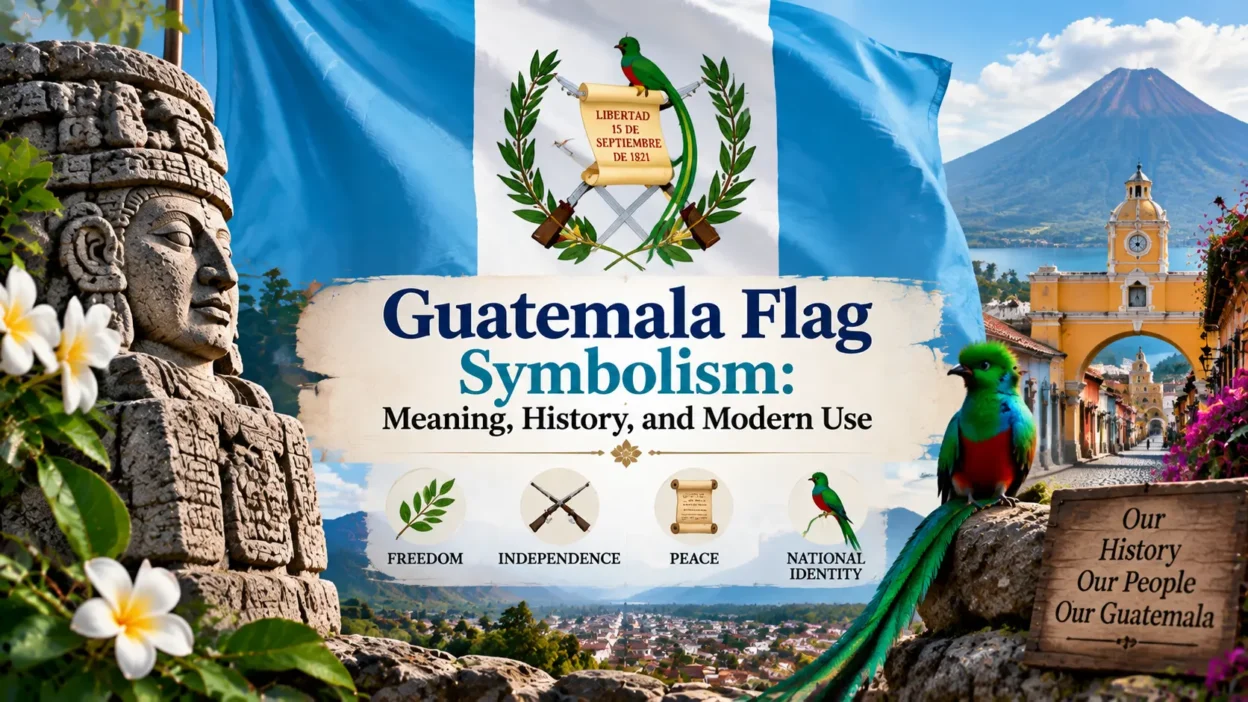
The flag of Guatemala has a simple but meaningful design. It features three vertical stripes:
- A light blue stripe on the left
- A white stripe in the center
- A light blue stripe on the right
At the center of the white stripe appears Guatemala’s national coat of arms. Unlike many national flags that place symbols in a corner, Guatemala’s emblem sits prominently in the middle, making it the main visual focus.
The coat of arms includes several important elements:
- A scroll showing the date of Central American independence
- Crossed rifles representing the country’s willingness to defend its independence
- Crossed swords symbolizing honor
- A laurel wreath representing victory
- A quetzal bird representing freedom
The combination of colors and symbols creates a flag that communicates both national history and cultural identity.
What the Colors Symbolize in Guatemala’s Flag
The colors of Guatemala’s flag carry meanings connected to geography, politics, and national ideals.
| Element | Meaning in Guatemala | Common Associations | Notes |
|---|---|---|---|
| Blue stripes | Sky and oceans surrounding Guatemala | Freedom, loyalty, national pride | Represents Guatemala’s natural environment |
| White stripe | Peace and purity | Unity, honesty, harmony | Reflects national ideals |
| Quetzal bird | Freedom | Independence and liberty | A major symbol in Maya and Guatemalan culture |
| National emblem | Sovereignty and history | Independence, courage | Represents the nation’s identity |
The blue color is often connected with Guatemala’s position between the Pacific Ocean and Caribbean Sea. It also reflects the country’s skies and the ideals associated with loyalty and justice.
The white center represents peace. This meaning became especially important because Guatemala’s national identity developed through periods of political conflict, independence movements, and social change.
Ancient Roots and Early Symbolic Influences
Although the modern flag design is relatively recent, many of its symbols connect with Guatemala’s much older cultural traditions.
Guatemala is home to one of the world’s most important Maya civilizations. Maya culture developed complex systems of symbolism involving animals, nature, astronomy, and spiritual beliefs.
The quetzal bird, featured on Guatemala’s coat of arms, has deep cultural importance. In Maya traditions, the quetzal was associated with freedom, beauty, and spiritual significance. Because the bird could not survive captivity, it became linked with liberty.
This connection continues today. The quetzal represents Guatemala’s desire to protect independence and maintain cultural identity.
The Historical Origins of Guatemala’s Flag
The modern Guatemalan flag developed after Guatemala gained independence from Spanish rule in 1821. During the early years of Central American independence, Guatemala and neighboring countries experienced several changes in political identity.
The first flags used by the region reflected broader Central American unity. Over time, Guatemala created its own national symbols to distinguish itself as an independent country.
The current style of the flag was officially adopted in the late 19th century. The design separated Guatemala from earlier regional symbols and emphasized its unique national character.
The addition of the coat of arms made the flag different from many other Central American flags by highlighting independence and sovereignty.
How Americans Understand the Guatemala Flag
In the United States, the Guatemalan flag often carries meanings connected to heritage, family, and cultural belonging.
Guatemala has one of the largest Central American communities in the United States. Many Guatemalan Americans display the flag during:
- Independence Day celebrations
- Cultural festivals
- Family gatherings
- Soccer events
- Community events
For immigrants and their families, the flag may represent memories of home, connection to relatives, and pride in their background.
In multicultural American communities, national flags often serve as identity symbols. The Guatemalan flag allows people to celebrate their ancestry while participating in American society.
The Flag’s Role in Cultural Identity
A national flag can become a personal symbol when people connect it with their experiences.
For Guatemalans living abroad, the flag may represent:
- Childhood memories
- Family traditions
- Language and culture
- National history
- Connection to future generations
Young Guatemalan Americans may use the flag to express a dual identity. They may feel connected to both Guatemala and the United States, using cultural symbols to honor their heritage.
The flag is especially visible during cultural celebrations where food, music, traditional clothing, and history come together.
The Quetzal Bird and Its Symbolic Importance
The quetzal is one of the most recognizable elements of Guatemala’s national symbolism.
The bird appears in the coat of arms holding a scroll that contains the date of independence. Its meaning goes beyond decoration.
The quetzal represents:
- Freedom
- Independence
- Natural beauty
- Cultural heritage
The bird’s association with freedom comes from the belief that it does not live well in captivity. This quality made it a fitting national symbol for a country that fought for independence.
The quetzal also appears in Guatemala’s currency, the Guatemalan quetzal, showing how important the symbol remains in national life.
Religious and Spiritual Connections
The Guatemala flag is primarily a national symbol rather than a religious one. However, some elements connect with broader spiritual and cultural traditions.
The quetzal has significance in Maya traditions, where birds often represented connections between the earthly world and spiritual realms.
Nature also plays an important role in Guatemalan cultural symbolism. Mountains, forests, animals, and the natural environment appear frequently in artistic and traditional expressions.
The flag itself does not represent a specific religion, but it reflects cultural influences shaped by Guatemala’s Indigenous and historical communities.
Modern Uses of the Guatemala Flag
Today, people use the Guatemalan flag in many personal and public settings.
Common examples include:
- Clothing and accessories
- Home decorations
- Tattoos
- Social media profiles
- Sports events
- Cultural celebrations
A person choosing a Guatemalan flag tattoo may be expressing pride, family heritage, or a connection to their homeland.
In digital culture, people often use flag emojis and images to represent nationality, travel experiences, cultural discussions, or community connections.
Guatemala Flag Symbolism in Tattoos and Personal Style
Flag tattoos often carry personal meanings that go beyond national identity.
A Guatemalan flag tattoo may symbolize:
- Love for Guatemala
- Respect for ancestors
- Immigrant experiences
- Family connections
- Cultural pride
Some designs combine the flag with other symbols, such as the quetzal bird, traditional patterns, landscapes, or national landmarks.
The meaning depends on the person wearing it. For some, it represents birthplace; for others, it represents family history or cultural connection.
Common Misunderstandings About the Flag
Because national symbols travel across borders, they can sometimes be misunderstood.
One common misunderstanding is viewing the flag only as a political symbol. For many people, it represents everyday culture, family, and personal identity rather than a specific political viewpoint.
Another misunderstanding is assuming that all people interpret the flag in exactly the same way. Different generations and communities may connect with it differently depending on their experiences.
The flag’s historical symbols should also be separated from modern political debates. A national symbol can represent a country’s people and culture without representing every government decision or political event.
How the Meaning of the Flag Has Changed Over Time
The meaning of Guatemala’s flag has evolved alongside the country itself.
Originally, the flag focused strongly on independence and national separation from colonial rule. Over time, it became connected with broader ideas of cultural identity and belonging.
For people inside Guatemala, it represents citizenship and national unity. For Guatemalans abroad, it often becomes a symbol of memory and connection.
Today, the flag carries both historical meanings and personal interpretations shaped by modern migration, globalization, and cultural exchange.
Guatemala Flag Symbolism Compared With Other National Flags
Many national flags use colors and symbols to communicate shared values. Guatemala’s design follows this tradition while adding unique cultural elements.
Unlike simple flags that rely only on colors, Guatemala includes a detailed emblem that tells a story about independence and freedom.
The presence of the quetzal also makes it distinctive because the bird connects national identity with local wildlife and Indigenous cultural history.
Frequently Asked Questions
What does the Guatemala flag symbolize?
The Guatemala flag symbolizes independence, peace, freedom, and national pride. Its colors and emblem represent the country’s history, geography, and cultural identity.
What do the blue and white colors mean on the Guatemala flag?
The blue stripes represent Guatemala’s skies, oceans, and ideals connected with loyalty and justice. The white stripe represents peace, purity, and unity.
Why is there a bird on the Guatemala flag?
The bird is a quetzal, Guatemala’s national bird. It symbolizes freedom because of its connection with liberty and its importance in Maya and Guatemalan traditions.
What does the Guatemala flag mean to people in the United States?
For many Guatemalan Americans, the flag represents heritage, family connections, cultural pride, and memories of Guatemala. It is often displayed during celebrations and community events.
Is the Guatemala flag a religious symbol?
No. The flag is a national symbol rather than a religious symbol. However, some elements, such as the quetzal, connect with older cultural traditions.
Why is the Guatemala flag different from other Central American flags?
Guatemala’s flag stands out because it uses a vertical blue-white-blue design and includes a detailed coat of arms featuring national symbols like the quetzal.
Conclusion
The Guatemala flag symbolism reflects a combination of independence, peace, freedom, and cultural identity. Its colors represent national ideals and natural surroundings, while the quetzal and coat of arms connect the flag to Guatemala’s historical journey.
In the United States and around the world, the flag continues to serve as a reminder of heritage and belonging. For many people, it represents not only a country but also family stories, cultural traditions, and personal connections that continue across generations.