Quick Answer: What Does Gatsby’s House Symbolize?
In F. Scott Fitzgerald’s The Great Gatsby, Gatsby’s house symbolizes wealth, ambition, social status, the American Dream, and the illusion of happiness. Its enormous size and luxurious design represent Gatsby’s desire to prove himself successful and win back Daisy Buchanan. However, despite its grandeur, the mansion also reflects Gatsby’s loneliness and the emptiness of pursuing a dream built on money and the past.
TL;DR: Key Meanings of Gatsby’s House
- Wealth and success: The mansion displays Gatsby’s enormous fortune and extravagant lifestyle.
- The American Dream: It represents Gatsby’s ambition to rise above his humble beginnings.
- Love and desire: Gatsby uses his house and possessions to impress Daisy and recreate their past relationship.
- Social status: The mansion demonstrates his attempt to gain acceptance among the wealthy elite.
- Loneliness: Despite its size and luxury, the house cannot provide Gatsby with genuine companionship.
- Illusion and disappointment: Its beauty hides the emotional problems and unrealistic expectations behind Gatsby’s dream.
Introduction: Gatsby’s House in The Great Gatsby
In F. Scott Fitzgerald’s novel The Great Gatsby, Jay Gatsby’s mansion is much more than an impressive building. It is one of the story’s most important symbols, revealing the relationship between wealth, ambition, love, and the American Dream.
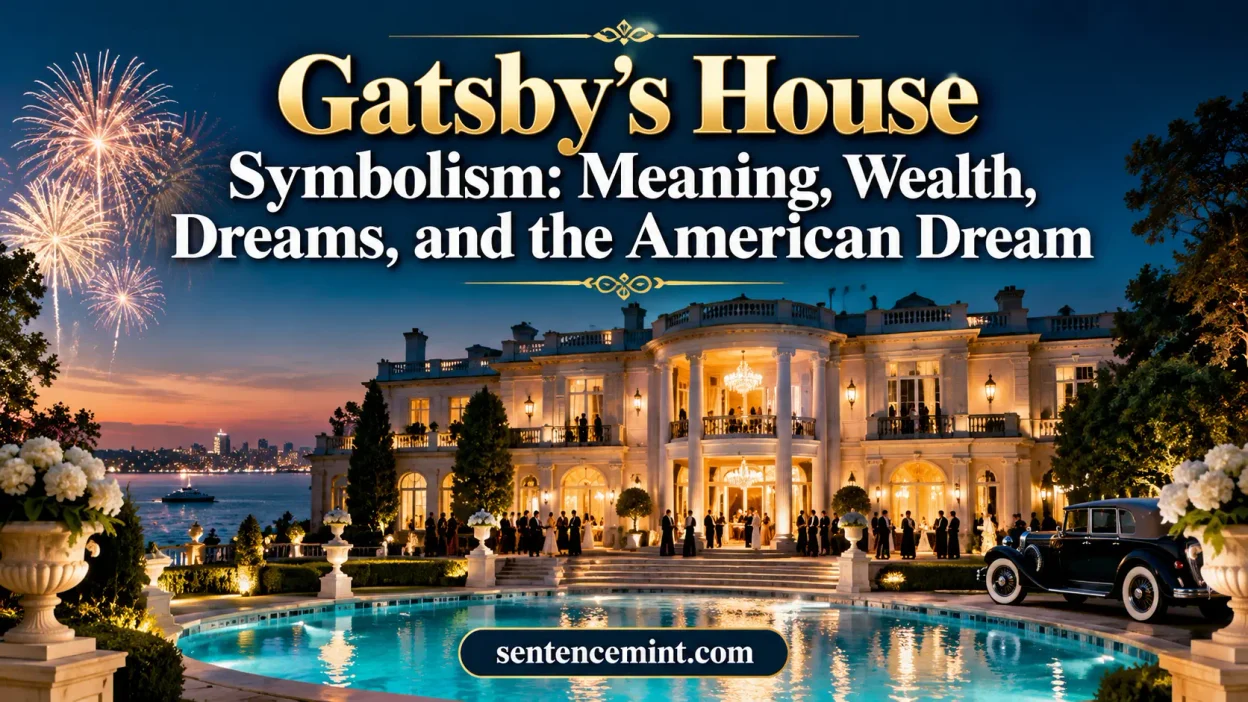
Gatsby lives in an enormous mansion in West Egg, a wealthy community on Long Island. His property features luxurious rooms, elaborate decorations, beautiful grounds, and space for extravagant parties. From the outside, the house appears to represent the perfect life: money, popularity, comfort, and endless possibilities.
Yet Gatsby’s mansion also reveals a deeper truth. Although he possesses extraordinary wealth, he remains emotionally attached to an idealized version of his past with Daisy Buchanan. Much of what he owns is connected to his desire to win her back.
Through Gatsby’s house, Fitzgerald explores the difference between appearing successful and achieving genuine happiness. The mansion represents both the promise of Gatsby’s dreams and the limitations that eventually destroy them.
1. Gatsby’s House Symbolizes Wealth and Material Success
One of the most obvious meanings of Gatsby’s house is wealth. The mansion demonstrates that Gatsby has accumulated a tremendous amount of money and wants the world to recognize his success.
His home is large, impressive, and filled with expensive possessions. It communicates luxury before Gatsby even speaks. Visitors can see that he has access to a lifestyle associated with the richest members of society.
However, Fitzgerald presents this wealth as something more complicated than financial achievement.
Gatsby’s fortune does not simply provide comfort. It becomes part of his identity and a way to establish his importance in a society that judges people according to their money, possessions, and social connections.
His mansion therefore symbolizes the power of material wealth in American society. It shows how money can create an appearance of success, even when a person’s private life remains uncertain and unfulfilled.
The Difference Between Wealth and Happiness
Gatsby’s house is beautiful, but it does not make him happy in a lasting way. His luxurious surroundings cannot guarantee the love, acceptance, or emotional security he wants.
This contrast is central to the novel. Gatsby has achieved the kind of financial success many people admire, yet his most important personal goal remains out of reach.
His mansion illustrates the limitations of material possessions. Money can purchase an impressive home, but it cannot force another person to love him or restore the past exactly as he remembers it.
2. Gatsby’s House Represents the American Dream
Gatsby’s mansion is closely connected to the American Dream—the belief that individuals can improve their lives through ambition, hard work, and opportunity.
Gatsby begins life with humble origins and eventually becomes a wealthy man. His mansion represents the dramatic transformation he has achieved, at least in terms of material success.
The house appears to confirm that he has risen above his beginnings. It is a physical expression of his determination to become someone important.
However, Fitzgerald questions whether the American Dream has become corrupted by the pursuit of money and social recognition.
The Dream’s Promise and Its Failure
Gatsby does not want wealth only for its own sake. He believes money will help him achieve a larger dream: a future with Daisy.
His mansion becomes part of this plan. By creating an impressive home near Daisy’s residence, he attempts to demonstrate that he is now wealthy enough to belong in her world.
But Gatsby confuses financial achievement with the ability to control life and love. He believes that if he accumulates enough wealth, he can recover the relationship he lost years earlier.
The mansion therefore represents both the promise and the failure of the American Dream. Gatsby succeeds in building an extraordinary life of material luxury, but he cannot make his ideal future come true.
3. Gatsby’s House Symbolizes His Love for Daisy
Gatsby’s mansion is also a symbol of his love for Daisy Buchanan. Much of his wealth and lifestyle is connected to his desire to impress her and make their reunion possible.
His home is located in West Egg, across the water from Daisy’s home in East Egg. This geographical arrangement reinforces the emotional and social distance between them.
Gatsby can see the world in which Daisy lives, but he cannot easily become part of it. His mansion brings him closer to her physically without resolving the differences separating them.
The Mansion as a Display of Love
Gatsby believes that his house and possessions will help Daisy understand how successful he has become. His home functions almost like a carefully constructed argument: he wants to prove that he is worthy of the woman he has loved for years.
Yet the mansion also exposes a weakness in his understanding of love. He places too much importance on what he can show Daisy and too little on the fact that she has developed a life of her own.
Gatsby’s house is therefore not simply a romantic symbol. It represents the way his affection has become intertwined with wealth, status, and an idealized vision of the past.
4. Gatsby’s House Represents Social Status and Class Divisions
In The Great Gatsby, a person’s home communicates more than personal taste. It can also reveal their social position and relationship to wealth.
Gatsby’s mansion is located in West Egg, while Daisy and Tom Buchanan live in East Egg. Both communities contain wealthy residents, but the distinction between them helps Fitzgerald explore differences within the upper class.
East Egg is associated with established, inherited wealth. West Egg is associated more strongly with newly acquired fortunes.
Gatsby has money, but he does not possess the same social background as Daisy and Tom. His mansion demonstrates his financial power while also exposing his desire to enter a world that does not fully accept him.
Why the House Cannot Buy Acceptance
Gatsby’s home is grand enough to attract attention and host lavish parties. Nevertheless, its size cannot erase questions about his origins or the source of his fortune.
This distinction reveals an important theme in the novel: wealth and social acceptance are not always the same thing.
Gatsby attempts to use his mansion to overcome the barriers separating him from Daisy’s social world. Yet the house cannot transform his background or guarantee that people will recognize him as an equal.
Through this symbolism, Fitzgerald criticizes a society in which status depends not only on how much money a person has but also on where that money and social identity come from.
5. Gatsby’s House Symbolizes Loneliness and Isolation
Although Gatsby’s mansion is large enough for crowds of partygoers, it also symbolizes his profound loneliness.
Gatsby regularly hosts extravagant parties attended by people who enjoy his hospitality. Guests arrive to drink, dance, socialize, and experience the luxury of his home.
However, many of these people do not genuinely know Gatsby. They benefit from his generosity without necessarily caring about his personal struggles.
The mansion is therefore a place of public excitement but limited emotional intimacy.
A House Full of People but Empty of Meaning
Gatsby’s parties create the impression that he is popular and admired. Yet the crowds do not provide him with the meaningful relationships he needs.
His social life is largely connected to his hope that Daisy will eventually visit. The mansion becomes a stage on which he performs the success he believes will bring her back.
When Gatsby’s dream collapses, the emptiness beneath this social world becomes increasingly apparent. The people who once enjoyed his parties do not provide the lasting loyalty or support he might have expected.
The house symbolizes the difference between being surrounded by people and being genuinely understood.
6. Gatsby’s House Represents Illusion and False Appearances
Gatsby’s mansion looks like proof that he has achieved everything he desires. Its luxurious appearance creates an image of confidence, power, and success.
But appearances can be misleading.
Gatsby has built his identity around a carefully maintained image. His house helps support that image by presenting him as a man who has achieved extraordinary prosperity.
Yet his inner life is shaped by insecurity, longing, and an inability to accept that the past cannot be recreated perfectly.
The Mansion as a Carefully Constructed Image
The house allows Gatsby to present the person he wants others to see. Its grandeur helps conceal the distance between his public image and his private emotional reality.
This symbolism reflects a broader concern in Fitzgerald’s novel: the danger of judging people by appearances alone.
Gatsby’s possessions are real, but the happiness they appear to promise is not guaranteed. His mansion can make his dream look attainable without making it achievable.
The house thus becomes a symbol of the gap between outward success and inner fulfillment.
7. Gatsby’s House Reflects His Obsession with the Past
Gatsby’s desire to win Daisy back is rooted in his memories of their earlier relationship. He does not merely want a new future with her; he wants to recover what he believes they once had.
His mansion supports this desire by serving as a physical expression of the life he has created in preparation for their reunion.
Gatsby believes that the right circumstances—wealth, luxury, status, and proximity to Daisy—can help him restore their former relationship.
However, his dream depends on the assumption that time has not fundamentally changed either of them.
Can Wealth Bring Back the Past?
Gatsby’s house represents his attempt to make an idealized past real in the present. He has changed his circumstances, acquired wealth, and built an impressive home, but these achievements cannot reverse time.
Daisy has changed, Gatsby has changed, and the world around them has moved forward.
The mansion therefore symbolizes the limits of trying to recreate an earlier moment through material success. Gatsby can construct a new environment, but he cannot force reality to match his memories.
This makes the house a powerful symbol of both hope and self-deception.
8. Gatsby’s House and the Green Light
The green light at the end of Daisy’s dock is one of the most recognizable symbols in The Great Gatsby. Although it is distinct from Gatsby’s mansion, the two symbols are closely related.
Gatsby’s house and the green light both represent his desire for Daisy and the future he imagines with her.
The mansion shows what Gatsby has already acquired. The green light represents what he still wants but cannot fully possess.
The House as a Step Toward an Unreachable Goal
Gatsby’s home is a material achievement, while the green light expresses a continuing longing. His mansion is part of his effort to close the distance between himself and Daisy.
Yet the distance is not simply physical. It also involves class, time, personal choices, and Gatsby’s idealized expectations.
Together, the house and the green light reveal the difference between reaching a visible milestone and achieving the deeper desire that motivated it.
Gatsby has built a mansion, but the emotional destination he seeks remains uncertain.
9. Gatsby’s House Symbolizes the Corruption of the American Dream
Fitzgerald uses Gatsby’s mansion to explore how the American Dream can become distorted when success is measured primarily through wealth and possessions.
The ideal of improving one’s life may begin with hope, effort, and opportunity. In Gatsby’s case, however, financial success becomes closely connected to his desire to possess an idealized version of love and status.
His mansion is evidence of achievement, but it also reveals the questionable assumptions behind his ambition.
When Success Becomes an Obsession
Gatsby’s dream is not simply to live comfortably. He wants to become the person he believes Daisy should love and to create the circumstances in which their past can be restored.
The house becomes part of an increasingly narrow definition of success: if he can acquire enough wealth and display it convincingly, he believes he can overcome the obstacles between them.
Fitzgerald challenges this belief by showing that money cannot control human relationships or eliminate social prejudice.
Gatsby’s mansion consequently symbolizes the darker side of the American Dream: the possibility that ambition can become destructive when people mistake material achievement for emotional fulfillment.
10. What Happens to Gatsby’s House After His Death?
Gatsby’s death changes the meaning of his mansion. During his life, the house represents his wealth, hopes, and carefully constructed public identity. After his death, its grandeur appears far less meaningful.
The parties and excitement associated with the mansion do not translate into lasting loyalty. The people who benefited from Gatsby’s hospitality largely fail to provide the support that might have given his social world greater substance.
This outcome emphasizes the fragility of the life he has built.
The Mansion as a Symbol of Abandoned Dreams
After Gatsby dies, the house no longer functions as the center of his plans to reunite with Daisy. Its most important personal purpose disappears with him.
The mansion remains a symbol of what he achieved materially, but it also represents the dreams he could not fulfill.
This contrast strengthens Fitzgerald’s criticism of a society that celebrates wealth and spectacle while often neglecting genuine human connection.
The house’s symbolic importance therefore extends beyond Gatsby himself. It reflects a culture in which outward prosperity can conceal emotional emptiness and moral indifference.
11. Major Symbols Connected to Gatsby’s House
The mansion becomes even more meaningful when considered alongside other important settings and objects in the novel.
| Symbol | Main Meaning | Connection to Gatsby’s House |
|---|---|---|
| Gatsby’s mansion | Wealth, ambition, illusion | Represents Gatsby’s material success and personal dream |
| Green light | Hope and longing | Expresses the future Gatsby wants to reach |
| East Egg | Established wealth and inherited status | Represents the social world Gatsby hopes to enter |
| West Egg | New money and social ambition | Provides the setting for Gatsby’s mansion |
| Gatsby’s parties | Spectacle and superficial relationships | Reveal the social world surrounding the house |
| Valley of Ashes | Decay and social inequality | Contrasts with the luxury displayed by wealthy characters |
| Daisy’s home | Privilege and established status | Represents the world Gatsby hopes to join |
These symbols work together to reveal the tensions between appearance and reality, aspiration and disappointment, and material success and emotional fulfillment.
12. Gatsby’s House Symbolism in Modern Life
The symbolism of Gatsby’s house remains relevant because modern society often associates expensive homes and luxury lifestyles with personal achievement.
Large houses, designer interiors, luxury cars, and extravagant events can all communicate success. Social media can intensify this tendency by encouraging people to display carefully selected images of their lives.
Gatsby’s mansion provides a useful reminder that visible prosperity does not reveal the whole truth about a person.
The Difference Between Looking Successful and Feeling Fulfilled
A person may achieve professional success, acquire expensive possessions, and receive public admiration without feeling emotionally secure.
Similarly, someone may pursue wealth in the belief that it will guarantee love, respect, or acceptance. Gatsby’s story suggests that these goals cannot be secured through possessions alone.
The mansion encourages readers to consider what success actually means. Is it the accumulation of wealth, recognition from others, meaningful relationships, or a sense of personal purpose?
Fitzgerald does not suggest that wealth itself is meaningless. Instead, the novel questions what happens when material success becomes a substitute for emotional fulfillment and realistic self-understanding.
Frequently Asked Questions About Gatsby’s House Symbolism
1. What does Gatsby’s house symbolize in The Great Gatsby?
Gatsby’s house symbolizes wealth, ambition, the American Dream, social status, love, and illusion. It represents his attempt to transform his life and win back Daisy through material success.
2. Why is Gatsby’s mansion so important?
The mansion is important because it provides a physical expression of Gatsby’s ambitions. Its size and luxury reveal his financial success, while its connection to Daisy exposes the personal dream motivating his pursuit of wealth.
3. How does Gatsby’s house represent the American Dream?
The house represents Gatsby’s rise from humble beginnings to extraordinary wealth. However, it also shows the limitations of a dream centered on possessions, social recognition, and the belief that money can guarantee happiness.
4. Does Gatsby’s house symbolize his love for Daisy?
Yes. Gatsby’s mansion is connected to his desire to impress Daisy and prove that he has become wealthy enough to enter her world. It reflects both his devotion and his mistaken belief that material success can restore their past relationship.
5. What does Gatsby’s house reveal about his loneliness?
Although Gatsby hosts large parties, the mansion does not provide him with genuine companionship. The crowds surrounding him often value the entertainment and luxury he offers rather than forming meaningful relationships with him.
6. How does Gatsby’s house represent social class?
The mansion demonstrates Gatsby’s financial power but does not guarantee his acceptance among people with inherited wealth. Its location in West Egg helps illustrate the social distinctions separating Gatsby from Daisy and Tom Buchanan.
7. What is the relationship between Gatsby’s house and the green light?
Both symbols are connected to Gatsby’s longing for Daisy and the future he imagines. The house represents what he has built, while the green light represents the desired future that remains beyond his complete reach.
8. Does Gatsby’s house symbolize illusion?
Yes. The mansion creates an appearance of success and happiness, but it cannot resolve Gatsby’s emotional struggles or guarantee that his dream will come true. It illustrates the difference between outward appearances and inner reality.
9. What does Gatsby’s house symbolize after his death?
After Gatsby’s death, the mansion represents the fragility of his achievements and the failure of his dream. Its luxury becomes less significant when the relationships and future he hoped to build disappear.
10. What is Fitzgerald’s main message through Gatsby’s house?
Fitzgerald uses the mansion to question the belief that wealth and possessions can guarantee love, acceptance, or happiness. The house reveals both the power of ambition and the danger of building one’s life around unrealistic expectations.
Conclusion: The Deeper Meaning of Gatsby’s House
In The Great Gatsby, Gatsby’s house is a powerful symbol of wealth, ambition, love, social class, and the American Dream. Its magnificent appearance reflects the extraordinary life Gatsby has created, but its deeper meaning emerges from the hopes he attaches to it.
The mansion is not merely a display of money. It is part of Gatsby’s attempt to transform himself, impress Daisy, and recreate a past that can never return exactly as he remembers it.
Ultimately, Fitzgerald uses Gatsby’s house to show that material success cannot guarantee emotional fulfillment. Gatsby can build a magnificent home, attract crowds, and acquire the outward signs of prosperity, but he cannot purchase genuine love or control the future.
The mansion therefore captures the central tension of the novel: the difference between the life people appear to have achieved and the happiness they continue to seek.