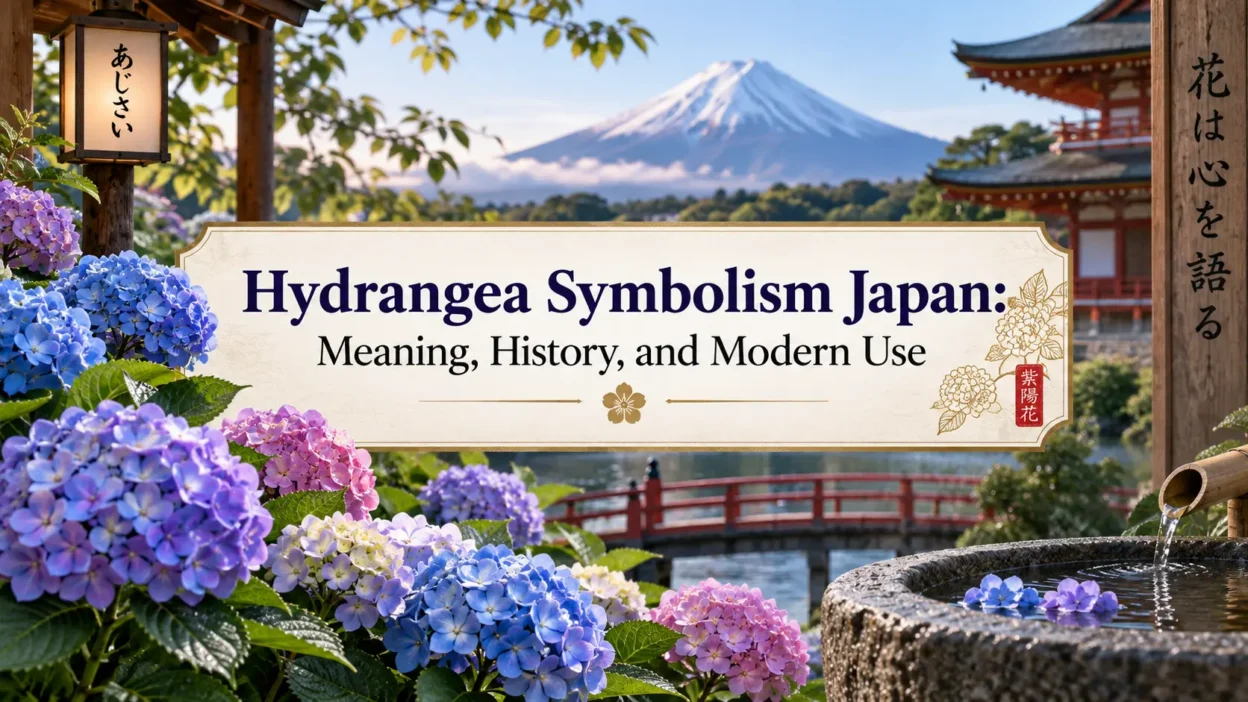
Hydrangeas, called ajisai (紫陽花) in Japan, are strongly connected with the rainy season, changing emotions, patience, gratitude, and family togetherness. When discussing hydrangea symbolism Japan, it is important to understand that the flower does not have one fixed meaning; its symbolism has changed across time and can differ by color and context.
In Japan, hydrangeas bloom mainly during June and July, when the country enters its rainy season, known as tsuyu. Their blue, purple, pink, and white flower clusters turn wet gardens, temple grounds, parks, and streets into some of the most recognizable seasonal landscapes in Japan.
The flower also has an unusual symbolic history. Its changing colors once helped create associations with fickleness and changing feelings. Today, however, Japanese interpretations can also emphasize patience, heartfelt emotion, gratitude, family connection, and appreciation.
Quick Answer
Hydrangea symbolism in Japan commonly represents gratitude, heartfelt emotion, patience, and the changing nature of feelings, especially in modern floral culture. Historically, its changing colors also connected it with fickleness and impermanence, while its summer bloom made it a lasting symbol of Japan’s rainy season.
TL;DR
- Ajisai is Japan’s signature rainy-season flower.
- Hydrangeas can symbolize gratitude and heartfelt emotion.
- Changing colors created older associations with fickleness.
- Flower clusters can suggest family unity and togetherness.
- Temple gardens made ajisai part of seasonal Japanese culture.
- Modern meanings are generally more positive and varied.
What Does Ajisai Mean in Japanese Culture?
Ajisai is the Japanese name commonly used for hydrangea. The flower is strongly associated with early summer because its main flowering period overlaps with tsuyu, Japan’s rainy season.
That seasonal connection is more than a calendar detail. For many people, seeing hydrangeas means recognizing a particular time of year: gray skies, steady rain, wet stone paths, green foliage, and clusters of blue or purple flowers.
Japanese flower traditions also give ajisai several symbolic meanings. Depending on the source and context, these include fickleness, patience, family togetherness, and changing emotions. Some modern interpretations place greater emphasis on positive ideas such as gratitude and heartfelt feeling.
This variety is important. There is no single universal Japanese interpretation that applies to every hydrangea.
Why Hydrangeas Represent the Rainy Season
Hydrangeas are one of the flowers most closely associated with tsuyu. They generally bloom from June into July, making them a natural visual marker for the transition from spring toward summer.
Rain actually enhances their appearance. Water settles on the large flower clusters and leaves, while the colors can appear richer against dark green foliage and cloudy skies.
This creates a distinctly Japanese seasonal image. Instead of treating rainy weather only as an inconvenience, flower-viewing traditions give people a reason to appreciate the landscape during a wet part of the year.
For this reason, hydrangeas can symbolize seasonality, patience, renewal, and finding beauty during an imperfect period.
The Historical Roots of Hydrangea Symbolism in Japan
Hydrangeas are not a recent addition to Japan. Native varieties appear in old Japanese written records, including references associated with the Man’yōshū, Japan’s oldest major poetry anthology.
However, the flower did not always enjoy the popularity it has today.
During earlier periods, its changing appearance could produce negative associations. A hydrangea may shift in color as it develops, and soil conditions strongly affect the colors produced by many varieties. People connected this visible change with changing human feelings.
That helped create the older symbolic idea of fickleness or an unreliable heart.
Another historical association involved the number four. Hydrangea flower heads contain structures that can appear as four large petal-like sepals. In Japanese, shi can refer to the number four while also sounding like a word associated with death. This contributed to an older belief that the flower could carry an unlucky association. Historical explanations of this idea should be treated as cultural interpretations rather than evidence that all Japanese people considered hydrangeas unlucky.
Changing Color and the Symbolism of Fickleness
One of the most interesting reasons for hydrangea symbolism comes directly from the plant itself.
Many bigleaf hydrangeas can produce different flower colors depending partly on soil chemistry. Acidic conditions tend to encourage blue or purple tones, while less acidic conditions can produce pinker flowers.
To modern gardeners, this is plant science. To earlier observers, however, changing color could look like a change of heart.
That visual transformation helped create the symbolic association with fickleness, changing feelings, and emotional uncertainty. Japanese flower-language traditions still record these meanings alongside more positive ones.
This is one reason hydrangea symbolism is more complicated than simply calling the flower a symbol of love or gratitude.
Its changing color can represent either adaptability or instability, depending on how the observer interprets change.
Hydrangeas and Patience
Another Japanese interpretation connects hydrangeas with patience.
The flowers appear during the rainy season, a period associated with persistent rain and damp weather. Yet the plant continues to bloom and create large clusters of color.
This makes patience a natural symbolic reading. Instead of representing a sudden burst of beauty, the hydrangea can suggest continuing through an uncomfortable or uncertain period.
In this sense, the flower can work well as a symbol for someone who remains steady while circumstances change.
The idea is especially useful when the hydrangea is viewed not as a romantic symbol but as a reminder of endurance and emotional steadiness.
Family Togetherness and the Shape of the Flower
Look closely at a hydrangea flower head and you will see many small individual flowers or flower-like structures grouped closely together.
Japanese flower-language traditions have connected this clustered appearance with family togetherness, harmony, and people gathering around one another.
The symbolism is easy to understand visually. A single small flower contributes to a larger cluster, just as individual family members contribute to a household.
This interpretation has helped give hydrangeas a warmer modern role in floral arrangements and decorative settings.
Instead of focusing only on romance, the flower can represent the people who stay connected through everyday life.
Gratitude, Apology, and Heartfelt Emotion
Some modern Japanese flower-language traditions associate hydrangeas, particularly blue varieties, with gratitude, apology, patience, and sincere emotion.
The idea of apology is often connected online and in popular flower-language explanations with a traditional story involving an emperor and an apology. However, that story is better treated as a legend or later floral tradition, not as a firmly documented historical event.
The broader idea is more useful: blue hydrangeas can be chosen to communicate an emotion that is difficult to express directly.
That makes the flower suitable for messages such as appreciation, regret, understanding, or emotional sincerity.
It also explains why hydrangeas can carry both positive and negative meanings. A flower that changes color can represent changing feelings, but it can also represent the complexity of human emotions.
Hydrangea Symbolism by Color
Color adds another layer to the meaning of ajisai. These associations are not universal rules, but they are useful when interpreting floral arrangements or decorative choices.
| Hydrangea Color | Common Symbolic Reading | Common Emotional Association | Important Note |
|---|---|---|---|
| Blue | Patience, sincerity, apology | Calm and reflection | Often linked with Japanese rainy-season imagery |
| Purple | Emotion, dignity, changing feelings | Thoughtfulness | Meaning varies by flower-language tradition |
| Pink | Affection and heartfelt feeling | Warmth and appreciation | Often gives the flower a more romantic appearance |
| White | Grace, sincerity, openness | Peace and simplicity | Often interpreted more positively in modern settings |
| Green | Renewal and persistence | Freshness and growth | Meaning varies by variety and cultural context |
The safest approach is to consider the color, occasion, and relationship between the giver and receiver together, rather than assuming one color always has one fixed meaning.
Hydrangeas in Japanese Temple Culture
Japanese temples and shrines are closely associated with seasonal flowers, and hydrangeas became especially famous at several temple sites.
Meigetsuin in Kamakura is commonly called Ajisaidera, or “Hydrangea Temple,” because of its large displays during the rainy season. Hasedera in Kamakura is also famous for hydrangeas growing along its hillside paths.
Other temples and religious sites across Japan have developed their own hydrangea-viewing traditions. Kongosenji Temple in Nara, for example, is known for thousands of hydrangea plants that bloom during June and July.
The religious setting does not mean that hydrangeas have one official Buddhist meaning. Rather, their presence in temple gardens connects them with seasonal awareness, quiet observation, beauty, and reflection.
This distinction matters. A flower growing beside a Buddhist temple does not automatically become a formal Buddhist symbol.
The Connection With Impermanence
Japanese aesthetics often pay attention to seasonal change and the temporary nature of beauty. Hydrangeas fit naturally into this way of observing the natural world.
Their flowers change as they mature. Their colors may shift. Their peak season lasts for a limited period. Their appearance is also strongly tied to rain and changing weather.
Because of this, hydrangeas can be interpreted through the broader idea of impermanence.
The flower does not need a supernatural meaning to communicate that idea. Its physical changes provide the message themselves: conditions change, colors change, seasons move forward, and beauty does not remain exactly the same.
This interpretation is particularly appropriate when hydrangeas appear in gardens, photography, poetry, or quiet seasonal scenes.
Hydrangeas in Modern United States Culture
American audiences generally encounter hydrangeas differently from people in Japan.
In the United States, hydrangeas are widely associated with gardens, weddings, bouquets, landscaping, summer decoration, and elegant home design. They are often chosen because their large flower heads create visual impact rather than because the buyer knows a specific Japanese flower-language meaning.
Modern American flower culture also tends to emphasize positive associations such as appreciation, abundance, affection, beauty, and hospitality.
Therefore, an American reader should not automatically apply every Japanese meaning to a hydrangea arrangement.
If someone in the United States gives you hydrangeas, the most useful interpretation usually comes from the occasion and relationship. A wedding arrangement, Mother’s Day bouquet, sympathy arrangement, and garden planting can communicate very different ideas.
Hydrangeas in Weddings, Gifts, and Home Decor
Hydrangeas work especially well in arrangements because their large flower heads provide volume without requiring many individual stems.
In wedding settings, they can suggest togetherness, affection, abundance, and a shared life. Their clustered structure also fits naturally with the idea of many individuals becoming one family.
For gifts, the message depends heavily on color and context. Blue hydrangeas may be appropriate when the intended message involves understanding, patience, or sincere emotion. Pink varieties can create a warmer impression, while white hydrangeas often suit clean, understated arrangements.
In home decor, the symbolic message is usually less specific. A vase of hydrangeas can simply create a seasonal feeling associated with summer, gardens, freshness, and hospitality.
Emotional and Psychological Meaning
From a psychological perspective, hydrangeas can represent emotional change without necessarily treating change as something negative.
Their colors provide a useful visual metaphor. Feelings can shift in response to circumstances, relationships, and experiences just as hydrangea color can respond to growing conditions.
The flower can therefore symbolize:
- emotional flexibility
- patience during difficult periods
- appreciation
- family connection
- changing relationships
- acceptance of seasonal change
- sincere communication
This makes hydrangeas particularly suitable for people who want a symbol that acknowledges complexity rather than presenting life as permanently fixed.
Hydrangea Tattoos and Personal Symbolism
A hydrangea tattoo can carry Japanese-inspired meaning, but the tattoo owner’s personal story should come first.
Someone might choose an ajisai tattoo to represent a connection to Japan, a memorable rainy-season trip, family relationships, emotional growth, or the ability to adapt when circumstances change.
Blue hydrangeas may emphasize calmness or patience. Pink or purple flowers can create a softer emotional message, while a multicolored hydrangea can highlight transformation.
If the design specifically claims to represent a traditional Japanese meaning, it is worth understanding the cultural background rather than assigning a made-up meaning to the flower.
The strongest tattoo symbolism usually comes from combining cultural context with a personal reason for choosing the image.
Common Misunderstandings About Japanese Hydrangea Symbolism
One common mistake is saying that hydrangeas in Japan only symbolize apology. That is too narrow.
Another mistake is claiming that hydrangeas are universally unlucky in Japanese culture. Historical negative associations existed, but the flower is now extremely popular and is celebrated during its blooming season.
It is also misleading to say that every Japanese person interprets hydrangeas according to traditional hanakotoba. Flower language is a symbolic tradition, not a universal code used by everyone in everyday life.
Finally, temple associations should not automatically be treated as formal religious symbolism. Hydrangeas are often appreciated at temples because they are beautiful seasonal flowers, while individual sites may have their own histories and traditions.
How Hydrangea Meaning Has Changed
The story of Japanese hydrangea symbolism is really a story about changing interpretation.
Older traditions could view the flower’s color changes negatively, linking them with fickleness or changing loyalty. Historical concerns about the number four also contributed to unfavorable associations.
Modern Japan presents a different picture. Hydrangeas are now celebrated as one of the defining flowers of the rainy season. Popular temple gardens, flower-viewing events, parks, and gardens have made ajisai an important part of seasonal tourism and everyday appreciation.
This evolution shows why flower symbolism should never be treated as a permanent dictionary definition.
The same physical characteristic—changing color—can produce two very different readings: fickleness on one hand and adaptability or emotional complexity on the other.
Why Hydrangea Symbolism Still Matters Today
For modern readers, the appeal of hydrangea symbolism lies in its ability to hold several ideas at once.
The flower can represent gratitude while acknowledging regret. It can represent family while recognizing individuality. It can suggest patience while reminding us that circumstances change.
That flexibility makes ajisai useful in art, photography, gardening, gifts, weddings, tattoos, and seasonal design.
It also provides a good example of how cultural symbolism develops. Meanings do not always come from one ancient source. They can grow from language, physical characteristics, seasonal traditions, literature, religion, horticulture, and modern popular culture.
Frequently Asked Questions
What does a hydrangea symbolize in Japan?
Hydrangeas can symbolize gratitude, heartfelt emotion, patience, family togetherness, and changing feelings. Traditional flower-language sources also associate them with fickleness because their colors can change.
What does a blue hydrangea mean in Japan?
Blue hydrangeas are often associated with patience, sincere emotion, apology, and gratitude in modern flower-language traditions. The exact meaning depends on the source and situation rather than following one universal rule.
Why are hydrangeas associated with rain in Japan?
Hydrangeas normally bloom during June and July, which overlaps with Japan’s rainy season, tsuyu. Their widespread appearance during this period made ajisai one of the clearest floral symbols of the rainy season.
Are hydrangeas considered unlucky in Japan?
Historically, some negative associations existed, including connections with the number four and the flower’s changing colors. Today, however, hydrangeas are extremely popular, and many Japanese people enjoy them as a major seasonal flower.
What does a hydrangea symbolize in a tattoo?
A hydrangea tattoo can represent patience, emotional change, family, gratitude, adaptation, or a personal connection with Japan. The meaning is strongest when the design reflects the wearer’s own story rather than relying on a single traditional definition.
Are hydrangeas connected to Buddhism?
Hydrangeas frequently appear in the gardens of Japanese Buddhist temples, especially during the rainy season. Their presence can encourage seasonal appreciation and reflection, but hydrangeas are not simply a universal formal symbol of Buddhism.
Do hydrangeas symbolize love in Japan?
They can be connected with heartfelt emotion, patience, and family relationships, and some flower-language traditions associate certain colors with forms of love. However, hydrangea is not limited to romantic love and can communicate broader emotional or family-related ideas.
Conclusion
Japanese hydrangea symbolism combines gratitude, patience, emotional change, family connection, and seasonal beauty. Its changing colors explain some of its older associations with fickleness, while its long relationship with the rainy season has helped make ajisai one of Japan’s most recognizable summer flowers.
In the United States, hydrangeas are usually understood more positively through gardens, weddings, gifts, and home decoration. Understanding hydrangea symbolism Japan adds another layer: the flower can remind us that emotions and circumstances change, while relationships and appreciation can remain meaningful.
That balance between change and connection is what makes the hydrangea such a useful symbol today.