
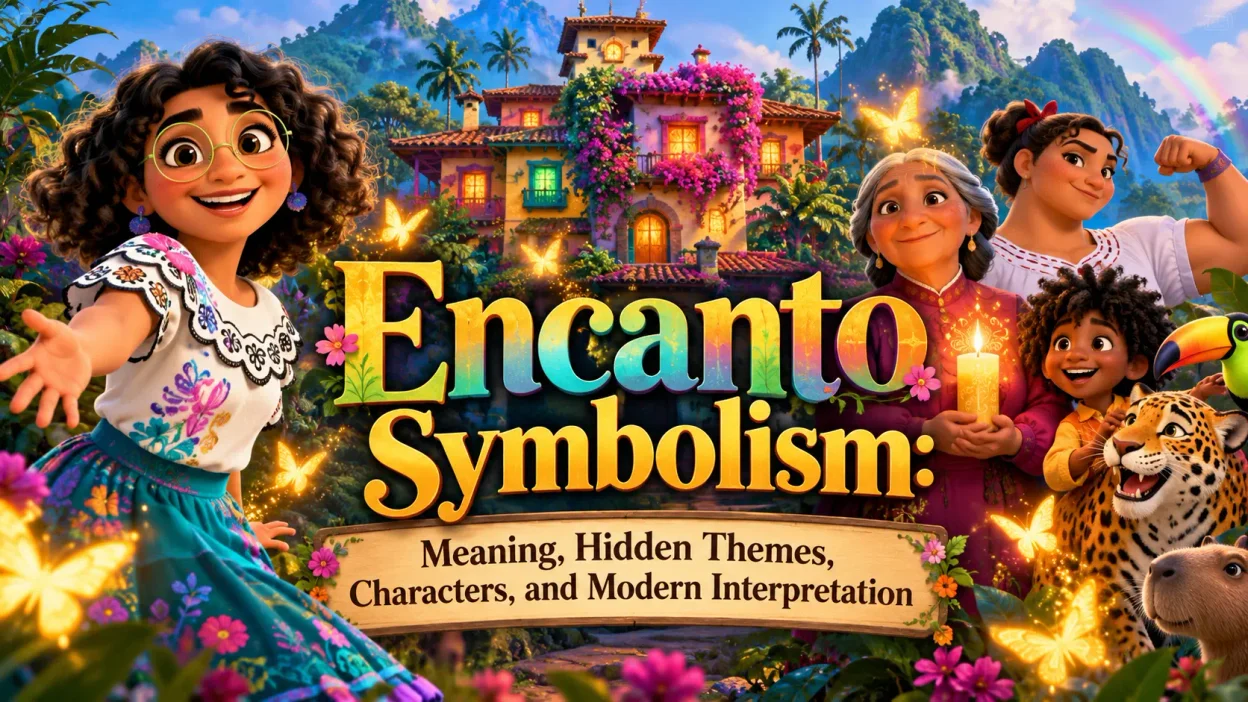
Quick Answer: What Does Encanto Symbolize?
Disney’s Encanto symbolizes the importance of family, self-acceptance, emotional healing, and recognizing that a person’s worth is not determined by their talents or achievements. Through the Madrigal family’s magical gifts and enchanted home, the film explores how love can become complicated when people feel pressured to meet unrealistic expectations.
The magical house, Casita, reflects the family’s emotional condition, while the cracks in its walls represent the problems hidden beneath their seemingly perfect life. Mirabel, the only Madrigal child without a magical gift, symbolizes the power of empathy, courage, and belonging without needing to prove one’s value.
Set in Colombia, the film also celebrates cultural identity, community, resilience, and the connections that help families recover from painful experiences. Disney’s filmmakers have explained that Casita was designed as a physical representation of the family’s emotional relationships. Source: Disney News
TL;DR: Major Symbols in Encanto
- Casita: Family relationships, emotional well-being, and a sense of belonging.
- The magical candle: Hope, protection, sacrifice, and the miracle that sustains the Madrigals.
- Butterflies: Transformation, renewal, hope, and the continuation of life.
- Cracks in the house: Hidden pain, family conflict, and the consequences of unrealistic expectations.
- Mirabel: Self-acceptance, empathy, and the importance of being valued for who you are.
- Abuela Alma: Generational trauma, protective love, fear, and the need to heal.
- Bruno: Truth, misunderstanding, exclusion, and the fear of uncomfortable realities.
- Luisa’s super strength: Responsibility, pressure, and the burden of always appearing strong.
- Isabela’s flowers: Perfectionism, freedom, authenticity, and personal growth.
- Antonio’s animal gift: Kindness, trust, connection, and a fresh perspective.
- The magical doors: Identity, expectations, and the roles assigned to family members.
- The rebuilt house: Reconciliation, collective effort, and a healthier understanding of family.
1. What Is the Deeper Meaning of Encanto?
Released in 2021, Encanto is an animated musical from Walt Disney Animation Studios. It follows the Madrigals, a Colombian family whose members receive magical gifts through a mysterious miracle. Mirabel is the exception: she does not receive a magical ability like the other children.
When the family’s magic begins to weaken, Mirabel investigates what is happening and gradually uncovers the emotional problems affecting her family. Source: Disney Movies
Beneath its colorful animation and memorable songs, the story explores a familiar human struggle: the desire to be loved while feeling pressure to become the person everyone expects you to be.
The Madrigals appear extraordinary because each magical gift serves a practical purpose. Some members protect the community, some heal people, and others provide food, beauty, or emotional comfort. However, their abilities also create expectations that can become difficult to escape.
The central message is that being useful is not the same as being worthy of love.
Mirabel’s journey challenges the assumption that a person must possess a special talent to matter. Her importance emerges through her willingness to listen, recognize hidden pain, and help her family confront the truth.
The film’s magic therefore works on two levels: it creates a fantasy world, but it also gives visible form to familiar emotional experiences.
2. Casita Symbolism: The House as a Reflection of the Family
<text>Casita, the Madrigals’ enchanted home, is one of the most important symbols in <Entity value=”Encanto” category=”movie” disambig=”2021 Disney animated musical film”/>. It responds to the family, moves its tiles, opens doors, and appears to have a personality of its own.</text>
Casita represents more than shelter. It symbolizes the relationships, traditions, shared memories, and emotional atmosphere that make a house feel like a home.
Disney’s filmmakers explicitly described the house as a representation of the family and its emotional connections. When the family is happy, the house appears healthy; when the family struggles, cracks begin to appear. Source: Disney News
A home that feels alive
Casita’s playful movements communicate warmth and belonging. It helps family members, responds to their needs, and provides a setting in which generations live together.
This can symbolize the supportive side of family life: cooperation, familiarity, shared history, and care.
A house that reflects emotional problems
As tension grows within the Madrigal family, Casita becomes increasingly unstable. Its deterioration suggests that the family’s problems cannot remain hidden forever.
The house’s condition also challenges the idea that a beautiful home or respected family must necessarily be emotionally healthy.
Why Casita matters
Casita shows that family well-being depends on more than maintaining appearances. A home may look successful from the outside while the people inside feel anxious, isolated, or misunderstood.
The symbol encourages viewers to consider whether their relationships provide genuine emotional safety or merely demand that everyone follow established expectations.
3. The Magical Candle Symbolism: Hope, Sacrifice, and Protection
The enchanted candle is closely connected to the origin of the Madrigals’ miracle.
In the film’s backstory, Alma Madrigal loses her husband, Pedro, while fleeing violence with their young family. His sacrifice is followed by the appearance of the miracle that protects Alma, her children, and the community they establish.
The candle becomes a visible representation of this extraordinary event.
Hope after tragedy
The candle symbolizes the possibility of building a future after devastating loss. It represents the hope that life can continue even when circumstances change painfully and unexpectedly.
Protection and responsibility
The miracle protects the family, but its power also becomes associated with an obligation to serve the community.
Alma believes that the family must honor the miracle by using its gifts to help others. This belief gives their lives a sense of purpose, but it eventually becomes entangled with fear and pressure.
When gratitude becomes an expectation
The candle’s symbolism becomes more complicated as Alma tries to preserve everything the miracle represents.
Her desire to protect the family is understandable, yet her fear of losing the magic leads her to demand perfection from her descendants.
The candle therefore represents both the benefits and the burdens of inherited responsibility. A gift can inspire gratitude, but it becomes emotionally difficult when people feel they must continually prove that they deserve it.
4. Butterfly Symbolism in Encanto: Transformation and Renewal
Butterflies are among the film’s most recognizable visual motifs. They are associated with the miracle and appear in imagery connected with the family’s history and emotional journey.
Their symbolism draws on familiar associations with metamorphosis, renewal, and the transition from one stage of life to another.
Transformation through hardship
A butterfly’s life cycle provides a natural metaphor for change. In the context of Encanto, butterflies can suggest that painful experiences do not have to define the rest of a person’s life.
The Madrigals must change their understanding of one another before they can move toward a healthier future.
Hope and continuity
Butterflies also connect the film’s present with its past. Their presence encourages viewers to consider how family history continues to influence later generations.
Yet history does not have to be repeated exactly. Understanding the past can help people make different choices.
A symbol of emotional growth
The butterfly motif supports one of the film’s central ideas: transformation involves more than restoring what was lost. It can require changing the beliefs, relationships, and habits that contributed to the problem.
In this interpretation, renewal means creating a stronger foundation rather than simply returning to the old version of family life.
5. Cracks in Casita: Hidden Pain and Generational Trauma
The cracks that spread through Casita are among the film’s clearest symbols.
At first, the Madrigals appear to be a successful family with extraordinary abilities. However, their relationships are strained by fear, silence, and the pressure to maintain an ideal image.
As the emotional problems intensify, the physical cracks become harder to ignore.
The difference between appearance and reality
The cracks symbolize the gap between how the family appears to the community and how its members actually feel.
A family can be admired by outsiders while its members experience anxiety, exhaustion, or loneliness.
The effects of generational trauma
Alma’s fear originates in a devastating loss. Having experienced violence and displacement, she becomes determined to protect the family and preserve their security.
Her intentions are rooted in love, but unresolved fear influences how she treats later generations. Her descendants inherit not only the miracle but also expectations shaped by the trauma that preceded them.
This is one way the film portrays generational trauma: painful experiences can shape family rules and relationships long after the original event.
Why the cracks are necessary
The cracks are not simply signs of destruction. They reveal problems that have been concealed beneath the family’s outward success.
The film suggests that healing begins when people acknowledge those problems rather than demanding that everyone continue pretending everything is perfect.
6. Mirabel Symbolism: Belonging Without a Magical Gift
Mirabel Madrigal is the emotional center of the film. Unlike her siblings and cousins, she does not receive a supernatural ability during her magical ceremony.
Her lack of a gift makes her feel different from the rest of the family, especially because the Madrigals’ identities are closely connected to their powers.
Mirabel symbolizes the struggle to find self-worth in a world that constantly measures people against others.
The fear of being ordinary
Mirabel wants to belong. She loves her family and wants to contribute, but she worries that her lack of a gift makes her less important.
Her experience reflects the pressure many people feel when they believe they must be exceptionally talented, successful, attractive, or useful to deserve recognition.
The power of empathy
Mirabel’s strength is not a magical ability. She notices what other family members are experiencing and becomes willing to ask questions that others avoid.
She recognizes that Luisa is struggling beneath her strength and that Isabela’s apparent perfection conceals dissatisfaction.
Her ability to understand people becomes essential to repairing the family’s relationships.
The meaning of her final role
Mirabel ultimately helps the family understand that their value cannot depend entirely on magic.
Her importance lies in her willingness to bring people together, challenge harmful expectations, and encourage honesty.
The character’s symbolism is especially meaningful because the story does not resolve her struggle by simply giving her the same kind of gift as everyone else. Instead, it challenges the assumption that she needs one to deserve a place in her family.
7. Abuela Alma Symbolism: Love, Fear, and Generational Trauma
Abuela Alma is both a protector and a source of pressure within the Madrigal family.
Her story begins with loss and displacement. After Pedro’s death, she must protect her children and establish a new life. The miracle becomes associated with their survival, making its preservation deeply personal.
Alma symbolizes how love can become complicated when it is governed by unresolved fear.
Protection that becomes control
Alma believes the family’s gifts are responsibilities that must be used for the good of the community. She values discipline and service, but she increasingly expects the family to meet an ideal standard.
Her descendants can begin to feel that they must perform their roles perfectly to maintain her approval.
The burden of survival
Alma’s behavior becomes more understandable when viewed in the context of her loss. She fears that losing the miracle could mean losing the security she fought so hard to establish.
However, understanding her fear does not mean that every decision she makes is harmless.
The film shows how protective intentions can still hurt loved ones when fear prevents honest communication.
The importance of accountability
Alma’s emotional journey requires her to acknowledge the pain she has caused. Reconciliation becomes possible when she recognizes that preserving the family requires caring for its members, not simply preserving its traditions and abilities.
Her character illustrates that healing can involve compassion for previous generations alongside a willingness to change harmful patterns.
8. Bruno Symbolism: Truth, Silence, and Being Misunderstood
Bruno Madrigal possesses the ability to see visions of possible futures. Because his visions sometimes reveal troubling outcomes, his family and community become uncomfortable with his presence.
He eventually withdraws from the family, living secretly within Casita rather than confronting the rejection he has experienced.
Bruno symbolizes the person who becomes excluded for expressing uncomfortable truths.
Fear of difficult information
Bruno’s visions are treated as frightening because they reveal possibilities that the family would rather avoid.
Instead of recognizing the uncertainty of the future, people often respond to his visions as if he himself were responsible for the outcomes.
This reflects a familiar human tendency: blaming the messenger when a message creates discomfort.
The symbolism of silence
Bruno’s absence becomes part of the family’s emotional problem. His relatives speak about him, but they do not fully understand his experience or why he withdrew.
The song “We Don’t Talk About Bruno” captures this contradiction. The family repeatedly discusses him while avoiding a more honest conversation about what happened.
Reconnection and acceptance
Bruno’s return illustrates the importance of making room for people who have been misunderstood or pushed aside.
His story suggests that families become healthier when they can discuss uncomfortable subjects without treating the person who raises them as the problem.
Bruno’s symbolism is therefore connected with truth, vulnerability, and the courage required to restore relationships after exclusion.
9. Luisa’s Super Strength: The Pressure to Be Strong
Luisa Madrigal possesses extraordinary physical strength. She is relied upon to lift heavy objects, repair structures, and handle demanding tasks for the community.
Her gift makes her dependable, but it also places an enormous burden on her.
The song “Surface Pressure” reveals the anxiety beneath her confident exterior.
Strength as an obligation
Luisa feels that everyone depends on her. She worries about what might happen if she fails to meet their expectations.
Her magical ability becomes more than something she can do; it becomes a role she feels she must always fulfill.
The hidden cost of being dependable
Luisa represents people who are praised for their strength but rarely asked whether they are struggling.
In families and workplaces, dependable individuals can become trapped in a cycle in which their willingness to help leads others to expect even more from them.
The meaning of her vulnerability
Luisa’s emotional struggle challenges the idea that strong people should never need support.
Her story shows that resilience does not require carrying every burden alone. Accepting help can be a form of strength rather than a sign of weakness.
10. Isabela’s Flowers: Perfectionism and Authenticity
Isabela Madrigal initially appears to be the family’s ideal daughter. She can make plants grow and flowers bloom, creating beautiful displays that reinforce her reputation for grace and perfection.
However, her carefully maintained image conceals the fact that she feels restricted by other people’s expectations.
Beauty as a social role
Isabela’s flowers symbolize the ideal version of herself that the family expects her to embody.
She is admired for looking graceful, behaving correctly, and meeting expectations. Over time, this makes it difficult for her to express preferences that do not fit her established role.
Discovering imperfection
When Isabela experiments with unusual plants and unexpected forms of growth, her powers become an expression of freedom.
She discovers that creativity does not have to produce something polished or predictable to be valuable.
What her transformation means
Isabela’s journey symbolizes the freedom to move beyond perfectionism.
It encourages people to ask whether they are making choices because they genuinely want to or because they are afraid of disappointing others.
Her flowers become most meaningful when they express her individuality rather than simply reinforcing the image everyone expects.
11. Antonio’s Animals: Kindness, Trust, and Connection
Antonio receives the ability to communicate with animals. He is shy and sensitive, and his relationship with animals reflects his gentle approach to the world.
His gift symbolizes connection, trust, and the value of understanding others without forcing them to conform.
Listening before judging
Antonio’s ability allows him to communicate with creatures that other characters cannot understand in the same way.
Symbolically, this suggests that connection can develop when people are patient and receptive to perspectives beyond their own.
A different kind of strength
Unlike gifts associated with physical strength or public admiration, Antonio’s ability emphasizes gentleness and companionship.
His story reminds viewers that kindness and emotional sensitivity can be meaningful contributions to a family and community.
Nature and belonging
The animals and lush plant life also help establish the film’s connection with Colombia’s biodiversity. Disney’s production materials describe the filmmakers’ work with botanical and other cultural consultants to shape the film’s visual world. Source: Disney News
Antonio’s symbolism therefore connects personal relationships with a wider appreciation for the natural world.
12. Magical Doors: Identity, Expectations, and Personal Potential
Each gifted Madrigal child receives a magical door associated with their power and personal room.
These doors represent the family’s recognition of each child’s identity. They also show how quickly a person can become defined by a single ability.
A door as a symbol of opportunity
A magical door marks the beginning of a new stage of life. It gives each child a personal space connected to their abilities and role within the family.
In this sense, doors can symbolize opportunity, discovery, and the possibilities that emerge as a person grows.
A door as a fixed identity
However, the rooms also reflect the expectations attached to each gift.
When a family member is known primarily for a particular ability, it may become difficult for them to explore other interests or admit limitations.
The door can therefore represent both recognition and restriction.
Mirabel’s missing door
Mirabel’s lack of a magical door makes her feel excluded from the family’s defining tradition.
Her experience symbolizes the fear of being left behind when everyone else appears to have found their purpose.
The story ultimately challenges the idea that belonging must be earned through a special achievement.
13. The Family Madrigal and the Symbolism of Different Gifts
The Madrigals’ powers can be interpreted as symbolic expressions of familiar family roles.
| Character | Magical gift | Symbolic meaning |
|---|---|---|
| Julieta | Heals people through food | Nurturing, care, and the desire to make others feel better |
| Pepa | Weather changes with her emotions | Emotional expression and the pressure to manage feelings |
| Bruno | Sees visions of possible futures | Truth, uncertainty, and uncomfortable possibilities |
| Luisa | Super strength | Responsibility, endurance, and overwork |
| Isabela | Makes plants and flowers grow | Perfectionism, beauty, and authenticity |
| Dolores | Exceptional hearing | Awareness, sensitivity, and the burden of knowing too much |
| Camilo | Changes his appearance | Identity, adaptability, and the expectations of different roles |
| Antonio | Communicates with animals | Kindness, trust, and connection |
| Mirabel | No magical gift | Empathy, self-acceptance, and belonging beyond achievement |
These interpretations are analytical readings of the characters rather than official, exclusive meanings assigned to every power.
Together, the gifts create a picture of a family in which everyone contributes something valuable, yet each person also experiences pressure associated with their role.
The film suggests that recognizing someone’s strengths should not prevent others from noticing their needs.
14. The Symbolism of the Rebuilt House
Near the end of the film, the Madrigals lose their magical home and must confront the reality of what has happened to their relationships.
The rebuilding of Casita becomes a collective act. Family members and people from the community contribute to creating a new home.
This moment symbolizes reconciliation, cooperation, and a changed understanding of what holds the family together.
Community beyond magic
The villagers help the Madrigals rebuild, demonstrating that meaningful relationships extend beyond supernatural gifts.
The family is not valuable only because it can perform extraordinary services. It also belongs to a community that can offer support in return.
A new foundation
The rebuilt house is not simply a restoration of the old structure. It represents the possibility of creating a healthier family culture.
Instead of relying exclusively on magical abilities, the family must recognize the value of its members as people.
The meaning of the final door
Mirabel’s place in the rebuilt home emphasizes that she belongs even without a conventional magical gift.
Her importance is not based on becoming identical to her relatives. It comes from the role she plays in helping them understand one another.
The rebuilt Casita symbolizes a home in which belonging can be based on love, mutual support, and acceptance rather than perfection.
15. Encanto Symbolism in Colombian Culture
Encanto is rooted in a fictional community in Colombia, and its visual world reflects the filmmakers’ efforts to represent Colombian environments, architecture, clothing, music, food, and biodiversity.
The film uses colorful houses, lush landscapes, regional details, and multigenerational family life to create a setting that feels culturally specific.
Disney’s production materials describe the filmmakers’ research in Colombia and their collaboration with experts who advised on subjects including anthropology, clothing, botany, music, and language. Source: The Walt Disney Company
Architecture and family life
Casita’s courtyard and indoor-outdoor atmosphere help communicate the importance of shared space and relationships.
The house is not presented as a detached, private structure alone. It is a setting in which family members interact, help one another, and remain connected to the wider community.
Nature and biodiversity
The film’s plants, animals, mountains, and colorful landscapes contribute to its celebration of Colombia’s natural diversity.
Nature is not merely background decoration. It forms part of the magical world and helps communicate growth, beauty, and interdependence.
Family, memory, and resilience
The story also explores the lasting effects of displacement and violence. Alma’s memories of losing Pedro influence how she understands safety and responsibility.
This personal history gives the family’s magic a deeper emotional context. Their extraordinary circumstances are connected to a painful past, not simply to a desire for adventure.
Although the film draws on Colombian culture, it should not be treated as a complete representation of every Colombian family or tradition. Its story combines specific cultural inspirations with fictional magical elements and themes that audiences around the world may recognize.
16. The Deeper Meaning of Encanto’s Songs
Music helps the characters express feelings that are difficult to communicate through ordinary conversation. Several songs function as symbolic windows into the family’s emotional struggles.
“Waiting on a Miracle”
Mirabel’s song expresses her desire to belong and her frustration at being the only child without a magical gift.
It symbolizes the emotional cost of comparing oneself with others and waiting for external recognition to confirm personal worth.
“Surface Pressure”
Luisa’s song reveals the anxiety that comes from being treated as the person who can handle everything.
It symbolizes the burden of responsibility and the fear that asking for help might disappoint others.
“We Don’t Talk About Bruno”
The song reflects the family’s tendency to circulate stories about Bruno while avoiding a direct, compassionate conversation with him.
It symbolizes silence, misunderstanding, and the way fear can turn an individual into a family scapegoat.
“What Else Can I Do?”
Isabela’s song marks her movement away from perfectionism and toward experimentation.
It symbolizes creative freedom and the discovery that unexpected outcomes can be valuable.
“Dos Oruguitas”
The song accompanies imagery of change, separation, and the continuation of life. Its butterfly-related imagery supports the film’s themes of transformation and the need to accept change.
Together, the songs deepen the story’s symbolism by allowing characters to reveal the emotions hidden beneath their public roles.
17. Encanto’s Central Message: You Are More Than Your Gifts
One of the film’s most important ideas is that a person’s identity should not be reduced to a talent or function.
Luisa is more than her strength. Isabela is more than her beauty. Bruno is more than his visions. Mirabel is more than the absence of a magical gift.
Each character experiences pain when others focus too narrowly on what they can provide.
This theme applies to ordinary life. Students may feel valued only for their grades, employees only for their productivity, and family members only for how much help they provide.
The film asks viewers to consider what happens when people are allowed to exist without constantly proving their usefulness.
It also distinguishes love from approval. Approval may depend on performance, but healthy relationships make room for mistakes, vulnerability, and personal change.
The Madrigals begin to heal when they stop treating their gifts as the only evidence of their worth.
18. Modern Lessons from Encanto Symbolism
The film’s symbols can offer useful ways to think about modern relationships, personal development, and emotional well-being.
Recognize hidden pressure. People who appear confident or capable may be struggling with expectations that others cannot see.
Make room for difficult conversations. Silence may temporarily prevent conflict, but unresolved issues can continue affecting relationships.
Separate identity from achievement. Skills and talents can be valuable without determining a person’s entire worth.
Question perfectionism. Trying to maintain an ideal image can prevent people from expressing their real needs.
Understand family history. Past experiences can influence present behavior, but people can work toward healthier patterns.
Allow people to change. A person who has always been the dependable one, the quiet one, or the successful one should still have the freedom to develop in new directions.
Accept support. Caring for others does not mean that you must carry every burden alone.
These lessons are not limited to families. They can also apply to friendships, workplaces, schools, and communities in which people feel pressure to perform a particular role.
Frequently Asked Questions About Encanto Symbolism
1. What is the main symbolism of Encanto?
The main symbolism of Encanto concerns family relationships, self-acceptance, generational trauma, and the difference between being useful and being worthy of love. Its magical elements make invisible emotional problems visible.
2. What does Casita symbolize in Encanto?
Casita symbolizes the Madrigal family’s emotional relationships and sense of belonging. Its playful behavior reflects their connection, while its cracks represent conflict and hidden pain.
3. What do the butterflies symbolize in Encanto?
Butterflies commonly suggest transformation, renewal, hope, and continuity. In the film, they reinforce the idea that painful experiences can lead to change and a new understanding of family.
4. What does the candle symbolize in Encanto?
The magical candle represents the miracle that protects the Madrigal family, connecting themes of hope, sacrifice, survival, and responsibility.
5. What do the cracks in the house mean?
The cracks represent the emotional fractures within the family. They suggest that the pressure to maintain a perfect image is damaging the relationships beneath that image.
6. Why is Mirabel important if she has no magical gift?
Mirabel symbolizes the idea that worth does not depend on extraordinary abilities. Her empathy, courage, and willingness to address family problems help the Madrigals understand what they need to change.
7. What does Bruno symbolize?
Bruno symbolizes uncomfortable truth, misunderstanding, exclusion, and the consequences of avoiding difficult conversations. His story shows how fear can cause people to reject someone who reveals information they do not want to hear.
8. What does Luisa symbolize in Encanto?
Luisa symbolizes the pressure to be strong and dependable. Her struggles reveal the emotional cost of carrying other people’s expectations without allowing herself to ask for help.
9. What does Isabela’s transformation symbolize?
Isabela’s transformation represents freedom from perfectionism and the discovery of an authentic identity. Her changing relationship with her powers shows that creativity does not have to follow other people’s expectations.
10. What does the rebuilt Casita symbolize?
The rebuilt house symbolizes reconciliation, community support, and a healthier understanding of family. It represents the idea that relationships can be rebuilt when people accept one another beyond their talents and roles.
11. Is Encanto a story about generational trauma?
Yes, generational trauma is a major theme in the film. Alma’s experiences of loss and displacement shape her fear of losing the miracle, and that fear contributes to the expectations placed on her descendants. The story explores how acknowledging past pain can help families change harmful patterns.
12. What is the spiritual meaning of Encanto?
A spiritual interpretation of Encanto may emphasize compassion, humility, forgiveness, transformation, and the value of each person’s unique contribution. These are interpretive themes rather than evidence that the film promotes one specific spiritual doctrine.
Conclusion
Encanto uses magic, music, colorful imagery, and family relationships to explore the emotional pressures hidden beneath an apparently perfect life. Casita symbolizes the family’s connections, the candle represents hope and responsibility, and the cracks reveal the damage caused by unresolved pain and unrealistic expectations.
Mirabel’s journey is central to the film’s message because she helps her family recognize that love cannot depend entirely on magical gifts, achievement, or usefulness. Luisa and Isabela reveal the burdens of perfection and responsibility, while Bruno’s story exposes the cost of silence and misunderstanding.
The film’s cultural setting also enriches its themes through its celebration of Colombian landscapes, traditions, community, and resilience.
Ultimately, the deepest symbolism of Encanto is that a family becomes stronger when its members are allowed to be human. Healing begins when people stop demanding perfection, listen to one another, and recognize that every person deserves belonging—even when they have nothing extraordinary to prove.


