
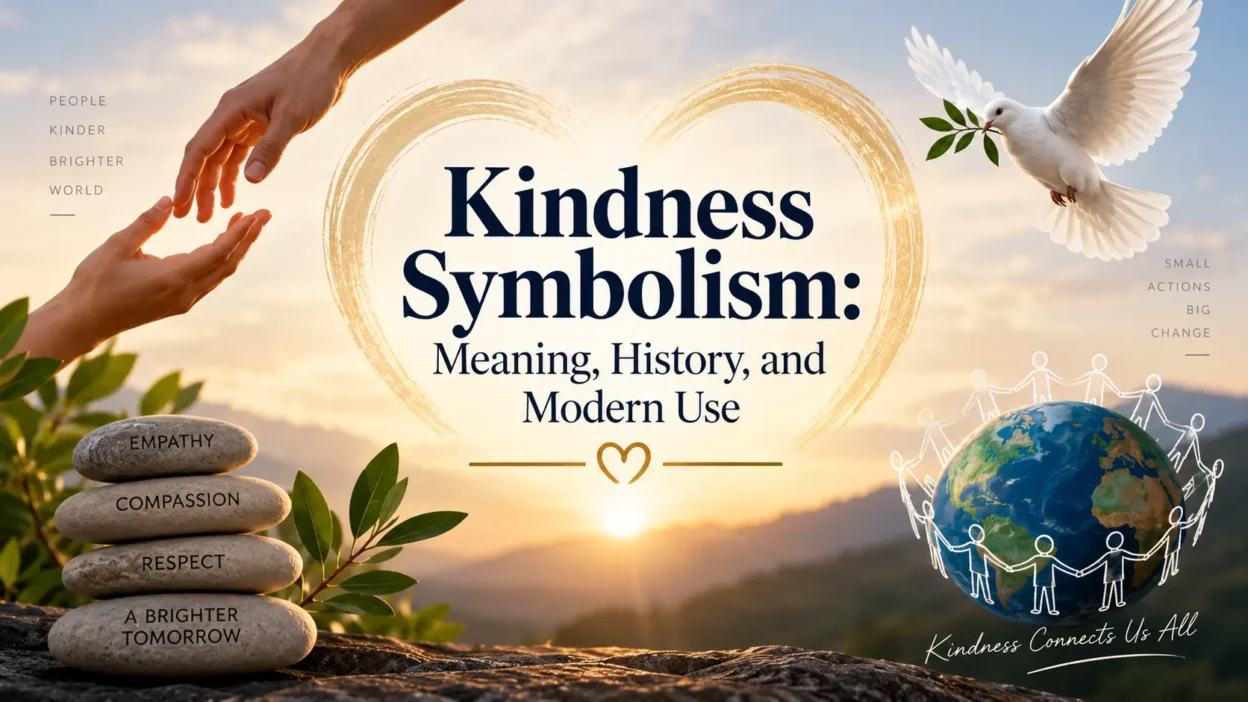
Kindness is often represented by simple human actions: an offered hand, a warm smile, a helping gesture, a thoughtful gift, or someone making time for another person. In modern American culture, kindness symbolism usually points to compassion, generosity, empathy, respect, and a willingness to help without expecting something in return.
People look for the symbolism of kindness because the idea appears in many parts of everyday life. It can shape a wedding message, a memorial design, a tattoo, a classroom lesson, a charity campaign, or a personal reminder to treat others well. Unlike a symbol such as a rose or a particular animal, kindness does not have one fixed visual form. Its meaning comes from the action, image, or object used to express it.
In the United States, kindness is also connected with volunteering, community service, charitable giving, friendship, caregiving, and small everyday acts of consideration. Its meaning has developed alongside religious traditions, social reform, philanthropy, and changing ideas about community responsibility.
Quick Answer
Kindness symbolism commonly represents compassion, generosity, empathy, respect, and helping others in modern American culture. Historically, it has also been connected with religious charity, benevolence, mutual aid, and the idea that people have a responsibility to care for others.
TL;DR
- Kindness commonly symbolizes compassion, empathy, generosity, and respect.
- Helping hands became a familiar image of practical support.
- American religious traditions strongly influenced ideas about charitable kindness.
- Volunteering and philanthropy expanded kindness into organized community action.
- Today, kindness appears in art, tattoos, gifts, campaigns, and social media.
- Kindness can express both personal character and community responsibility.
What Does Kindness Represent?
At its simplest, kindness represents choosing to make another person’s situation a little better.
That can mean offering emotional support, sharing resources, listening carefully, protecting someone who needs help, or showing patience when anger would be easier. Kindness does not always involve money or a dramatic sacrifice.
A small gesture can carry the same basic message as a major charitable act. Holding a door, checking on a neighbor, thanking a worker, helping someone carry something, or giving encouragement can all communicate consideration.
Because kindness focuses on how people treat one another, its symbolism often includes:
- Compassion
- Empathy
- Generosity
- Patience
- Respect
- Friendship
- Cooperation
- Mercy
- Care
- Human connection
The meaning also depends on context. A heart on a greeting card may communicate affection, while a helping hand in a community campaign may represent practical assistance.
What Does Kindness Look Like as a Symbol?
Kindness has no universally accepted single symbol. Instead, several images commonly communicate the idea.
A helping hand is one of the clearest. It suggests assistance, support, cooperation, and reaching out to someone in need.
A heart often represents caring and emotional warmth. When combined with hands, people may read the image as compassion expressed through action.
A dove can represent peace and goodwill, particularly when kindness is presented as the opposite of hostility or conflict.
A smile or friendly face can communicate warmth and acceptance. In modern graphic design, simple human figures embracing, holding hands, or helping one another can also symbolize kindness.
Flowers, ribbons, handwritten notes, gifts, and acts of service may serve the same purpose. The important point is that kindness is usually communicated through human relationships and behavior, rather than through one fixed object.
The Historical Roots of Kindness and Benevolence
The idea of helping others is much older than the modern word “kindness.” Religious teachings, philosophical traditions, family customs, and community practices have encouraged generosity and care across many societies.
In early American communities, charity was strongly influenced by European legal traditions and religious teaching. Assistance often moved through churches, wealthy community members, and local institutions.
The meaning gradually changed as the United States developed. During the late eighteenth and nineteenth centuries, Americans increasingly created voluntary associations to help people facing poverty, illness, homelessness, discrimination, or other hardships. The Library of Congress documents how benevolent associations became an important part of American civil society.
This shift matters symbolically because kindness moved beyond a private personal virtue. It became something people could organize around.
A person could be kind individually, but a group could also turn kindness into a school, charity, mutual-aid society, hospital, shelter, or volunteer organization.
How Religion Shaped Kindness Symbolism
Religious traditions have played an important role in the cultural history of kindness.
Christian teachings about loving one’s neighbor, caring for vulnerable people, practicing mercy, and helping strangers influenced American ideas about charity and benevolence. During religious revival movements in the nineteenth century, benevolence became closely connected with active social reform.
However, kindness should not be treated as an exclusively Christian concept. Jewish, Islamic, Buddhist, Hindu, Sikh, and other religious traditions contain their own teachings about generosity, compassion, service, mercy, or care for others.
For this reason, kindness can carry a religious meaning for one person and a secular ethical meaning for another.
In modern America, someone may wear a bracelet about kindness because of personal faith, while another person may use the same idea to express humanism or community values.
Kindness Symbolism in the United States
In the United States, kindness is often associated with action rather than appearance.
Americans commonly encounter the idea through volunteering, donations, food drives, community projects, school programs, neighborhood support, and informal help between strangers.
The history of American philanthropy shows how giving developed from an obligation often associated with wealth and religion into broader participation in volunteerism and community organizations.
The symbolism therefore has two connected sides.
The first is personal kindness: being considerate toward another person.
The second is social kindness: using time, money, skills, or collective effort to address another person’s needs.
This distinction helps explain why kindness appears in everything from classroom posters to nonprofit campaigns. It can describe both an individual’s character and a community’s behavior.
| Context | Meaning in the USA | Common Associations | Notes |
|---|---|---|---|
| Helping hand | Support and assistance | Community, friendship, service | Often represents practical help |
| Heart | Care and compassion | Love, empathy, warmth | Usually emotional rather than institutional |
| Volunteering | Service to others | Charity, community, civic life | Kindness becomes organized action |
| Gift or note | Thoughtfulness | Gratitude, friendship, encouragement | Common in personal relationships |
| Dove | Peace and goodwill | Harmony, reconciliation | More indirect symbol of kindness |
| Kindness message | Positive treatment of others | Respect, inclusion, empathy | Common in schools and campaigns |
Why the Helping Hand Is a Major Kindness Symbol
The helping hand deserves special attention because it turns an abstract value into a visible action.
A hand reaching toward someone suggests that the person is not being left alone. Two hands joined together can suggest cooperation. One person pulling another upward can communicate rescue, encouragement, or support.
This symbolism has a particularly strong American connection because mutual assistance has long been represented through voluntary organizations and community groups. The Library of Congress describes the desire to “lend a hand” to people facing hardship as a recurring motivation behind American associations.
The image also avoids some of the limitations of a heart.
A heart can mean love. A helping hand specifically suggests doing something.
That makes it useful for charities, schools, healthcare organizations, community programs, and campaigns centered on service.
Kindness, Compassion, and Empathy Are Not Identical
These ideas overlap, but they are not interchangeable.
Empathy involves understanding or recognizing another person’s feelings or perspective.
Compassion adds concern for another person’s suffering and a desire to respond.
Kindness is often the visible behavior that follows. It can be as simple as listening, encouraging someone, giving assistance, or treating someone with patience.
For example, imagine a coworker having a difficult day.
Empathy might help you recognize that the person is struggling. Compassion might make you care about what they are experiencing. Kindness might lead you to offer help or give them space.
That distinction is useful when interpreting symbolic images. A heart may emphasize emotional care, while an open hand may emphasize compassionate action.
The Emotional Meaning of Kindness
Kindness commonly communicates emotional safety and social connection.
When people describe someone as kind, they often mean that person is approachable, considerate, trustworthy, or willing to help. As a result, kindness symbolism can suggest qualities people want in relationships.
Common emotional associations include:
- Warmth
- Trust
- Belonging
- Comfort
- Gratitude
- Acceptance
- Hope
- Friendship
- Forgiveness
- Security
Kindness can also symbolize strength without aggression. Someone can show consideration without being passive or weak.
This is an important modern interpretation. Kindness does not necessarily mean agreeing with everyone. A person can establish boundaries, reject harmful behavior, and still communicate respect.
What Psychology Says About Kindness
Psychological research generally connects prosocial behavior with well-being, although the effects are not identical for everyone or in every situation.
A large 2020 meta-analysis found a modest overall relationship between prosocial behavior and well-being, with stronger associations in some forms of psychological functioning.
More recent research continues to examine why helping others may benefit the person offering help. A 2026 review describes possible links involving social connection, reward processing, empathy, and stress-related processes.
Other research provides an important caution: kindness should not be presented as a guaranteed treatment for mental health problems. One preregistered study found that a four-week kindness intervention did not produce the expected changes in well-being or telomere length, although participants who performed kind acts for others showed reduced loneliness in follow-up measurements.
So psychologically, kindness can symbolize connection and prosocial behavior, but it should not be portrayed as a cure-all.
Kindness in American Holidays and Community Life
Kindness appears naturally in many American holidays and community traditions.
During Thanksgiving, generosity and sharing often become visible through meals, food drives, donations, and helping families who need support.
During the holiday season, kindness may appear through gift drives, toy collections, volunteering, charitable donations, and community meals.
On Valentine’s Day, kindness can be expressed through cards, flowers, thoughtful messages, and small acts of appreciation. These gestures may symbolize affection, but they can also represent gratitude and consideration.
Schools frequently use kindness as a social value. Students may be encouraged to include others, resolve conflicts peacefully, help classmates, or recognize helpful behavior.
The symbolism is therefore not limited to one holiday. It becomes especially visible whenever communities emphasize generosity and mutual care.
Kindness in Tattoos, Jewelry, and Personal Style
A kindness symbol can become a personal reminder when placed on the body or worn as jewelry.
A person might choose a heart, helping hand, small flower, dove, word tattoo, or handwritten phrase to represent kindness.
A tattoo may commemorate someone who demonstrated compassion. It might also serve as a reminder to remain patient, generous, or caring during difficult periods.
Jewelry can carry a similar meaning. A simple bracelet engraved with a kindness message may represent a personal value rather than a religious belief.
The symbolism becomes more personal in these settings. The same heart can mean romantic love for one person, family affection for another, and compassion for someone else.
Kindness in Art, Design, and Social Media
Modern visual culture often reduces kindness symbolism to recognizable shapes and short messages.
Graphic designers may use:
- Open hands
- Hearts
- Smiling faces
- People helping each other
- Joined hands
- Doves
- Flowers
- Warm typography
These images work because viewers can understand the basic emotional message quickly.
Social media has also changed how kindness is displayed. People share appreciation posts, supportive messages, fundraising campaigns, volunteer activities, and stories about strangers helping strangers.
There is a tension here, however. A public display of kindness can inspire others, but it can also become performative when the image receives more attention than the person being helped.
That distinction matters. Symbolically, genuine kindness centers the well-being of another person, while performative kindness may center the helper’s public image.
Cross-Cultural Meanings of Kindness
Kindness does not belong to one culture.
Many traditions have concepts that overlap with kindness, including compassion, mercy, generosity, hospitality, charity, service, and care for one’s community.
The specific behavior may differ. One culture may place particular importance on hospitality toward guests. Another may emphasize charitable giving. Another may focus on compassion toward living beings or service to the community.
The symbols also vary.
A flower, hand, heart, light, religious object, or gesture can communicate goodwill depending on cultural context. Therefore, readers should avoid assuming that one kindness symbol has exactly the same meaning everywhere.
For an American audience, the most useful approach is to recognize kindness as a broad human value while respecting the specific tradition behind a particular symbol.
How Kindness Became Connected With American Philanthropy
Kindness and philanthropy overlap, but they are not the same.
Kindness can happen between two people. Philanthropy usually involves organized giving of money, time, knowledge, or resources toward a broader purpose.
American philanthropy has a complicated history. The Smithsonian notes that Americans have given for different reasons, including religious or moral obligations, social change, community responsibility, status, and influence.
This history adds an important layer to kindness symbolism.
A donation may symbolize generosity, but generosity does not automatically mean that every charitable action is purely selfless. People can give because they care, because they want to solve a problem, because their community expects it, or for several reasons at once.
Kindness symbolism is strongest when it recognizes the person or community receiving support rather than treating charity as a way to establish superiority.
Kindness and Animal Welfare
American ideas about kindness have also extended beyond human relationships.
Animal welfare became an important reform movement in the nineteenth century. Historical work on American animal advocacy shows how kindness toward animals became connected with ideas about moral responsibility, humane treatment, and social reform.
Today, symbols of kindness may include adopting a shelter animal, caring for wildlife, supporting animal rescue, or choosing humane treatment.
This does not mean every animal-related symbol automatically represents kindness. Context matters.
A paw print might simply represent affection for pets. In an animal-rescue campaign, the same image can represent protection, care, and responsibility.
Common Misunderstandings About Kindness Symbolism
One common misunderstanding is that kindness means being agreeable all the time.
It does not.
A person can say no, establish a boundary, disagree with someone, or report harmful behavior while still acting respectfully.
Another misconception is that kindness always requires sacrifice. Small actions can communicate genuine consideration without requiring major personal cost.
There is also a risk of confusing kindness with weakness. In many modern contexts, kindness represents emotional maturity and self-control rather than submission.
Finally, no symbol can prove that a person is kind. A heart tattoo, charitable slogan, or helping-hand logo communicates an intended value. The person’s actual behavior provides stronger evidence of character.
How the Meaning of Kindness Has Changed
The central idea of kindness has remained recognizable, but its social expression has changed.
In earlier communities, kindness was often closely connected with family, neighbors, religious groups, and local charity. As American cities expanded, organized associations became increasingly important forms of mutual assistance.
Over time, kindness became connected with broader ideas of social responsibility.
The twentieth and twenty-first centuries expanded the range further. Americans now encounter kindness through nonprofits, workplace culture, schools, online communities, animal welfare, mental-health conversations, mutual aid, and volunteer networks.
Digital culture has also made kindness more visible. A supportive comment can cross geographic boundaries in seconds, while online fundraising can connect donors with people they have never met.
The basic idea remains simple: care becomes meaningful when it influences how people treat others.
What Kindness Symbolizes in Modern America
In 2025–2026, kindness symbolism is especially relevant because Americans encounter the concept in both private and public spaces.
At a personal level, it can represent the type of person someone wants to become.
In relationships, it can symbolize patience, trust, appreciation, and emotional care.
In communities, it can represent volunteerism, mutual support, and civic responsibility.
In design, it provides an immediate visual language for compassion and goodwill.
In digital culture, kindness can signal encouragement, inclusion, support, or opposition to online hostility.
A modern American interpretation therefore tends to emphasize how values become behavior. Kindness is not simply feeling sympathy. It is often understood as choosing a considerate response.
Frequently Asked Questions
What is the main symbol of kindness?
There is no single universal symbol of kindness. The helping hand is one of the clearest modern representations because it directly communicates assistance, while hearts, doves, flowers, and caring human figures can express related ideas.
What does a helping hand symbolize?
A helping hand usually symbolizes support, cooperation, generosity, and practical assistance. In American culture, it can also represent volunteering and community service.
What does a kindness tattoo mean?
A kindness tattoo can represent compassion, empathy, generosity, or a personal commitment to treating people well. Its exact meaning depends on the image and the person’s reason for choosing it.
Is kindness a religious symbol?
Kindness itself is not limited to one religion. Many religious traditions teach compassion, charity, mercy, generosity, or service, while secular American culture also treats kindness as an ethical and social value.
Does kindness symbolize weakness?
No. Kindness can represent patience, emotional control, confidence, and respect rather than weakness. Setting healthy boundaries can also be an act of kindness when it prevents harmful or disrespectful behavior.
What color represents kindness?
There is no universally established color for kindness. Pink may suggest warmth or care, while blue can suggest calmness and trust, but color meanings depend heavily on cultural and design context.
Why is kindness important in American culture?
Kindness is often connected with friendship, volunteering, charity, community support, and everyday courtesy. American history also shows a long tradition of organized associations and philanthropic efforts aimed at helping people facing hardship.
Conclusion
Kindness symbolizes compassion, generosity, empathy, respect, and practical care for others. Its most recognizable modern images include helping hands, hearts, caring gestures, and people supporting one another, but no single object defines the idea.
In the United States, the meaning has developed through religious charity, voluntary associations, philanthropy, social reform, community service, and ordinary acts of consideration. Today, kindness symbolism can appear in tattoos, jewelry, artwork, school programs, charitable campaigns, holidays, and digital communities.
The clearest interpretation is also the most practical: kindness is best represented not by what a symbol claims, but by the way people use it to encourage considerate action.


