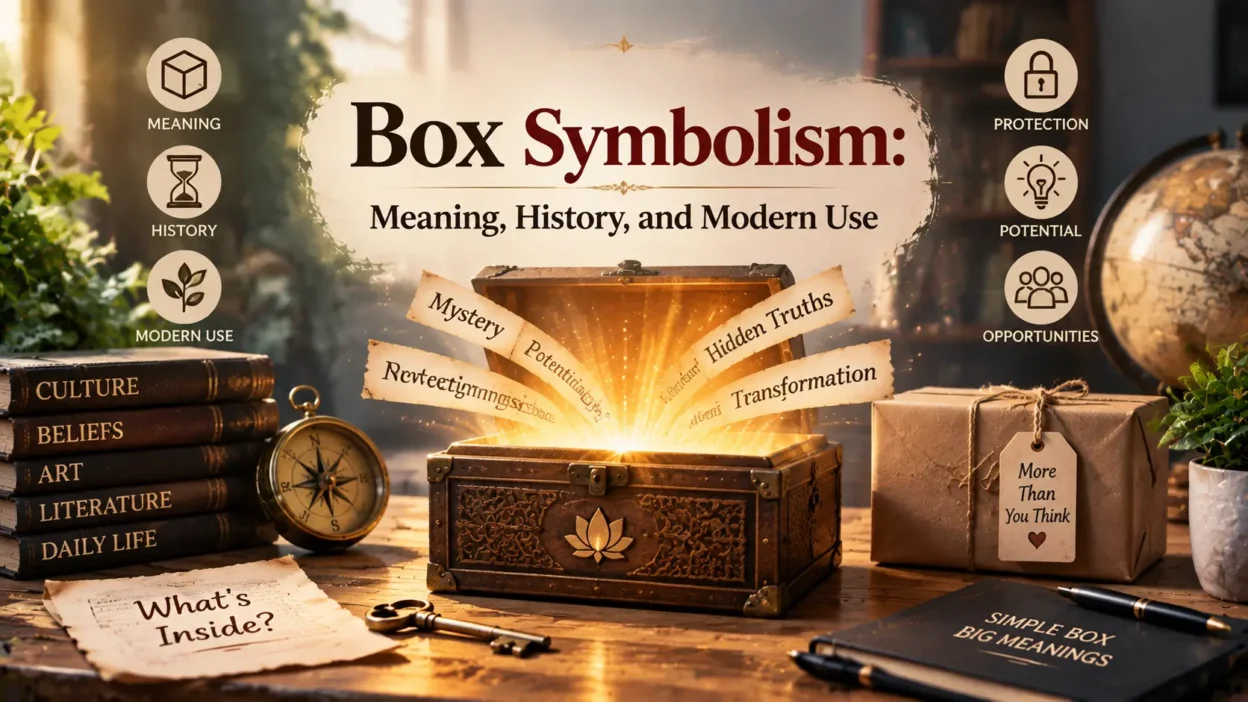
A box is an ordinary object found in homes, workplaces, gifts, storage spaces, and personal belongings. Yet box symbolism carries meanings that go beyond simple storage. Across cultures, a box can represent protection, secrets, boundaries, potential, memories, and the hidden parts of human experience.
People often connect boxes with ideas of keeping something safe, preserving the past, or holding something valuable until the right moment. In modern American culture, boxes appear in celebrations, moving experiences, personal keepsakes, art, design, and even storytelling because they represent both what is visible and what remains unknown.
Quick Answer
Box symbolism commonly represents protection, privacy, hidden possibilities, and personal value in modern American culture. Historically, boxes have also been associated with storing treasures, preserving memories, and separating important objects from everyday life.
TL;DR
- Boxes symbolize protection, privacy, and hidden potential.
- Ancient containers preserved valuable objects and cultural treasures.
- Americans connect boxes with gifts, memories, and life transitions.
- Open boxes often represent discovery and new opportunities.
- Closed boxes can symbolize secrets or unknown possibilities.
- Modern designs use boxes to express identity and organization.
What a Box Represents as a Symbol
A box is a container with defined edges, a clear inside and outside, and a purpose of holding something separate from its surroundings. This simple structure gives it symbolic meaning.
At its most basic level, a box represents containment. It creates a protected space where something can be stored, organized, hidden, or preserved. Because of this, people often associate boxes with safety and control.
A closed box may suggest mystery because its contents are unknown. An open box may suggest discovery, opportunity, or revelation. The meaning changes depending on the situation, the object inside, and the cultural context.
In everyday American life, people encounter boxes constantly:
- Gift boxes during celebrations
- Moving boxes during major life changes
- Memory boxes holding personal items
- Jewelry boxes protecting valuable possessions
- Storage boxes organizing homes
- Product packaging representing brands and identity
These everyday uses create emotional connections that influence how people understand the symbol.
The Core Meanings Associated With Boxes
Boxes have several common symbolic meanings that appear across different cultures and personal experiences.
| Context | Meaning in the USA | Common Associations | Notes |
|---|---|---|---|
| Gift box | Surprise and generosity | Birthdays, holidays, celebrations | Represents something meaningful being revealed |
| Storage box | Organization and security | Home, memories, belongings | Suggests protection and preservation |
| Closed box | Mystery and possibility | Unknown outcomes, secrets | Meaning depends on context |
| Memory box | Personal history | Photos, letters, keepsakes | Connects objects with identity |
| Moving box | Change and transition | New homes, new beginnings | Represents life shifts |
A box can represent both limitation and possibility. While its walls create boundaries, those same boundaries protect what matters.
Ancient Roots and Early Symbolism of Containers
The symbolic importance of boxes comes from humanity’s long relationship with containers. Long before modern cardboard boxes existed, civilizations created containers from wood, clay, metal, stone, and precious materials.
Ancient societies used containers to protect:
- Food supplies
- Religious objects
- Jewelry
- Documents
- Personal possessions
- Burial items
A container’s ability to protect valuable things gave it symbolic importance. A decorated box was not just practical; it could show status, belief, and cultural identity.
In ancient Egypt, containers and chests were used to preserve valuable possessions and burial items. Wooden chests and decorated containers reflected beliefs about protecting objects beyond ordinary life.
Across many societies, the act of placing something inside a container suggested care and importance. The container became a symbol of preservation.
Box Symbolism in the United States
In the United States, boxes often carry meanings connected to personal experiences and cultural traditions.
One of the strongest associations is the gift box. A wrapped box represents anticipation, generosity, and emotional connection. During Christmas, birthdays, weddings, and other celebrations, the box becomes part of the experience because opening it creates a moment of discovery.
Boxes also represent major life changes. Moving boxes are closely connected with:
- Leaving a familiar home
- Starting a new chapter
- Building a different lifestyle
- Adjusting to change
For many Americans, a box filled with belongings represents personal history. A person’s possessions inside a box can reflect memories, relationships, and important moments.
Storage boxes also connect with American ideas of organization and preserving memories. People often keep childhood items, photographs, family records, and sentimental objects in boxes for future generations.
The Symbolism of Closed and Open Boxes
The position of a box changes its symbolic meaning.
A closed box often represents:
- Secrets
- Privacy
- Unknown possibilities
- Hidden emotions
- Untold stories
A closed box creates curiosity because people naturally want to know what is inside.
An open box often represents:
- Discovery
- Freedom
- New opportunities
- Sharing
- Understanding
This contrast appears frequently in literature, movies, and artwork. A closed container creates suspense, while opening it represents a moment of knowledge or transformation.
Boxes as Symbols of Protection and Security
One of the oldest meanings connected with boxes is protection.
A box creates a barrier between an object and the outside world. This practical function creates symbolic associations with safety and care.
People may use boxes to represent emotional protection as well. Someone may describe their memories as being “stored away” because boxes can represent private parts of life that are not shared with everyone.
Examples include:
- A childhood memory box
- A family history collection
- A box of letters from someone important
- A keepsake container after a major event
In these cases, the box becomes a symbol of preserving emotional connections.
Box Symbolism in Art, Stories, and Folklore
Boxes frequently appear in storytelling because they naturally create questions: What is inside? Why is it hidden? What happens when it opens?
Many stories use boxes as symbols of curiosity and consequence.
A famous example is the Greek myth of Pandora’s box. Although the original Greek story involved a container called a jar rather than the modern idea of a box, later interpretations transformed it into one of the world’s best-known symbolic containers. The story represents curiosity, unexpected consequences, and hope remaining after hardship.
In fiction, boxes often represent:
- Hidden knowledge
- Forbidden discoveries
- Personal secrets
- Transformation
Writers and artists use boxes because they create a visual difference between what people know and what they do not know.
Emotional and Psychological Meaning of Boxes
From a psychological perspective, boxes can represent the human desire to organize experiences and create boundaries.
People often categorize memories, emotions, and information. A box provides a physical image for this mental process.
A person might think of a box as:
- A safe place for important memories
- A private space for personal thoughts
- A symbol of control during uncertain times
At the same time, boxes can represent emotional limitation. The phrase “thinking outside the box” became popular in American culture because the box came to symbolize restricted thinking or traditional approaches.
In this expression, leaving the box means exploring new ideas and questioning familiar patterns.
Religious and Spiritual Interpretations of Boxes
Boxes and containers appear in many religious traditions because they protect sacred objects and important materials.
In spiritual contexts, containers may represent:
- Preservation of sacred knowledge
- Protection of meaningful objects
- Respect for important traditions
Religious objects are often placed in special containers to show their importance. The container itself may not be sacred, but it demonstrates care toward what it holds.
Different traditions interpret containers differently depending on their beliefs, rituals, and cultural history.
Box Symbolism in Tattoos and Personal Style
Boxes are less common tattoo symbols than animals, flowers, or celestial images, but when they appear, they often carry personal meanings.
A box tattoo may represent:
- Personal memories
- Hidden emotions
- A private journey
- Protection
- A new beginning
Some people choose open box designs to represent discovery or creativity. Others choose locked or closed boxes to symbolize privacy or parts of themselves they keep personal.
The meaning usually depends on additional elements, such as:
- Keys
- Flowers
- Names
- Dates
- Objects inside the box
Modern Uses of Box Symbolism in Design and Culture
Modern designers frequently use box shapes because they communicate order, simplicity, and reliability.
Boxes appear in:
- Product packaging
- Technology design
- Architecture
- Branding
- Digital interfaces
- Home organization
A box-shaped design often suggests structure and efficiency. Many companies use simple packaging because a clean container can communicate professionalism and trust.
In digital culture, boxes also appear in icons, buttons, and layouts because they help organize information.
Common Misunderstandings About Box Symbolism
Because boxes can represent hidden things, some interpretations become exaggerated. A box does not always symbolize secrecy, mystery, or emotional restriction.
The meaning depends on context.
For example:
- A gift box usually represents kindness, not secrecy.
- A moving box often represents change, not loss.
- A storage box may represent organization, not isolation.
Symbolism works through human experience, so the same object can communicate different ideas in different situations.
How Box Meaning Has Changed Over Time
The meaning of boxes has evolved alongside human lifestyles.
Earlier societies often viewed containers as protection for valuable objects, food, and sacred items. Modern society still keeps this idea but adds new meanings connected with identity, organization, and personal memories.
Today, boxes can represent both physical and emotional spaces. They can hold possessions, preserve memories, or represent ideas about creativity and possibility.
The phrase “outside the box” also changed the symbol by turning the box into a metaphor for conventional thinking.
Why Boxes Remain Meaningful Today
Boxes continue to matter because they connect simple physical actions with human experiences.
Everyone has opened a box, packed a box, saved something in a box, or received a box from someone else. These experiences create personal associations.
A box can represent:
- A beginning
- A memory
- A secret
- A gift
- A transition
- A protected part of life
Its meaning comes from the relationship between the container and what it holds.
Frequently Asked Questions
What does a box symbolize spiritually?
A box can symbolize protection, preservation, and respect for something valuable. In spiritual contexts, containers often represent safeguarding important knowledge, objects, or traditions.
What does an open box symbolize?
An open box commonly represents discovery, opportunity, sharing, and new experiences. It suggests that something hidden has become available or understood.
What does a closed box symbolize?
A closed box often represents privacy, mystery, possibilities, or things that have not yet been revealed. The meaning depends on whether the hidden contents are viewed positively or negatively.
What does a box tattoo mean?
A box tattoo can represent personal memories, protection, hidden emotions, or a life journey. The meaning usually changes based on additional symbols included in the design.
Why are boxes used as symbols in stories?
Boxes create curiosity because they separate what is known from what is unknown. Writers use them to represent secrets, discoveries, choices, and consequences.
Does a box always represent something hidden?
No. Boxes can represent many ideas, including organization, generosity, safety, and personal history. Hidden meanings are only one possible interpretation.
Conclusion
Boxes may appear simple, but their role in human life gives them many layers of meaning. They protect valuable objects, preserve memories, create moments of discovery, and represent personal boundaries.
Box symbolism reflects a basic human experience: the desire to protect what matters while remaining curious about what lies beyond what we can see. In modern American culture, boxes continue to represent both security and possibility, making them a familiar symbol in everyday life, art, and personal expression.


