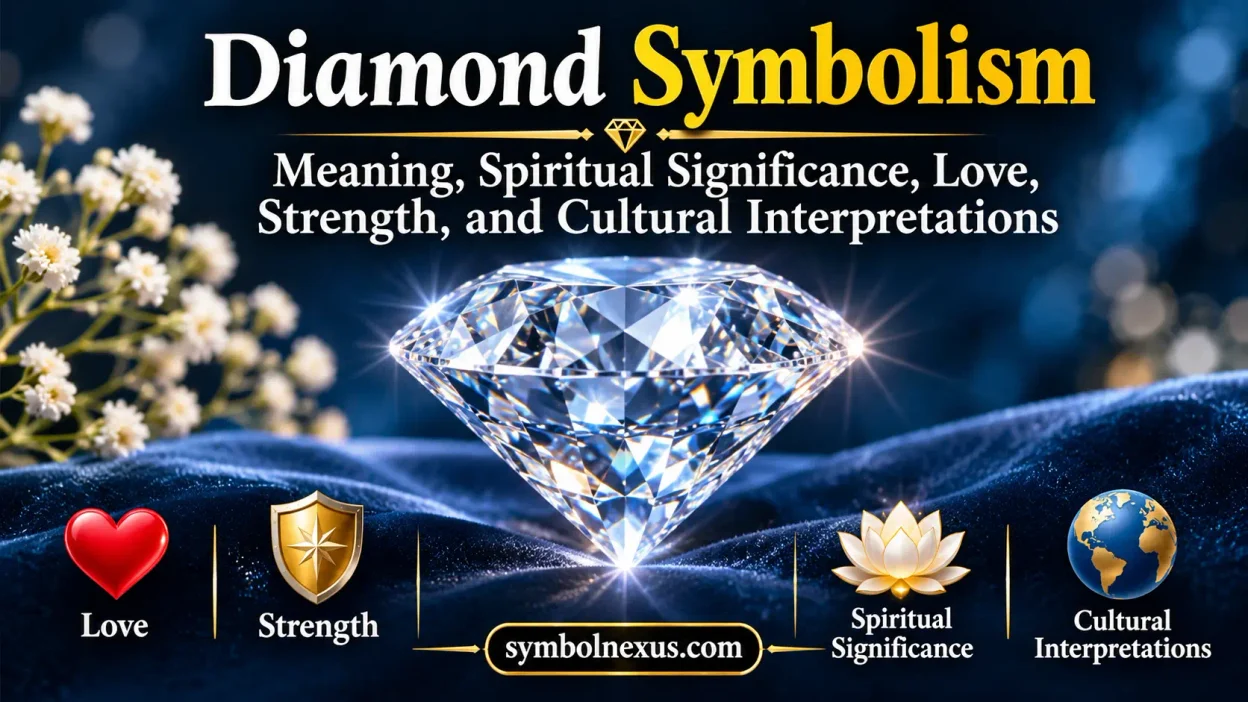
Diamonds have fascinated people for centuries because of their extraordinary brilliance, rarity, and remarkable hardness. Formed deep within the Earth under intense pressure and heat, these precious gemstones have become powerful symbols of enduring love, strength, purity, wealth, and spiritual transformation.
Diamond symbolism is closely connected with permanence and resilience. Because diamonds are among the hardest naturally occurring materials, they are often used to represent unbreakable commitments, emotional strength, and the ability to overcome difficult experiences. Their sparkling appearance also connects them with light, clarity, beauty, and spiritual awareness.
Across different cultures and historical periods, diamonds have represented royal power, divine protection, prosperity, and eternal relationships. Today, they remain especially popular as symbols of engagement, marriage, achievement, and personal milestones.
What Does a Diamond Symbolize?
A diamond commonly symbolizes strength, eternal love, purity, clarity, wealth, and resilience. Its physical properties and brilliant appearance have inspired many of these symbolic associations.
The most common meanings of diamonds include:
- Eternal love: Represents lasting commitment, loyalty, and devotion.
- Strength: Symbolizes resilience, determination, and the ability to withstand pressure.
- Purity: Represents innocence, sincerity, and spiritual cleanliness.
- Clarity: Reflects truth, honesty, wisdom, and clear thinking.
- Wealth: Symbolizes luxury, prosperity, status, and success.
- Protection: Associated with spiritual defense and courage in some historical traditions.
- Transformation: Represents personal growth through challenging experiences.
- Beauty: Reflects elegance, uniqueness, and timeless appeal.
These meanings are symbolic interpretations rather than universal beliefs. Different societies and individuals may associate diamonds with different qualities.
Spiritual Meaning of Diamonds
In modern spiritual interpretations, diamonds are often connected with inner strength, clarity, enlightenment, and the ability to remain grounded during difficult times.
Their formation under intense geological conditions provides a powerful metaphor for personal transformation. Just as a diamond develops deep within the Earth, people may interpret the gemstone as a reminder that difficult experiences can contribute to personal growth.
1. Spiritual Clarity
Diamonds are often associated with clear thinking, truth, and awareness. Their transparent appearance can symbolize the desire to understand yourself and the world more honestly.
Spiritually, a diamond may represent removing confusion, recognizing your priorities, and making decisions with confidence.
2. Inner Strength and Resilience
A diamond’s exceptional hardness makes it a natural symbol of endurance. In personal spirituality, it can represent the ability to remain strong when facing emotional, professional, or personal challenges.
It may serve as a reminder that difficult circumstances do not have to define your future.
3. Purity and Higher Awareness
The brilliance of a diamond has inspired associations with purity, light, and spiritual awareness. Some modern spiritual traditions interpret it as a symbol of a clear mind and sincere intentions.
4. Personal Transformation
Diamonds form under extraordinary pressure and temperature conditions. Symbolically, this process represents growth, patience, and the possibility of becoming stronger through life’s challenges.
5. Protection and Positive Energy
Some historical and contemporary gemstone traditions associate diamonds with protection, courage, and positive energy. These are cultural and spiritual beliefs rather than scientifically established properties.
Diamond Symbolism in Different Cultures
Diamonds have held different meanings across civilizations. Their rarity, beauty, and durability have made them valuable in royal collections, religious traditions, jewelry, and cultural ceremonies.
Ancient Indian Diamond Symbolism
India has a particularly important place in diamond history. For many centuries, it was one of the world’s major sources of diamonds, and gemstones played significant roles in royal wealth, trade, and traditional jewelry.
In ancient Indian traditions, diamonds were sometimes associated with strength, protection, status, and spiritual significance. Sanskrit texts and historical gemstone traditions discussed precious stones and their qualities.
Diamonds also appear in the broader cultural and religious history of India, although their meanings vary between texts, communities, and periods.
Ancient Greek and Roman Diamond Symbolism
The ancient Greeks and Romans admired diamonds for their exceptional hardness and brilliance.
The Greek word adamas means something like “unconquerable” or “invincible.” This term is connected to the historical naming of diamonds and reflects their association with strength and permanence.
Ancient writers sometimes connected diamonds with divine power, courage, and protection. These beliefs contributed to the gemstone’s reputation as a powerful and extraordinary material.
Medieval European Diamond Symbolism
During the medieval period, diamonds became associated with royal authority, wealth, and spiritual protection.
Some European traditions believed that diamonds could protect their owners from danger, strengthen courage, or bring victory. Their rarity also made them valuable possessions among rulers and wealthy families.
In Christian art and religious symbolism, precious stones could represent heavenly beauty, purity, and divine glory. However, diamond meanings varied, and not every religious interpretation referred specifically to diamonds.
Persian Diamond Symbolism
In Persian history and decorative traditions, diamonds were valued as precious objects associated with luxury, royal status, and refined craftsmanship.
Their presence in jewelry and royal collections reflected wealth and prestige. Modern interpretations may also connect diamonds with brilliance, elegance, and spiritual beauty.
Modern Western Diamond Symbolism
Today, diamonds are strongly associated with romantic commitment, engagement, marriage, and lasting relationships.
The modern popularity of diamond engagement rings grew significantly through European and American jewelry traditions and later advertising campaigns.
The gemstone’s durability made it a natural symbol of lasting love, while its brilliance helped establish it as an expression of beauty and celebration.
Diamond Symbolism in Love and Relationships
Diamonds are among the most recognizable symbols of romantic commitment. Their association with love is especially strong in engagement rings and wedding jewelry.
The gemstone’s durability represents the desire for a relationship that remains strong through changing circumstances.
Common meanings include:
- Eternal love: A commitment intended to last.
- Loyalty: Faithfulness and trust between partners.
- Devotion: A willingness to support and value one another.
- Honesty: Building a relationship through sincerity and communication.
- Commitment: Making a meaningful promise about the future.
- Emotional strength: Facing challenges together.
A diamond can also represent self-love, independence, and personal achievement. It does not have to symbolize romantic relationships alone.
Diamond Symbolism in Marriage and Engagement
Diamonds have become closely associated with engagement and marriage because of their perceived permanence, beauty, and rarity.
A diamond engagement ring often represents a promise of commitment and the hope of building a lasting relationship.
The tradition of giving diamond engagement rings became especially influential in the twentieth century. Although diamond rings existed earlier, modern advertising helped establish the diamond as a leading symbol of engagement.
The symbolic meanings of a diamond wedding ring include:
- Permanence: A lasting commitment between partners.
- Unity: Two people choosing to build a shared life.
- Trust: A relationship based on honesty and reliability.
- Devotion: Continued love and mutual care.
- Celebration: Recognition of an important relationship milestone.
The value of a marriage, however, comes from the relationship itself rather than the price or size of its gemstone.
Diamond Symbolism by Color
Diamonds occur in several natural colors, including colorless, yellow, pink, blue, green, brown, and black. Modern symbolic interpretations often assign different meanings to each color.
| Diamond ColorCommon Symbolic Meaning | |
|---|---|
| Colorless or White | Purity, clarity, innocence, and eternal love |
| Yellow | Happiness, optimism, abundance, and confidence |
| Pink | Romance, compassion, affection, and tenderness |
| Blue | Peace, wisdom, trust, and emotional balance |
| Black | Mystery, strength, independence, and protection |
| Green | Renewal, growth, prosperity, and harmony |
| Red | Passion, courage, energy, and intense love |
| Brown or Champagne | Stability, grounding, warmth, and practicality |
| Orange | Creativity, enthusiasm, and vitality |
These meanings are modern symbolic associations and may differ between jewelry traditions and individual interpretations.
White Diamond Symbolism
White or colorless diamonds are commonly associated with purity, innocence, clarity, and everlasting love.
Their transparent appearance and brilliant sparkle have made them popular in engagement rings and wedding jewelry.
Symbolically, a white diamond may represent honesty, sincere intentions, and the desire for a relationship built on trust.
It can also represent a fresh beginning or a commitment to living with integrity.
Black Diamond Symbolism
Black diamonds are often associated with mystery, strength, individuality, protection, and independence.
Their dark appearance gives them a distinctive character compared with traditional colorless diamonds.
In modern jewelry and spiritual interpretations, black diamonds can represent confidence, personal boundaries, and the ability to remain strong during uncertain times.
They are also popular in alternative engagement rings and distinctive jewelry designs.
Blue Diamond Symbolism
Blue diamonds are commonly associated with peace, wisdom, loyalty, and emotional stability.
Their rare and striking color inspires interpretations involving trust, honesty, and calm communication.
A blue diamond can symbolize a relationship built on mutual understanding or a personal desire for clarity and emotional balance.
Pink Diamond Symbolism
Pink diamonds are often connected with romance, compassion, tenderness, and emotional connection.
Their delicate color makes them popular symbols of affection, appreciation, and meaningful relationships.
In modern symbolic interpretations, pink diamonds may represent self-love, kindness, and the importance of nurturing emotional bonds.
Yellow Diamond Symbolism
Yellow diamonds are associated with sunshine, optimism, happiness, and abundance.
Their warm color can represent enthusiasm, confidence, and a positive approach to life.
A yellow diamond may also symbolize prosperity, creativity, and the celebration of personal success.
Diamond Symbolism in Religion
Diamonds have appeared in religious art, historical gemstone traditions, and spiritual interpretations. However, their meanings differ between religions, and not every tradition assigns them a specific sacred meaning.
Diamond Symbolism in Christianity
Diamonds are sometimes used in Christian-inspired symbolism to represent purity, heavenly light, spiritual strength, and divine glory.
The Bible describes precious stones in several passages, including Revelation 21, which presents a vision of the New Jerusalem decorated with precious stones.
However, biblical translations and historical gemstone identifications can vary. The text does not establish one universal spiritual meaning for diamonds.
Some Christians may interpret a diamond’s brilliance as a metaphor for faith, while its durability may represent steadfastness and commitment.
Diamond Symbolism in Hinduism
Diamonds have a long history in Indian culture and traditional gemstone practices.
In some Hindu astrological and gemstone traditions, diamond is associated with Venus, known as Shukra. Venus is traditionally connected with beauty, luxury, pleasure, relationships, and artistic appreciation.
The diamond is also associated with the vajra, a powerful ritual and symbolic object in Indian religious traditions. However, the vajra is not simply another name for a diamond; it has a distinct religious and historical meaning.
Beliefs about wearing diamonds for astrological purposes vary, and such claims are not scientifically established.
Diamond Symbolism in Buddhism
The diamond is particularly significant in Buddhist philosophy through the concept of the vajra, which represents indestructibility, spiritual power, and the clarity of awakened wisdom in Vajrayana Buddhism.
The title of the Diamond Sutra refers to wisdom that cuts through illusion and mistaken perceptions.
In this context, diamond imagery symbolizes the strength and clarity of wisdom rather than material wealth.
Diamond Symbolism in Dreams
Dreams about diamonds can have different interpretations depending on the dreamer’s emotions, experiences, and the details of the dream.
In symbolic dream interpretation, diamonds may represent personal value, love, ambition, confidence, and lasting commitments.
| Diamond Dream | Possible Symbolic Meaning |
|---|---|
| Finding a diamond | Discovering personal value or a new opportunity |
| Receiving a diamond | Appreciation, affection, or commitment |
| Losing a diamond | Fear of losing something valuable |
| Wearing a diamond ring | Love, commitment, or an important promise |
| Seeing a large diamond | Ambition, success, or personal confidence |
| Broken diamond | Disappointment or changing expectations |
| Black diamond | Independence, mystery, or inner strength |
| Many diamonds | Abundance, achievement, or material aspirations |
| Dirty diamond | Overlooked potential or unclear priorities |
Dream interpretations are personal and are not scientifically proven predictions. The most useful approach is to consider what the gemstone represents in your own life.
Diamond Symbolism in Art and Literature
Diamonds frequently appear in literature, poetry, paintings, and popular culture as symbols of beauty, wealth, desire, and permanence.
Writers and artists often use diamonds to explore the relationship between outward appearance and inner value.
Common literary and artistic meanings include:
- Wealth and social status: Diamonds can represent luxury, privilege, and material success.
- Desire and ambition: Their rarity can symbolize the pursuit of something valuable.
- Beauty and perfection: Their brilliance can represent elegance and idealized beauty.
- Permanence: Their hardness can suggest loyalty and lasting relationships.
- Temptation: Their financial value can represent greed or the attraction of material possessions.
- Inner worth: A diamond can symbolize qualities that remain valuable beyond outward appearance.
The phrase “a diamond in the rough” is also widely used to describe someone or something with great potential that has not yet been fully recognized or developed.
Diamond Symbolism in Jewelry and Fashion
Diamonds have remained popular in jewelry because of their brilliance, durability, and association with important life events.
Their symbolic meanings often depend on the type of jewelry and the occasion.
| Jewelry Type | Common Symbolic Meaning |
|---|---|
| Diamond engagement ring | Love and commitment |
| Diamond wedding band | Lasting partnership |
| Diamond necklace | Elegance, affection, and personal value |
| Diamond earrings | Beauty, confidence, and sophistication |
| Diamond bracelet | Celebration, achievement, and luxury |
| Diamond pendant | Personal meaning, remembrance, or devotion |
Diamonds are also used in contemporary fashion to express individuality, status, and personal style.
Diamond as a Symbol of Strength and Resilience
One of the strongest associations of diamonds is resilience.
Diamonds are known for their exceptional hardness, which makes them resistant to scratching. This physical characteristic has inspired the idea that diamonds represent strength and the ability to withstand pressure.
In a personal context, diamond symbolism can encourage people to:
- Remain determined during difficult circumstances.
- Learn from setbacks and disappointments.
- Protect their values and principles.
- Develop confidence through experience.
- Recognize their own potential.
- Continue working toward meaningful goals.
However, diamond hardness does not mean diamonds are impossible to break. They can fracture or chip under certain conditions. This distinction also offers a useful reminder that strength does not mean being invulnerable.
Why Are Diamonds Associated With Eternal Love?
Diamonds are associated with eternal love mainly because of their durability, rarity, and long-standing role in engagement and wedding traditions.
Their hardness provides a metaphor for a relationship that can endure difficulties, while their brilliance represents beauty and affection.
The symbolism became particularly influential through modern engagement-ring marketing and popular culture.
A diamond can therefore represent a promise of lasting love, but the strength of a relationship ultimately depends on trust, respect, communication, and shared commitment.
Interesting Facts About Diamonds
Understanding the science and history of diamonds helps explain why they have developed such powerful symbolic associations.
- Diamonds are made of carbon: Their crystal structure gives them their exceptional hardness.
- They form deep within the Earth: Natural diamonds generally develop under high pressure and temperature conditions in the Earth’s mantle.
- They are extremely hard: Diamond ranks 10 on the Mohs scale of mineral hardness.
- They are not indestructible: Despite their hardness, diamonds can fracture or chip.
- They can occur in different colors: Chemical impurities, structural defects, and other factors contribute to diamond color.
- India was an early major source: India supplied diamonds to international markets for many centuries before major deposits were discovered elsewhere.
- Not all diamonds are used in jewelry: Industrial diamonds are valuable for cutting, drilling, grinding, and other applications.
These characteristics help explain why diamonds have become symbols of endurance, rarity, and exceptional value.
Diamond vs. Other Gemstone Symbolism
Different gemstones have developed distinct symbolic associations throughout history and modern spiritual traditions.
| Gemstone | Common Symbolic Meaning |
|---|---|
| Diamond | Strength, purity, eternal love, and clarity |
| Ruby | Passion, courage, vitality, and love |
| Sapphire | Wisdom, loyalty, truth, and spiritual insight |
| Emerald | Growth, renewal, prosperity, and harmony |
| Amethyst | Peace, intuition, and spiritual awareness |
| Pearl | Purity, wisdom, elegance, and transformation |
These meanings are broad symbolic associations, not fixed rules. Gemstone symbolism varies across cultures, historical periods, and personal beliefs.
Conclusion
Diamond symbolism is deeply connected with strength, eternal love, purity, clarity, wealth, and transformation. Its remarkable hardness and brilliant appearance have made it one of the most recognizable symbols of lasting commitment and personal resilience.
Across different cultures and spiritual traditions, diamonds have represented royal power, divine light, protection, wisdom, and prosperity. Their colors also inspire modern interpretations involving romance, confidence, peace, and renewal.
Whether worn as an engagement ring, treasured as a family heirloom, or used as a personal symbol, a diamond can represent something valuable that withstands the passage of time. Its most meaningful message is that true strength, beauty, and worth are not defined by appearance alone.
Frequently Asked Questions (FAQs)
1. What does a diamond symbolize spiritually?
Spiritually, a diamond commonly symbolizes clarity, purity, inner strength, wisdom, resilience, and transformation. Some modern spiritual traditions also associate it with protection and higher awareness.
2. What does a diamond symbolize in love?
A diamond represents eternal love, loyalty, devotion, trust, and lasting commitment. It is especially associated with engagement and marriage because of its durability and brilliance.
3. Why are diamonds a symbol of strength?
Diamonds are among the hardest naturally occurring materials. Their resistance to scratching has made them symbols of resilience, determination, endurance, and the ability to withstand challenges.
4. What does a white diamond symbolize?
A white or colorless diamond commonly symbolizes purity, innocence, clarity, honesty, and everlasting love. It is particularly popular in engagement and wedding jewelry.
5. What does a black diamond symbolize?
A black diamond is often associated with mystery, independence, protection, confidence, and inner strength. It can also represent individuality and unconventional beauty.
6. What does a blue diamond symbolize?
A blue diamond commonly represents peace, wisdom, trust, loyalty, and emotional balance in modern symbolic interpretations.
7. What does a pink diamond symbolize?
Pink diamonds are associated with romance, compassion, tenderness, affection, and emotional connection.
8. What does a diamond symbolize in Christianity?
Some Christians interpret diamonds as symbols of purity, spiritual strength, and heavenly light. However, the Bible does not establish one universal symbolic meaning for diamonds.
9. What does a diamond symbolize in Hinduism?
In some Hindu gemstone and astrological traditions, diamonds are associated with Venus or Shukra, which is connected with beauty, luxury, relationships, and artistic qualities.
10. What does a diamond mean in a dream?
A diamond in a dream may represent personal value, love, success, confidence, or something important in your life. Its interpretation depends on the dream’s context and your personal feelings.
11. What does finding a diamond symbolize?
Finding a diamond may symbolically represent discovering your abilities, recognizing your worth, or encountering a valuable opportunity. It does not predict future wealth or good fortune.
12. Are diamonds a symbol of good luck?
Diamonds have been associated with protection, prosperity, and good fortune in some historical and modern traditions. These are cultural beliefs rather than scientifically proven effects.
13. What does a diamond ring symbolize?
A diamond ring commonly represents love, loyalty, commitment, and a lasting promise. Its meaning may also reflect personal achievement, family connection, or an important milestone.