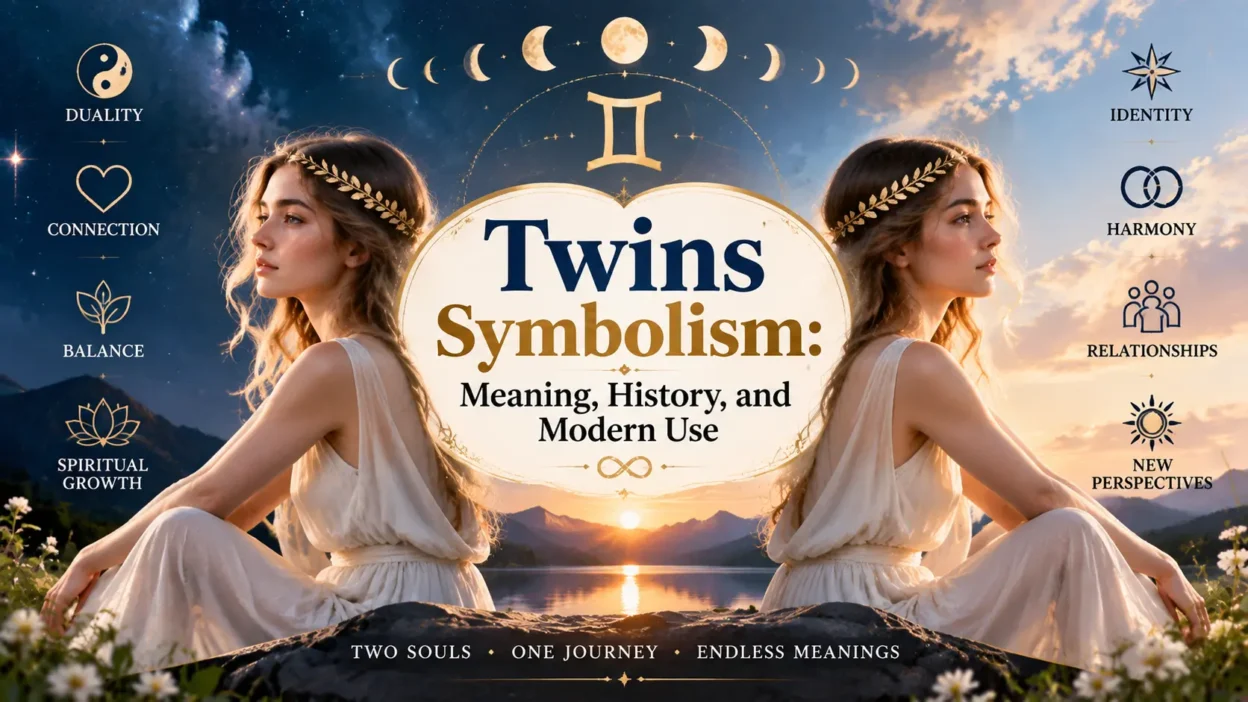
Twins have long stood for more than two people born at the same time. Twins symbolism often centers on duality, connection, balance, shared identity, and the relationship between two forces that are alike yet distinct. The image can express harmony, but it can also represent rivalry, contrast, or competing paths.
These meanings appear in mythology, religion, art, folklore, astrology, literature, and modern popular culture. Some traditions treat twins as fortunate or sacred figures. Others use twin stories to explore conflict between brothers, opposing sides of human nature, or the tension between individuality and belonging.
In the United States today, twins most often suggest a special bond, similarity, partnership, and two individual identities linked by a shared beginning. Their meaning changes considerably, however, depending on the cultural or personal context.
Quick Answer
Twins symbolism commonly represents duality, close connection, balance, shared origins, and individuality within a pair. Historically, twins have also symbolized sacred partnership, opposing forces, protection, rivalry, good fortune, and the idea that two different identities can emerge from the same beginning.
TL;DR
- Twins commonly symbolize connection, duality, balance, and shared origins.
- Similar appearance can represent unity without erasing individuality.
- Ancient twin myths often combine cooperation with rivalry.
- Some cultures associate twins with sacredness, fortune, or protection.
- Modern imagery emphasizes family bonds, identity, love, and partnership.
- Twin symbolism can be positive, negative, or deliberately ambiguous.
What Twins Commonly Symbolize
At its simplest, a pair of twins represents two connected individuals. This makes twins a natural symbol for relationships in which similarity and difference exist at the same time.
Several meanings appear repeatedly:
Duality is perhaps the broadest. Twins can represent two sides of a whole: light and darkness, reason and emotion, order and chaos, or the inner and outer self.
Connection comes from their shared origin. In modern imagery, twins can stand for unusually close relationships, loyalty, companionship, and lasting family bonds.
Balance develops when the two figures complement each other. Rather than representing opposites locked in conflict, they may show different qualities working together.
Individuality is equally important. Real twins are separate people, even when they look alike. For that reason, modern interpretations increasingly use twins to express the idea of being connected without losing personal identity.
Twins can also represent rivalry. Many traditional stories place twin or closely paired figures in competition, making them useful symbols for conflict between people who share similar origins or claims.
Why Two Similar Figures Create Such Strong Symbolism
Twins create an immediate visual puzzle: they are two, yet they may appear almost as one.
That tension explains much of their symbolic appeal.
A mirrored pair can suggest symmetry and order. Small differences between them, however, draw attention to individuality. The viewer begins comparing the two figures—what they share, what separates them, and whether they cooperate or compete.
This structure makes twin imagery useful in stories about identity. A twin can function almost like a mirror, showing another possible version of the same person.
Writers and artists can therefore use twins to ask a basic question: How much of a person comes from shared beginnings, and how much comes from individual choices?
The symbolism does not require identical twins. Fraternal twins can communicate the same themes of shared origin, connection, and contrasting identity.
Twins as Symbols of Duality
Duality describes two distinct forces that exist within the same larger system.
Twins fit this idea especially well because they begin together but remain separate individuals. Symbolically, they can embody paired concepts such as:
- creation and destruction
- strength and gentleness
- reason and instinct
- similarity and difference
- cooperation and competition
- dependence and independence
These pairs should not automatically be reduced to “good twin versus evil twin.” Duality is broader than morality.
Two symbolic twins may represent complementary forces rather than enemies. One quality may even require the other to create balance.
This distinction matters because modern fiction often turns twins into simple opposites, while older myths can use paired figures in more complicated ways.
Balance, Symmetry, and Complementary Forces
When twins appear together in visual art, their matching forms naturally create symmetry.
Symmetry often communicates stability, equality, and balance. Two figures standing side by side may therefore suggest cooperation or mutual support.
But balance does not require both sides to be identical.
Think of two people carrying opposite ends of the same object. They perform different roles while contributing to one result. Symbolic twins can work the same way.
This gives twin imagery an important secondary meaning: complementarity.
One figure may represent qualities the other lacks. Instead of one defeating the other, the pair becomes complete through difference.
That interpretation works especially well in jewelry, tattoos, family art, and designs created for siblings or partners.
Connection Without Loss of Individuality
One of the most relevant modern interpretations of twins concerns the relationship between belonging and individuality.
Twins may share a birthday, family environment, physical characteristics, and important life experiences. Yet treating twins as interchangeable ignores their separate personalities and choices.
That reality gives modern twins symbolism a more nuanced meaning.
A twin pair can stand for:
“We came from the same beginning, but we are not the same person.”
This interpretation is particularly useful in family symbolism. Matching objects may celebrate the relationship, while different colors, initials, flowers, dates, or design details emphasize each person’s identity.
The result is not complete sameness. It is unity with distinction.
Twin Symbolism in Ancient Mythology
Twin and paired-sibling stories appear in numerous mythological traditions, but they do not all carry the same meaning.
In Greek tradition, Castor and Pollux—often called the Dioscuri—became one of the best-known twin pairs of the ancient Mediterranean world. Their story emphasizes brotherhood, loyalty, mortality, and a bond strong enough to cross the boundary between mortal and divine existence. They also became closely associated with the constellation Gemini.
Roman tradition offers a more conflicted example through Romulus and Remus. The brothers share an extraordinary beginning and are central to Rome’s legendary foundation, but their story ends in deadly rivalry. Their pairing therefore joins shared destiny with competition for authority.
These stories demonstrate why there is no single ancient meaning of twins.
Twins might cooperate, protect one another, compete for status, establish social order, or represent forces that must exist together.
Twins in Yoruba Tradition
One of the most distinctive cultural traditions involving twins comes from Yoruba communities of West Africa.
Twins, known as ìbejì, developed an important religious and cultural status. Traditions surrounding them have included associations with unusual spiritual importance, prosperity, fertility, and the welfare of the family. Historical attitudes were not completely static; scholarship documents significant changes in the treatment and religious interpretation of twin births over time.
A particularly important artistic tradition involves ere ibeji, carved figures associated with deceased twins. These figures could receive care such as dressing, washing, decoration, and offerings, reflecting an ongoing relationship between the family and the deceased child.
This tradition should not be reduced to the vague claim that “twins mean good luck.” Its meaning belongs to a specific religious and cultural framework involving family, remembrance, spiritual continuity, and ritual responsibility.
It also demonstrates how twin symbolism can connect birth, death, memory, family identity, and prosperity within the same tradition.
Twin Heroes in Indigenous American Traditions
Twin or paired hero figures also appear in several Indigenous traditions of the Americas. Their stories vary significantly among nations and should not be treated as a single universal “Native American” belief.
In some traditions, paired heroes confront dangerous beings, participate in creation narratives, or establish order in the world. Navajo narratives concerning Monster Slayer and Born-for-Water, for example, connect the heroic pair with overcoming monsters and making the world safer for human life.
Other traditions use paired figures to express contrasting or complementary aspects of existence.
Farther south, the K’iche’ Maya narrative preserved in the Popol Vuh tells of the Hero Twins Hunahpu and Xbalanque. Their adventures involve trials, cleverness, death, transformation, and victory over the powers of Xibalba.
These examples reinforce an important rule when interpreting twin symbolism: cultural context matters. Similar-looking motifs can carry very different meanings.
Gemini and the Symbolic Idea of Twins
In American popular culture, one of the most recognizable representations of twins is Gemini, the third sign of the Western zodiac.
Its name comes from the Latin word associated with twins, and its traditional symbol depicts a paired form. The constellation has long been connected in Greco-Roman tradition with Castor and Pollux.
Symbolically, Gemini imagery is commonly associated in modern astrology with duality, communication, adaptability, curiosity, and contrasting aspects of personality.
That does not mean twins themselves traditionally symbolize every personality trait assigned to Gemini. Astrology and broader twin symbolism overlap, but they are not interchangeable.
A Gemini tattoo, for example, may simply indicate a person’s zodiac sign. A tattoo of two human figures could instead represent siblings, dual identity, or another personal relationship.
Context determines which meaning applies.
Twins Symbolism in the United States
In contemporary American culture, twins usually carry a more personal and social meaning than a ritual one.
They are frequently associated with:
| Context | Common Meaning in the U.S. | Typical Association |
|---|---|---|
| Family | Lifelong connection | Sibling bond |
| Tattoos | Shared identity or duality | Matching designs |
| Astrology | Two-sidedness and adaptability | Gemini |
| Fiction | Contrast or mistaken identity | Twin characters |
| Photography | Similarity and individuality | Matching portraits |
| Memorials | Continuing emotional connection | Remembering a twin |
Parents may use matching clothing, initials, nursery decorations, or photographs to emphasize a twin relationship. Adult twins may choose matching jewelry or tattoos as a sign of sibling connection.
At the same time, American discussions increasingly recognize that twins should not be treated as a single identity simply because they share physical features or a birth date.
That shift has added individuality to the modern symbolism of the pair.
Psychological and Emotional Meaning of Twin Imagery
Symbolically, twins can function like mirrors.
Seeing two similar figures encourages comparison. In art and storytelling, that comparison can represent different versions of the self.
One twin might symbolize the identity a person shows publicly, while the other represents a private side. Another interpretation may contrast past and present selves, emotional and rational thinking, or conformity and independence.
These are symbolic readings rather than psychological rules about actual twins.
Real twins should not be assumed to have matching personalities, supernatural connections, or opposite temperaments simply because stories frequently use those ideas.
Emotionally, twin imagery can also communicate closeness. For someone who has a twin, the symbol may refer to shared childhood experiences, loyalty, grief, memory, or a relationship that remains important despite separate adult lives.
Twin Symbolism in Literature and Film
Twins are particularly useful storytelling devices because audiences immediately notice resemblance.
Writers can then play with the difference between appearance and identity.
The mistaken-identity plot uses physical similarity for confusion, humor, romance, or deception. In more serious stories, twins can explore questions of nature versus upbringing or show how two people with similar beginnings make very different choices.
Another familiar device is the contrasting twin.
One character may be cautious while the other takes risks. One follows family expectations while the other rebels. Sometimes the contrast becomes the exaggerated “good twin and bad twin” trope.
The device works because the shared beginning makes later differences more noticeable.
Twin characters can therefore symbolize a broader human question: Does origin determine identity, or do choices create it?
What Twins Can Symbolize in Tattoos
Twin tattoos can have several meanings, so the design matters as much as the subject.
For actual twins, matching tattoos often represent sibling loyalty, shared history, and a permanent family bond. The designs do not have to be identical. Complementary images may better express two independent people who belong to the same pair.
Common concepts include matching initials, birth dates, two stars, paired flowers, mirrored shapes, or two parts of a single design.
Someone who is not a twin may use twin imagery differently.
Two figures might symbolize opposing sides of personality, an important partnership, balance, Gemini, or a major relationship.
Memorial tattoos require another interpretation. When one twin has died, paired imagery can represent remembrance and the continuing emotional importance of that sibling relationship.
For this reason, it is better to interpret a twin tattoo from its details rather than assuming it has one universal meaning.
Twins in Dreams and Personal Symbolism
Dream interpretations should be treated cautiously. There is no reliable universal dictionary in which dreaming about twins predicts one specific event.
As personal symbols, however, twins can provide a useful framework for reflection.
A dream involving twins might remind someone of two competing choices, similar opportunities, divided responsibilities, or two parts of their identity. For someone who actually has twins in the family, the dream may simply reflect familiar people or current concerns.
The emotional tone offers more useful context than the image alone.
Peaceful twins may suggest cooperation or closeness to the dreamer. Fighting twins could reflect conflict or competing priorities. Losing sight of one twin might feel connected to separation or change.
These are interpretive possibilities, not predictions.
Twin dreams should therefore be understood through the dreamer’s circumstances rather than treated as supernatural forecasts.
Positive and Negative Meanings of Twins
Twin symbolism is not automatically positive.
Its meaning often depends on whether the two figures cooperate or oppose each other.
Positive associations can include:
- companionship
- loyalty
- balance
- family connection
- cooperation
- complementary strengths
- shared beginnings
More difficult associations can include rivalry, jealousy, divided identity, competition, mistaken identity, or conflict between two closely connected forces.
The story of Romulus and Remus demonstrates this ambiguity particularly well. The brothers’ shared origin connects them, but their rivalry ultimately separates them.
That contrast explains why twins work so effectively as symbols. The same pair can communicate unity and conflict without contradiction.
Twins, Mirrors, and Doppelgängers Are Not the Same Symbol
Twin imagery is sometimes confused with mirrors and doppelgängers because all three involve resemblance.
Their symbolic emphasis is different.
Twins usually begin with relationship and shared origin.
Mirrors often emphasize reflection, self-perception, truth, reversal, or appearance.
Doppelgängers commonly create unease by presenting an uncanny duplicate of a person. In fiction, they may symbolize a hidden self, replacement, danger, or fractured identity.
A twin is therefore not automatically a doppelgänger.
This distinction matters in horror and psychological fiction, where a duplicate character may deliberately imitate twin imagery while representing something much more threatening.
Why Twins Sometimes Represent Rivalry
Similarity can create closeness, but it can also create competition.
If two people occupy similar positions, others may compare them. Traditional stories amplify this dynamic by giving paired siblings the same inheritance, status, destiny, or claim to power.
The resulting conflict becomes symbolically useful.
Instead of representing two unrelated enemies, rival twins represent conflict within something originally connected.
That can stand for family division, civil conflict, competing identities, or two possible paths emerging from one source.
Romulus and Remus provide a famous example. Their story connects brotherhood and the legendary birth of a city with a struggle over leadership and boundaries.
In symbolic terms, rivalry between twins can therefore warn that similarity does not guarantee harmony.
Sacredness, Fortune, and Misunderstanding
Historical responses to twin births have varied widely.
Some communities gave twins elevated religious significance. Other societies viewed unusual births with suspicion or interpreted them through local ideas about supernatural events. Attitudes could also change within the same culture over generations.
The Yoruba example demonstrates this complexity particularly clearly. Historical research records changing attitudes toward twins alongside the later development of elaborate traditions honoring them.
Because of that variation, claims such as “twins always symbolize luck” or “ancient people feared twins” are too broad.
Neither statement works across all cultures.
A responsible interpretation identifies the particular society, historical period, myth, or religious tradition involved before assigning meaning.
How Twin Symbolism Has Changed
Older twin symbolism often belonged to mythology, religion, cosmology, or stories explaining the origins of communities.
Twin heroes could defeat monsters. Divine or semi-divine pairs could connect human and supernatural worlds. Legendary brothers could become founders of cities or ancestors of peoples.
Modern secular culture still uses these old patterns, but personal identity has become more prominent.
Today, twins appear in birthday gifts, family photography, tattoos, necklaces, social media posts, television, books, and personalized artwork.
The emphasis often shifts from cosmic order to human relationships.
Instead of asking what twins reveal about gods or the structure of the universe, modern symbolism often asks what they reveal about connection and individuality.
That change helps explain why matching-but-not-identical designs are so effective today. They acknowledge a shared beginning while preserving two separate identities.
Common Misunderstandings About Twins Symbolism
The first misconception is that twins universally represent opposites.
They can, but many traditions emphasize cooperation, sacredness, kinship, protection, or shared destiny instead.
Another misconception is that twins always symbolize perfect similarity. In fact, one of the richest interpretations comes from their differences.
A third mistake is treating every traditional twin belief as interchangeable. Yoruba ìbejì traditions, Roman foundation mythology, Gemini imagery, and Indigenous twin narratives developed in different cultural settings. They should not be blended into a supposedly universal ancient belief.
Finally, symbolic stories about twins should not be treated as facts about real twins.
Ideas about telepathy, supernatural bonds, predetermined personalities, or morally opposite twins belong mainly to folklore and fiction unless supported by evidence in a different context.
Symbolism explains what an image can communicate. It does not determine what actual people are like.
Frequently Asked Questions
What do twins symbolize spiritually?
In spiritual and religious traditions, twins can represent complementary forces, sacred partnership, shared destiny, protection, or the relationship between two aspects of existence. The exact interpretation depends on the tradition, so there is no universal spiritual meaning for twins.
Are twins a symbol of good luck?
They can represent good fortune in some cultural traditions, but this meaning is not universal. Different societies have interpreted twin births in very different ways, and those attitudes have sometimes changed over time.
What does a twins tattoo symbolize?
A twins tattoo commonly represents sibling connection, shared origins, loyalty, or two individual identities joined by a lasting relationship. For other wearers, paired figures may represent Gemini, duality, balance, or contrasting parts of the self.
What do twins symbolize in mythology?
Mythological twins often represent partnership, rivalry, complementary forces, heroic cooperation, or shared destiny. Castor and Pollux emphasize brotherhood, while Romulus and Remus show how a shared origin can develop into competition and conflict.
What is the difference between twins and Gemini symbolism?
Twins are a broad cultural symbol found in family life, mythology, religion, art, and literature. Gemini is a specific zodiac sign whose traditional imagery uses twins, so its astrological meanings form only one branch of wider twin symbolism.
Do twins symbolize dual personality?
Twins can symbolize two sides of a personality in art, fiction, tattoos, or personal interpretation. That is a metaphor and should not be confused with a psychological claim about real twins or personality disorders.
What does dreaming about twins mean?
There is no scientifically established universal meaning for dreaming about twins. Symbolically, the image may prompt reflection on partnership, two choices, competing priorities, similarity, or different aspects of identity, depending on the dreamer’s circumstances.
Conclusion
Twins symbolism is built around an unusual relationship between sameness and difference. Twins can represent connection, duality, balance, shared beginnings, loyalty, individuality, or rivalry depending on how and where the image appears.
Ancient myths used twin figures to explore gods, heroes, founders, conflict, and the structure of the world. Specific traditions, including Yoruba ìbejì practices, gave twins meanings rooted in their own religious and social histories. Modern American culture often brings the symbol closer to everyday life through family identity, tattoos, astrology, art, literature, and personal remembrance.
Perhaps the most useful modern interpretation is also the simplest: two people or forces can share an origin without becoming interchangeable. Twins make that relationship visible—connected, comparable, but still distinct.


