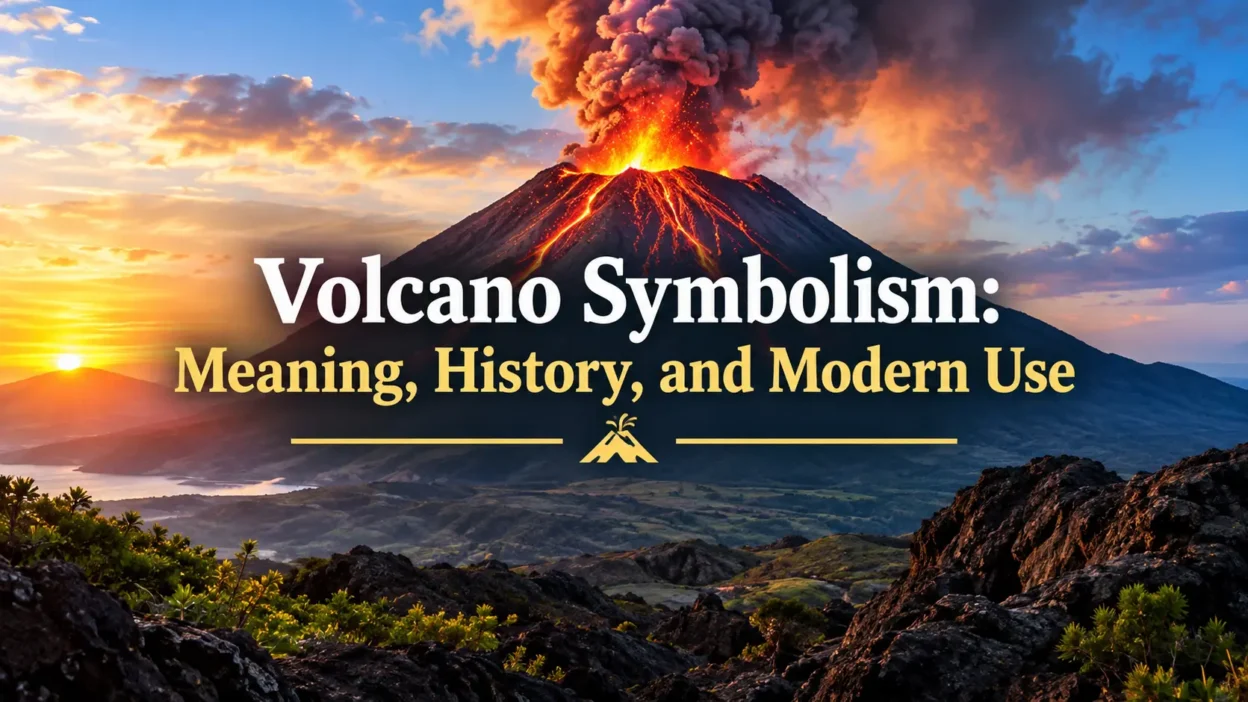
Volcanoes are among nature’s most dramatic forms. A mountain that appears quiet can suddenly release fire, ash, smoke, and molten rock, while the same geological process can eventually create new land. That contrast helps explain why volcano symbolism is often connected with destruction, transformation, creation, emotional intensity, and renewal.
In the United States, volcanoes carry several meanings at once. They can represent uncontrollable natural forces, buried emotions finally reaching the surface, personal change, resilience after disaster, or the creation of something new from destruction. Their symbolism also changes depending on whether a person is viewing a volcano through science, mythology, art, religion, or personal experience.
The meaning becomes especially interesting in places such as Hawaiʻi and the Pacific Northwest, where volcanoes are part of both the physical landscape and cultural memory. Modern Americans may encounter volcano imagery in tattoos, artwork, films, environmental education, travel photography, and discussions about natural disasters.
Quick Answer
Volcano symbolism commonly represents transformation, emotional intensity, destruction, creation, and renewal in modern American culture. Historically, volcanoes have also been connected with fire deities, sacred landscapes, fertility, divine power, and the cycle of destruction followed by new land and life.
TL;DR
- Volcanoes symbolize transformation, release, destruction, and renewal.
- Hawaiian traditions connect volcanic landscapes with the deity Pele.
- American culture often associates volcanoes with danger and resilience.
- Lava represents creation because volcanic activity can form new land.
- Eruptions can symbolize emotions that have been suppressed or released.
- Modern volcano imagery appears in tattoos, art, media, and design.
What Volcanoes Symbolize in the United States
The most common modern American interpretation of a volcano combines danger with transformation.
An erupting volcano is difficult to control or stop. That makes it a natural metaphor for forces that exceed human control. In everyday language, someone may even describe an angry person as a “volcano” when emotions are building toward an explosive reaction.
At the same time, destruction is only part of the picture. Volcanic activity can create new land, reshape coastlines, produce fertile soils, and establish new environments. This gives the volcano a second meaning: something can be destroyed while something else is being formed.
That contrast makes volcano imagery particularly useful for stories about major life changes. A person leaving an old career, ending a relationship, surviving a crisis, or beginning again may use a volcano as a metaphor for upheaval followed by rebuilding.
In American culture, therefore, the volcano is rarely a simple symbol of evil or destruction. Its meaning usually depends on what happens after the eruption.
Ancient Roots and Early Volcanic Symbolism
Long before modern geology explained magma, tectonic plates, and volcanic vents, people had to interpret mountains that could shake the ground and release fire.
Volcanoes naturally encouraged explanations involving supernatural beings, powerful spirits, gods, or sacred forces. Their behavior seemed fundamentally different from ordinary mountains. A mountain could suddenly roar, glow, produce smoke, or send material down its slopes.
In Mediterranean traditions, volcanic regions became associated with divine craftsmanship, fire, and underground forces. Greek traditions connected volcanic fire with Hephaestus, the god associated with metalworking and the forge, while Roman tradition associated him with Vulcan. These traditions helped reinforce an old symbolic relationship between volcanoes, fire, craftsmanship, and subterranean power.
Volcano symbolism was not identical everywhere, however. Different societies interpreted volcanic landscapes according to their own religious systems, histories, and relationships with the land.
This distinction matters because there is no single ancient “volcano meaning.” The symbol developed differently across cultures.
Pele and the Volcanic Landscape of Hawaiʻi
One of the most important volcanic traditions connected with the United States comes from Native Hawaiian culture.
Pelehonuamea, commonly known as Pele, is a Hawaiian volcanic deity associated with volcanic activity and the creation of volcanic landscapes. Hawaiian moʻolelo, or traditional stories, describe Pele in different ways, and versions can vary.
Pele is particularly important because her symbolism reflects the two-sided nature of volcanic activity. She can destroy existing landscapes while also creating new land. In this context, volcanic destruction is not simply an ending. It is part of a larger natural process.
This makes the Hawaiian tradition significantly different from the simplified idea that volcanoes symbolize anger or destruction alone.
For many Hawaiians, Pele is approached with respect rather than treated merely as a fictional character or decorative symbol. The volcanic landscape can have cultural and spiritual significance, which is why visitors should be careful about reducing Hawaiian traditions to generic “volcano goddess” imagery.
The lesson is important for modern symbolism: a sacred cultural tradition should not be separated from the people, land, stories, and practices that give it meaning.
Destruction and the End of an Old Form
An erupting volcano is an obvious symbol of destruction.
Lava can cover roads, forests, homes, and fields. Ash can disrupt transportation and affect communities far from an eruption. Historic volcanic disasters have left strong memories in many societies.
Symbolically, this makes the volcano useful when discussing the end of something that once seemed stable.
A volcano can represent:
- the collapse of an old structure
- sudden disruption
- irreversible change
- loss of control
- the destruction of outdated patterns
- the end of one stage of life
In personal symbolism, an erupting volcano might represent a situation that can no longer remain unchanged.
However, destruction does not automatically imply failure. Sometimes the old structure must disappear before something different can take its place.
That is where volcano symbolism becomes more complicated than ordinary disaster imagery.
Creation, Renewal, and New Beginnings
Volcanoes are also creators.
When lava cools, it becomes solid rock. Repeated volcanic activity can build islands, expand coastlines, and reshape landscapes. Over time, plants and animals can establish themselves on newly formed surfaces.
This gives volcano imagery an important symbolic meaning: creation can emerge from disruption.
Someone choosing a volcano tattoo after surviving a difficult period might use it to represent rebuilding rather than destruction. An artist may use volcanic imagery to communicate the birth of a new idea. A writer may use an eruption as the turning point between an old identity and a new one.
The symbolic message is not necessarily “everything was destroyed.” It can instead be:
Something changed, and the new landscape became possible because the old one changed first.
That interpretation makes the volcano especially suitable for themes of reinvention.
Volcanoes as Symbols of Suppressed Emotion
The comparison between volcanoes and human emotions is common because the physical image is easy to understand.
A volcano may remain quiet for long periods before an eruption. In metaphorical language, a person may also appear calm while frustration, anger, grief, or stress accumulates beneath the surface.
An eruption can therefore symbolize emotional release.
The comparison is useful when the emotion has been building gradually. Common examples include:
- anger finally being expressed
- grief becoming impossible to suppress
- passion suddenly becoming visible
- frustration reaching a breaking point
- creativity emerging after a period of silence
This interpretation should not be treated as a scientific psychological rule. It is a metaphor based on the visible behavior of volcanoes.
Still, the metaphor works because both situations involve an apparent surface calm contrasted with forces operating underneath.
Volcano Symbolism and Personal Transformation
Volcanoes can represent major turning points in personal identity.
A quiet mountain and an erupting mountain may look like completely different environments, even though they are part of the same geological system. That makes the volcano a useful metaphor for people who experience dramatic change without becoming completely different individuals.
For example, someone may use volcanic imagery after:
- overcoming a major setback
- leaving a difficult period behind
- changing careers
- beginning a creative project
- rebuilding after loss
- becoming more confident
- rejecting an outdated identity
The volcano can communicate that transformation is sometimes disruptive.
Unlike symbols such as butterflies, which usually emphasize graceful change, volcanoes emphasize forceful change. The process may be uncomfortable, unpredictable, and impossible to reverse.
That distinction gives volcano imagery a more intense emotional character.
Volcano Symbolism in American Culture and Public Memory
Volcanoes occupy a particular place in U.S. culture because the country has active and historically significant volcanic regions.
Hawaiʻi is perhaps the clearest example, but volcanoes are also important in Alaska and the Pacific Northwest. Mount St. Helens became especially significant in American public memory after its catastrophic 1980 eruption.
Because of events like this, American volcano symbolism is not purely mythological. It also includes scientific awareness, disaster preparation, environmental change, and community resilience.
Modern American interpretations may therefore combine two seemingly opposite ideas:
| Context | Meaning in the USA | Common Associations | Notes |
|---|---|---|---|
| Eruption | Sudden change or danger | Crisis, anger, disruption | Often used metaphorically |
| Lava | Creation and transformation | New land, rebuilding | Destruction can produce new landscapes |
| Volcano mountain | Hidden potential | Pressure, strength, uncertainty | Quiet does not necessarily mean inactive |
| Hawaiian volcano | Sacred cultural landscape | Pele, land, respect | Should be understood within Hawaiian traditions |
| Volcano disaster | Resilience | Survival, preparation, recovery | Strong connection to public memory |
This combination makes volcanoes unusually flexible symbols in American storytelling.
Fire, Passion, and Creative Energy
Fire is one of the oldest human symbols, and volcanoes naturally inherit some of its associations.
Volcanic fire can represent passion, ambition, sexuality, creativity, anger, courage, or determination. The exact meaning depends on the surrounding imagery.
For example, a calm volcano with a faint glow may suggest potential energy or controlled passion. A violent eruption may suggest overwhelming emotion or conflict. A volcano surrounded by flowers or vegetation may emphasize renewal and life after destruction.
Artists often use this contrast because it allows one image to communicate opposing forces.
A volcano can therefore symbolize intensity without automatically meaning negativity.
Volcanoes in Tattoos and Personal Style
Volcano tattoos often have a personal rather than universally recognized meaning.
Someone may choose volcanic imagery to represent survival, emotional intensity, transformation, a connection to a particular place, or an important travel experience.
Common design choices can change the message:
- Erupting volcano: emotional release or major transformation
- Lava flow: movement, change, or unstoppable progress
- Volcano with smoke: hidden pressure or uncertainty
- Volcano with flowers: renewal after hardship
- Volcano and ocean: opposing forces or balance
- Minimalist volcano: personal connection to a landscape or memory
A volcano tattoo does not have one fixed definition. The person wearing it determines much of its meaning.
This is especially important when volcanic imagery is connected to Hawaiian culture. Using a culturally significant figure or tradition simply as an exotic design can remove it from its original context.
Volcanoes in Art, Film, and Popular Media
Popular culture often emphasizes the spectacular side of volcanoes.
Films and television frequently use eruptions as symbols of impending disaster, chaos, or a dramatic turning point. In adventure stories, a volcano may represent a dangerous environment that characters must escape.
Visual artists can use the same landscape differently. A glowing volcanic horizon may suggest beauty, mystery, destruction, or the coexistence of life and geological force.
In digital culture, volcano imagery is also useful because it communicates intensity quickly. A glowing crater or flowing lava can function as a visual shorthand for pressure, excitement, anger, or dramatic change.
The modern meaning is therefore shaped not only by mythology but also by entertainment, photography, tourism, environmental education, and social media.
Volcanoes and the Psychology of Pressure
The volcano metaphor works particularly well for pressure because people can imagine an invisible force building beneath a visible surface.
A person who says they feel like they are “about to erupt” is describing emotional pressure rather than geology. The image suggests that continuing to suppress the situation may eventually lead to an outward reaction.
This symbolism can apply to positive forces as well.
A creative person might feel ideas accumulating until a new project finally emerges. An entrepreneur might describe a long period of preparation followed by rapid growth. A community may experience years of preparation before responding effectively to a crisis.
The volcano therefore represents not only pressure but stored potential.
What emerges depends on the circumstances.
Religious and Spiritual Interpretations
Volcanic landscapes have been treated as sacred in different parts of the world, but religious meanings should not be generalized into one universal interpretation.
In Hawaiian traditions, Pele is central to important moʻolelo and relationships with volcanic landscapes. In other historical cultures, underground fire could be associated with gods, divine craftsmanship, punishment, or the underworld.
Modern spiritual interpretations sometimes describe volcanoes as symbols of purification, awakening, release, or transformation. These are contemporary interpretive frameworks rather than universal religious teachings.
For readers exploring volcano symbolism spiritually, it is useful to separate three things:
- documented cultural traditions,
- historical mythology,
- personal symbolic interpretation.
Keeping those categories separate prevents a modern personal meaning from being presented as an ancient religious belief.
Positive and Negative Meanings of Volcanoes
Volcano symbolism can be positive, negative, or neutral.
Positive meanings often include:
- transformation
- renewal
- creativity
- courage
- passion
- new beginnings
- resilience
- creation
Negative meanings can include:
- destruction
- anger
- instability
- danger
- emotional overload
- loss of control
- sudden crisis
The same eruption can represent either side depending on the story surrounding it.
A person rebuilding after a disaster may see the volcano as a symbol of survival. Someone watching their home threatened by an eruption may understandably associate it with fear and loss.
Symbolism is shaped by experience, not simply by the object itself.
Common Misunderstandings About Volcano Symbolism
One common mistake is treating every volcano as a symbol of anger. Anger is one possible interpretation, but it ignores the volcano’s associations with creation, fertility, land formation, resilience, and transformation.
Another mistake is assuming that all cultures have the same volcano mythology. They do not. Volcanic traditions developed within specific communities and landscapes.
It is also misleading to claim that every eruption represents “rebirth.” Real eruptions can cause serious human suffering, and symbolic language should not erase that reality.
Finally, modern spiritual interpretations should not automatically be presented as ancient beliefs. A personal interpretation can be meaningful without being historically traditional.
How Volcano Meaning Has Changed Over Time
The symbolic history of volcanoes reflects changes in human knowledge.
Ancient societies often interpreted volcanic activity through mythology, religion, and observation. As geology developed, volcanic eruptions became understandable as physical processes rather than unexplained supernatural events.
Scientific knowledge did not completely eliminate symbolism. Instead, it added new layers.
Today, Americans can understand a volcano simultaneously as:
- a geological system
- a natural hazard
- a sacred landscape
- a cultural symbol
- a metaphor for emotional pressure
- an image of transformation
- a reminder of environmental change
That combination explains why volcano imagery remains useful even in a scientific age.
Why Volcano Symbolism Still Matters Today
Volcanoes continue to work as symbols because they combine opposites unusually well.
They can destroy and create. They can remain quiet and then become active. They can represent danger while also producing landscapes where life eventually develops.
That makes them particularly effective for modern stories about change.
In American culture, the image may refer to personal resilience, natural disaster, environmental awareness, creative intensity, or cultural identity. In Hawaiʻi especially, volcanic symbolism also carries meanings that deserve to be understood within Native Hawaiian traditions rather than reduced to generic motivational imagery.
The most useful interpretation is therefore not simply “volcano equals destruction.” It is that change can be disruptive, visible, and irreversible while still producing something new.
Frequently Asked Questions
What does a volcano symbolize spiritually?
A volcano may symbolize transformation, release, creation, purification, or forces beyond human control. Specific spiritual meanings depend on the religious or cultural tradition involved, so there is no single universal interpretation.
What does a volcano tattoo mean?
A volcano tattoo can represent resilience, passion, emotional release, transformation, or a personal connection to a volcanic landscape. The surrounding design and the wearer’s personal experience usually determine the intended meaning.
Is a volcano a positive or negative symbol?
It can be either. Volcanoes may symbolize destruction, anger, and danger, but they can also represent creativity, new beginnings, land formation, resilience, and transformation.
What does an erupting volcano symbolize?
An erupting volcano often represents sudden change, emotional release, intense passion, or a situation reaching a breaking point. In a positive context, it can also represent the beginning of a major transformation.
What does a volcano symbolize in Hawaiian culture?
In Hawaiian traditions, volcanic symbolism is closely connected with Pelehonuamea, or Pele, and the volcanic landscapes of Hawaiʻi. Pele is associated with both destruction and creation, so the symbolism cannot be reduced to anger or danger alone.
Why are volcanoes associated with anger?
The metaphor comes from the idea of pressure building beneath a quiet surface before an eruption. People use volcanic language to describe emotions such as anger or frustration that have accumulated and eventually become difficult to contain.
Does a volcano symbolize rebirth?
It can symbolize rebirth or renewal because volcanic activity can destroy existing landscapes while contributing to the formation of new land. As a personal symbol, it may represent rebuilding after a major change or difficult experience.
Conclusion
A volcano is a symbol of change under pressure. Its imagery can represent destruction, emotional release, passion, creation, resilience, and renewal, with the surrounding context determining which meaning matters most.
The broader lesson behind volcano symbolism is the coexistence of opposing forces. Fire can destroy while geological activity creates land; an eruption can end one landscape while beginning another. In modern American culture, that tension makes the volcano a fitting symbol for people and communities facing major change.
A volcano does not promise that transformation will be easy. It simply reminds us that a changed landscape can become the beginning of something new.