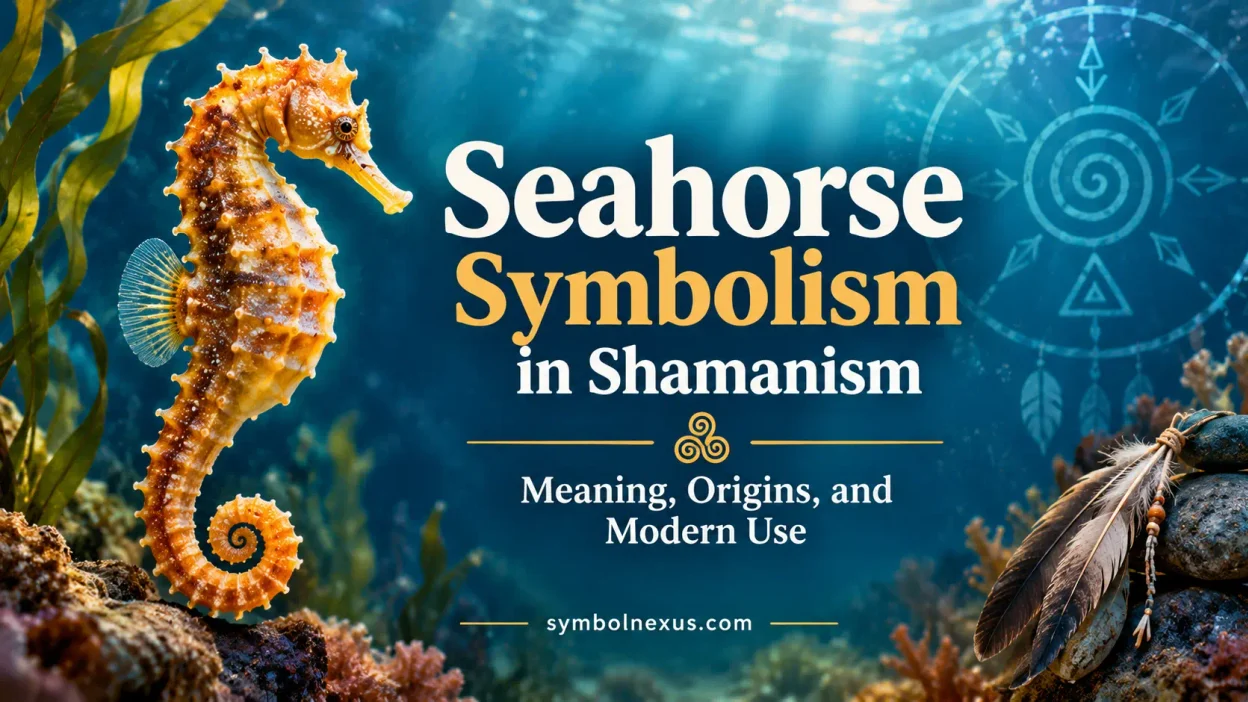
Seahorse symbolism in shamanism connects the small marine animal with themes such as adaptability, patience, emotional awareness, and the ability to move through uncertainty. In modern American spiritual writing, the seahorse may represent a guide through emotional change or a reminder to remain steady when life feels unpredictable. However, these interpretations vary, and there is no single seahorse meaning shared by every shamanic tradition.
The seahorse has several features that make it an appealing spiritual symbol. It moves slowly, grips underwater plants with its curled tail, and lives in environments where currents and changing conditions affect its survival. Male seahorses also carry developing young in a specialized pouch, a biological trait that has encouraged modern reflections on caregiving and unconventional expressions of parenthood.
Understanding this symbolism requires separating documented cultural history from contemporary spiritual interpretation. Ancient Mediterranean mythology featured the related mythical hippocampus, a creature with the front half of a horse and the tail of a fish. Modern spiritual practitioners may draw on this imagery, marine ecology, or personal experience when interpreting the real seahorse.
Quick Answer
Seahorse symbolism in shamanism commonly represents adaptability, patience, emotional balance, protection, and spiritual guidance in contemporary American spiritual interpretations. Its broader historical associations include the sea, mythological sea creatures, and journeys through unfamiliar waters, although no universal ancient shamanic meaning for the seahorse is established.
TL;DR
- Seahorses can symbolize patience, adaptability, and emotional steadiness.
- Modern spiritual interpretations often connect them with intuition and personal transformation.
- Ancient Mediterranean hippocamps linked horse imagery with sea gods and ocean journeys.
- Male pregnancy inspires contemporary associations with caregiving and nurturing.
- Seahorse imagery appears in American tattoos, jewelry, art, and coastal decor.
- Shamanic meanings vary by practitioner and should not be treated as universal Indigenous beliefs.
What the Seahorse Represents in Modern Spiritual Interpretations
In contemporary spirituality, the seahorse often represents the ability to remain grounded while navigating emotional or environmental change. Its unusual body, delicate movements, and dependence on sheltered marine habitats make it a useful image for reflecting on how people respond to difficult circumstances.
Adaptability is one common interpretation. A seahorse cannot overpower strong ocean currents, so it uses its tail to anchor itself to sea grass or other structures. As a metaphor, this behavior suggests recognizing circumstances that cannot be controlled and finding a stable position within them.
Patience is another association. Seahorses are not fast swimmers, and their movements contrast with the speed and force often associated with larger marine animals. Spiritually, this contrast can encourage a person to slow down, observe carefully, and avoid rushing a decision.
The seahorse may also suggest individuality. Its horse-like head, upright posture, and curled tail distinguish it from many other fish. Someone who feels different from the people around them might use the animal as a reminder that an unusual appearance or approach does not make them less capable.
These meanings are interpretations rather than fixed rules. A seahorse may symbolize calm for one person, parenthood for another, and ocean conservation for someone else.
How Seahorse Symbolism Connects With Shamanism
Shamanism is a broad term commonly used for diverse spiritual practices involving relationships with spirits, healing, ritual, altered states of consciousness, and connections between human communities and the natural world. Specific practices differ substantially across cultures, and some communities use their own names and concepts rather than the general term.
There is no reliable basis for claiming that every shamanic tradition assigns the seahorse a particular spiritual role. The animal is not established as a universal shamanic guide, and its modern associations with intuition or protection should not automatically be presented as ancient Indigenous teachings.
In contemporary spiritual settings, a practitioner may interpret the seahorse through observation, meditation, dreams, or a personal relationship with the ocean. Within that framework, its behavior can become a starting point for reflection. Holding on during a current, for example, might suggest maintaining personal boundaries during a period of change.
The distinction matters because spiritual symbolism can be meaningful without being historically universal. A personal interpretation can be described honestly as a modern spiritual reading rather than attributed to an entire culture without evidence.
The Historical Roots of Seahorse Imagery
The real seahorse and the mythical hippocampus have related names and appearances, but they are not the same creature. The biological seahorse is a fish belonging to the genus Hippocampus. The mythological hippocampus is a hybrid with the forequarters of a horse and the rear body of a fish.
In ancient Greek and later Roman imagery, hippocamps were associated with the sea and with deities such as Poseidon and Neptune. They appeared in artistic representations of marine processions and divine travel. This imagery connected the strength and movement of a horse with the unfamiliar world beneath the waves.
Later European artists continued to use hippocamps in decorative objects, sculpture, fountains, and maritime art. Their combination of land animal and sea creature offered a visual way to express the meeting of two environments.
This history helps explain why horse-like sea imagery can suggest movement between worlds or passage through uncertain waters in modern interpretation. It does not, however, prove that ancient Mediterranean people understood the real seahorse as a shamanic animal.
Water, Emotion, and the Unconscious
Water is a major source of meaning in contemporary spiritual and psychological interpretations. It can suggest life, change, emotional depth, renewal, and the parts of experience that are difficult to express in words. These associations vary by culture, religion, and personal experience.
Because seahorses live underwater, people may interpret them through this wider symbolism of water. A seahorse encountered in a dream, artwork, or meditation might prompt reflection on feelings that have been overlooked or situations that require greater sensitivity.
The seahorse’s small size and relatively gentle movements can also suggest approaching emotional problems without force. Rather than demanding an immediate answer, a person might take time to recognize what they feel and decide what deserves attention.
This is a symbolic approach, not a scientific claim that seahorses possess special access to the human unconscious. In practical terms, the image can serve as a reminder to listen carefully, notice emotional patterns, and respond thoughtfully instead of reacting automatically.
Patience, Stability, and Adaptability
The seahorse offers a useful contrast between stillness and movement. It may appear to drift with the water, but it can use its prehensile tail to hold on to underwater vegetation. This behavior creates a natural metaphor for flexibility without losing stability.
In everyday life, the interpretation can apply to changing jobs, family responsibilities, uncertain relationships, or major personal decisions. Adaptability does not necessarily mean accepting every circumstance. It can mean adjusting a strategy while protecting the values and boundaries that matter most.
The seahorse can also represent patience with processes that cannot be rushed. Recovery from disappointment, learning a skill, and rebuilding trust often require gradual effort rather than a single dramatic action.
For someone using the animal as a spiritual reminder, the central question might be: Where should I stay anchored, and where do I need to adjust? That question keeps the symbolism practical instead of turning it into a promise that difficulties will disappear.
Male Pregnancy and the Symbolism of Caregiving
One of the seahorse’s most distinctive biological features is its reproductive process. The female transfers eggs into the male’s brood pouch, where the male carries the developing young until they are ready to emerge.
This unusual arrangement has inspired contemporary associations with nurturing, shared responsibility, fatherhood, and challenges to traditional assumptions about gender roles. In American culture, the seahorse may therefore appeal to parents, caregivers, and people whose family experiences differ from familiar social expectations.
Its symbolism can extend beyond biological parenthood. The animal may represent taking responsibility for something vulnerable, supporting another person through a difficult stage, or recognizing care as an active form of strength.
These are modern interpretations drawn from observable biology, not proof that ancient spiritual traditions assigned the seahorse a universal meaning related to fatherhood. The distinction between a natural trait and a cultural interpretation makes the symbolism more accurate and useful.
Protection and Personal Boundaries
Seahorses are relatively small marine animals. Their bony external plates provide structure, while their ability to grasp vegetation helps them remain in suitable habitats. Their survival depends on more than force; it also involves concealment, positioning, and adaptation.
In spiritual reflection, these characteristics can represent protection through awareness rather than aggression. A person might associate the seahorse with choosing a safer environment, maintaining healthy boundaries, or recognizing when to withdraw from unnecessary conflict.
Protection does not have to mean avoiding every challenge. Sometimes it means understanding personal limits and conserving energy for what truly matters. The seahorse’s anchoring behavior offers a straightforward image for this kind of grounded response.
In contemporary spiritual art, the animal may appear alongside waves, shells, circles, or other ocean imagery. Such combinations can reinforce ideas of shelter and connection, although the meaning depends on the artist’s intentions and the viewer’s own associations.
Seahorse Symbolism in Dreams and Meditation
Dream interpretations are subjective, and a seahorse does not have one scientifically established meaning. Its significance in a dream may depend on the setting, the dreamer’s emotions, personal memories, and experiences with marine life.
A seahorse swimming calmly might suggest that the dreamer wants to approach a situation more patiently. One gripping a plant in rough water could bring to mind a need for stability during change. A seahorse appearing in a family setting might evoke care, responsibility, or a relationship that needs attention.
In meditation, someone may focus on the seahorse as an image of patience or flexibility. They might reflect on where they feel overwhelmed, what helps them remain steady, and whether their current approach needs adjustment.
These exercises can support personal reflection, but dreams should not be treated as certain predictions or unquestionable messages from a spirit. If a dream feels significant, its usefulness often lies in the questions it raises rather than in a fixed interpretation imposed from outside.
Seahorse Symbolism in the United States
In the United States, seahorse imagery is strongly associated with coastal life, aquariums, marine education, ocean conservation, and beach-inspired design. Its distinctive shape makes it recognizable in settings ranging from children’s illustrations to fine art and jewelry.
American interpretations often combine the animal’s real biological features with broader ideas about the sea. For some people, it suggests calm and an easygoing coastal lifestyle. For others, it represents ecological vulnerability, parenthood, individuality, or an interest in marine science.
Spiritual shops and contemporary wellness communities may also use the seahorse as a symbol of intuition, emotional balance, or personal guidance. These associations are best understood as current spiritual interpretations rather than as beliefs shared by all Americans or all Indigenous communities.
The following table summarizes common interpretations and their contexts.
| Context | Common symbolic meaning | Important distinction |
|---|---|---|
| Contemporary spirituality | Intuition, patience, emotional awareness | Meanings vary by practitioner |
| Shamanic-inspired practice | Personal guidance or connection with nature | Not a universal traditional teaching |
| Family and caregiving | Nurturing, fatherhood, shared responsibility | Inspired partly by male pregnancy |
| Coastal art and decor | Ocean life, calm, marine identity | Often decorative rather than spiritual |
| Conservation and education | Ecological vulnerability and biodiversity | Grounded in the animal’s real habitat needs |
Cross-Cultural Interpretations and Their Limits
The seahorse appears in different contexts around the world, but similar images do not necessarily carry identical meanings. Cultural history, language, religion, and local relationships with the ocean influence how an animal is understood.
In ancient Mediterranean art, the mythical hippocampus was linked with sea deities and marine travel. This is a documented mythological association, but it should not be confused with a universal spiritual belief about the biological seahorse.
In Chinese contexts, the term for seahorse, haima, has appeared in traditional medicine. Historical medicinal uses are not the same as symbolic beliefs, and they should not be interpreted as evidence of a shared shamanic meaning. Traditional medicinal claims also should not be treated as proof of modern clinical effectiveness.
Across modern global popular culture, seahorses can symbolize gentleness, uniqueness, ocean connection, or unconventional parenting. These interpretations may travel through art, tourism, social media, and contemporary spirituality, but they do not erase the differences among cultural traditions.
A respectful interpretation avoids treating every spiritual practice as interchangeable. When a specific community has a documented teaching about an animal, that teaching deserves its own context. When evidence is lacking, it is more accurate to describe the meaning as a personal or contemporary interpretation.
Why People Choose Seahorses for Tattoos and Jewelry
Seahorse tattoos and jewelry often combine visual appeal with personal significance. The animal’s curved body and curled tail create a distinctive design that works well in small pendants, fine-line tattoos, and detailed marine illustrations.
A person may choose a seahorse to mark a connection with the ocean, a coastal hometown, a memorable trip, or a loved one who enjoys marine life. Others may associate it with patience, caregiving, resilience, or a desire to live with greater flexibility.
Design details can influence the intended message. A seahorse surrounded by waves may emphasize an ocean connection, while one paired with a family name or date may commemorate a relationship. A simple outline may focus on individuality rather than any spiritual doctrine.
Colors can also affect personal interpretation. Blue and turquoise may evoke water and calm, while gold may suggest celebration or value. These associations are common design conventions, not universal rules.
For a tattoo intended to represent shamanism, it is worth considering whether the design reflects a personal spiritual practice or borrows imagery from a specific living culture. Clear intentions and accurate cultural context make the choice more thoughtful.
Common Misunderstandings About Seahorse Symbolism
One common misconception is that the seahorse has a single, ancient shamanic meaning. In reality, interpretations vary, and there is insufficient evidence to assign one meaning to all shamanic traditions.
Another mistake is confusing the real seahorse with the mythical hippocampus. Their resemblance explains some overlap in modern imagery, but their histories are different. The mythological creature’s role in Mediterranean stories does not establish a direct connection to Indigenous shamanic practices.
Some modern spiritual sources describe the seahorse as a universal spirit animal that guarantees protection, luck, healing, or success. Such statements go beyond what historical evidence can establish. They may express an individual’s beliefs, but they should not be presented as verified facts.
It is also misleading to assume that seeing a seahorse is automatically an omen. A real encounter, a picture, or a dream may feel meaningful to an individual, but the experience does not have one compulsory interpretation.
The most responsible approach is to separate documented history, observable biology, and personal spiritual meaning. Each can offer insight, but they answer different questions.
How to Interpret a Seahorse in Your Own Life
If a seahorse repeatedly catches your attention, begin with the context rather than assuming that it carries a predetermined message. Consider whether it appeared in a dream, a piece of art, a meaningful place, or an ordinary encounter with marine imagery.
Next, identify the qualities that stand out to you. You might notice its ability to anchor itself, its unusual appearance, its slow movement, or its reproductive role. Each feature can suggest a different question about your current circumstances.
For example, if you are dealing with uncertainty, the seahorse’s anchoring behavior might remind you to protect your stability while adapting to change. If you are taking care of someone, its association with male pregnancy might prompt reflection on shared responsibility and nurturing.
Finally, treat the interpretation as an invitation to think, not an instruction you must obey. A symbol is most useful when it helps you clarify your values, notice your feelings, or make a considered decision.
Seahorse Symbolism, Nature, and Conservation
The seahorse’s spiritual associations can also encourage greater attention to marine ecosystems. Seahorses depend on suitable habitats, including seagrass beds, mangroves, and coral environments, depending on the species. Habitat loss and collection for trade can place pressure on some populations.
When the animal represents balance or connection with nature, conservation provides a practical way to express that meaning. Learning about marine habitats, supporting responsible aquariums, and reducing pollution can turn admiration into informed action.
This perspective also offers an important correction to purely decorative interpretations. A seahorse is not simply a symbol on a pendant or a coastal motif; it is a living animal with specific ecological needs.
Respect for nature does not require believing that every animal carries a supernatural message. It can begin with curiosity, accurate knowledge, and a willingness to protect the environments that sustain life.
Frequently Asked Questions
What does a seahorse mean in shamanism?
In contemporary shamanic-inspired spirituality, the seahorse may represent patience, adaptability, emotional awareness, or guidance through change. There is no single documented meaning shared by all shamanic traditions, so interpretations should be connected to their specific cultural or personal context.
Is the seahorse considered a spirit animal?
Some modern spiritual practitioners use the term “spirit animal” for an animal they associate with personal qualities or guidance. The seahorse may represent calmness, individuality, or flexibility in that setting, but the concept should not be assumed to reflect every Indigenous tradition.
What does a seahorse symbolize spiritually?
Common contemporary interpretations include patience, protection, emotional balance, nurturing, and adaptability. The meaning depends on the person, the context, and the spiritual framework being used.
What does a seahorse tattoo symbolize?
A seahorse tattoo may express love for the ocean, personal resilience, caregiving, individuality, or a meaningful coastal connection. Its significance can become more specific through accompanying colors, names, dates, or other design elements.
Is a seahorse a symbol of protection?
It can symbolize protection in modern personal and spiritual interpretations, partly because seahorses anchor themselves to underwater vegetation. This is a metaphorical association, not evidence that seahorse imagery provides supernatural protection.
Why is the male seahorse associated with fatherhood?
Male seahorses carry developing young in a specialized brood pouch, a distinctive reproductive feature among animals. This has inspired contemporary associations with fatherhood, nurturing, and shared caregiving, although those meanings are cultural interpretations of a biological fact.
Does seeing a seahorse mean something is about to happen?
There is no reliable evidence that seeing a seahorse predicts a future event. You may choose to treat the encounter as a personal reminder to be patient, stay grounded, or pay attention to your relationship with nature.
Conclusion
Seahorse symbolism in shamanism is best understood as a combination of contemporary spiritual interpretation, personal reflection, marine biology, and the wider history of sea imagery. Patience, adaptability, emotional awareness, caregiving, and protection are common modern associations, but they do not form one universal teaching shared by every spiritual tradition.
The animal’s real behavior offers a grounded starting point for these meanings. Its ability to anchor itself, its unusual appearance, and the male’s role in carrying developing young all invite reflection on how people respond to change and care for others.
Whether a seahorse appears in a dream, a tattoo, a spiritual practice, or a piece of coastal art, its meaning becomes clearer when personal insight is balanced with cultural respect and an accurate understanding of the natural world.