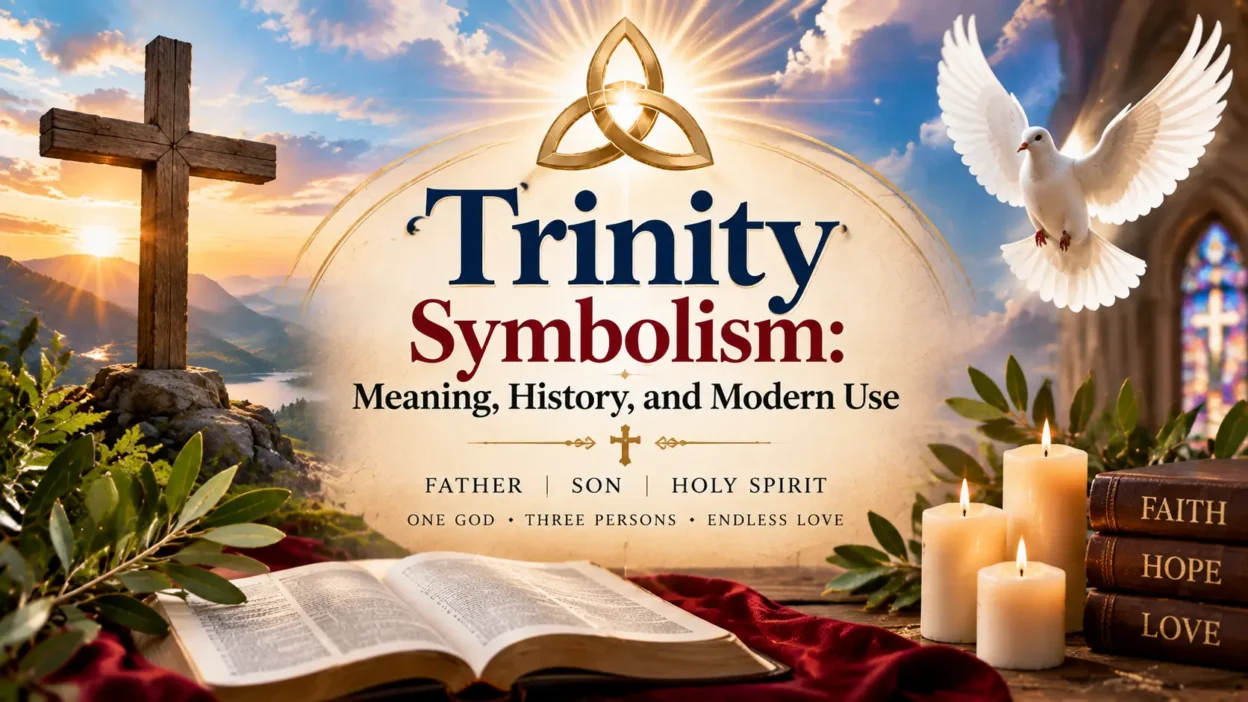
Trinity symbolism represents the idea of three connected parts forming a complete whole. In modern American culture, it is most commonly associated with the Christian belief in the Father, Son, and Holy Spirit, but the broader idea of three united elements appears in many traditions, philosophies, and cultural designs.
People encounter trinity symbols in churches, artwork, jewelry, tattoos, architecture, literature, and personal expressions of identity. The meaning can change depending on context, but the central idea often involves connection, balance, unity, and relationships between different parts.
Quick Answer
Trinity symbolism commonly represents the Christian concept of the Father, Son, and Holy Spirit in the United States, especially in religious art and traditions. Historically, three-part symbols have also represented unity, balance, and interconnected ideas across different cultures and belief systems.
TL;DR
- Trinity often represents three connected parts forming one whole.
- Christianity links it with Father, Son, and Holy Spirit.
- Three-part symbols appear across many ancient cultures.
- Americans use trinity designs in faith, art, and jewelry.
- Modern meanings include balance, unity, and personal identity.
What Does the Trinity Symbol Look Like?
The trinity symbol can appear in several forms depending on the tradition using it. The most recognized Christian representation is often the Trinity Knot, also called a Triquetra. This design features three interwoven loops that create a continuous shape without a clear beginning or end.
Another common representation is a triangle. Because a triangle has three sides connected into one structure, many people associate it with completeness and stability.
In Christian artwork, the Trinity may also appear through symbolic images rather than a single icon. Examples include three overlapping circles, three rays of light, or artistic depictions of God the Father, Jesus Christ, and the Holy Spirit.
The meaning depends heavily on where the symbol appears. A necklace worn as a personal faith reminder may communicate something different from a decorative pattern used in modern design.
What Does Trinity Symbolism Mean Today?
In the United States, trinity symbolism is primarily connected with Christianity. Many Christians use it as a visual reminder of the relationship between the three persons of the Trinity:
- The Father as the creator
- The Son as Jesus Christ and the source of salvation
- The Holy Spirit as God’s presence and guidance
Beyond religious settings, the idea of three connected parts has broader meanings. People may interpret it as representing:
- Family connections
- Mind, body, and spirit
- Past, present, and future
- Balance between different forces
- Unity among separate elements
The symbol often appeals to people because it communicates connection rather than isolation.
The Christian Origins of Trinity Symbolism
The Christian understanding of the Trinity developed from early debates about the nature of God. The concept describes one God existing in three persons: Father, Son, and Holy Spirit.
Early Christians used different images and explanations to express this belief. Over time, artists developed visual ways to represent the relationship between the three persons while maintaining the idea of one divine being.
The Trinity became especially important after early Christian councils clarified official teachings about the relationship between the Father, Son, and Holy Spirit.
Symbols helped communicate complex theological ideas to people who might not read religious texts. Visual representations became common in churches, manuscripts, paintings, and religious objects.
The Triquetra and Its Historical Development
The Triquetra is one of the most recognizable three-part symbols connected with the word trinity. It consists of three curved sections that overlap into one continuous design.
Although many people associate the Triquetra with Christianity today, the symbol existed before some Christian uses of it became widespread. Similar three-part designs appeared in earlier European artwork, including Celtic traditions.
Later Christian communities adopted the symbol because its three connected sections provided a visual way to express the Trinity.
However, historians caution that the exact meaning of ancient three-part symbols is not always clear. A symbol’s meaning often changes as different communities adopt and reinterpret it.
Trinity Symbolism in the United States
In the United States, trinity symbolism appears most often in Christian communities. Churches may display it in stained glass windows, crosses, artwork, and religious decorations.
It also appears in everyday personal items. Many Americans wear trinity necklaces, rings, or bracelets as expressions of faith, family connection, or personal values.
The symbol is also found in cultural spaces outside churches. Designers may use three-part patterns because they create visual balance and symmetry.
| Context | Meaning in the USA | Common Associations | Notes |
|---|---|---|---|
| Christianity | Father, Son, and Holy Spirit | Faith, worship, devotion | Most common interpretation |
| Jewelry | Personal beliefs or connections | Family, commitment, identity | Often worn privately |
| Tattoos | Personal meaning | Unity, spirituality, life stages | Meaning varies by person |
| Art and Design | Balance and structure | Harmony, creativity | Not always religious |
Three-Part Symbols Across Different Cultures
The idea of three connected elements is not limited to Christianity. Many cultures have used groups of three to organize important ideas.
In ancient philosophies, three-part systems often represented relationships between different aspects of life. Examples include connections between nature, humanity, and the spiritual world or divisions of time such as past, present, and future.
Some traditions use three because it creates a sense of completeness. A pair can represent connection between two things, while a third element can create a larger system.
However, similar shapes do not always share the same meaning. A three-part symbol in one culture may have a completely different interpretation in another.
Emotional and Psychological Meaning of the Trinity
People are often drawn to trinity symbols because they communicate connection and order. The human mind naturally looks for patterns, and groups of three often feel balanced and memorable.
A trinity symbol may represent:
- Relationships between important people
- Personal growth through different life stages
- Harmony between competing ideas
- A sense of wholeness
For some individuals, the symbol provides comfort because it represents that separate parts can exist together as one meaningful structure.
The emotional meaning usually comes from personal experience. A person wearing a trinity symbol may connect it with religion, family, personal transformation, or another important value.
Trinity Symbolism in Tattoos and Jewelry
Trinity designs are popular in tattoo culture because they are visually simple but allow many interpretations.
A person may choose a trinity tattoo to represent:
- Christian faith
- Family relationships
- Personal balance
- Important life changes
- Connection between three loved ones
Jewelry featuring trinity designs is also common. Rings, pendants, and bracelets often use the symbol because the continuous shape suggests lasting connection.
In modern fashion, some people choose the design because of its appearance without attaching a specific religious meaning to it.
Trinity Symbolism in Art, Architecture, and Design
Artists and architects have used three-part designs for centuries because they create visual balance.
In churches, trinity-related designs often appear in:
- Stained glass
- Altars
- Stone carvings
- Paintings
- Religious decorations
Outside religious spaces, designers use three-part patterns because they create symmetry and movement.
Modern graphic design often uses similar structures to communicate connection between products, ideas, or organizations. In these cases, the symbol may focus more on visual harmony than spiritual meaning.
The Meaning of Three in Symbolism
The number three carries symbolic importance in many societies. It often represents completion because it creates a beginning, middle, and end.
Examples of three-part concepts include:
- Birth, life, and death
- Past, present, and future
- Beginning, growth, and completion
- Body, mind, and spirit
This does not mean every group of three has the same meaning. The interpretation depends on the cultural and historical setting.
The popularity of three-part symbols comes partly from their ability to organize complicated ideas into a simple visual form.
Common Misunderstandings About Trinity Symbols
One common misunderstanding is assuming that every three-part symbol has the same religious meaning. While the Trinity is a central Christian concept, other cultures have used similar designs with different interpretations.
Another misunderstanding involves ancient symbols. People sometimes connect older symbols to modern meanings without strong historical evidence.
A symbol’s meaning is shaped by the community using it. Context, time period, and personal interpretation all influence what a symbol communicates.
How Trinity Meaning Has Changed Over Time
The meaning of trinity symbols has evolved as different groups adopted them. Early Christian communities used three-part imagery to explain religious beliefs. Later generations expanded its use into personal items, artwork, and cultural expressions.
Today, the symbol can communicate traditional faith or broader ideas about connection and balance.
Digital culture has also changed how people encounter symbols. Images once limited to churches or historical artwork now appear widely through social media, fashion, and online communities.
Positive and Negative Interpretations of Trinity Symbols
Most interpretations of trinity symbolism are positive, focusing on unity, faith, and connection.
However, symbols can sometimes be misunderstood when removed from their original context. A design may be associated with unrelated meanings depending on where it appears or who uses it.
Understanding the history behind a symbol helps separate its traditional meanings from later interpretations or assumptions.
Modern Uses of Trinity Symbolism
Today, people encounter trinity symbols in many areas of life, including:
- Religious celebrations
- Home decorations
- Personal accessories
- Tattoos
- Artwork
- Clothing designs
- Online profiles
For many Americans, the symbol remains connected to Christian faith. For others, it represents a personal idea of balance, relationships, or unity.
The meaning is often personal, shaped by individual beliefs and experiences.
Frequently Asked Questions
What does trinity symbolism represent?
Trinity symbolism most commonly represents the Christian belief in the Father, Son, and Holy Spirit. It can also represent unity, balance, and the relationship between three connected ideas.
Is the trinity symbol only Christian?
No. While the Trinity symbol is strongly connected with Christianity, three-part symbols have appeared in various cultures and traditions. Similar designs may have different meanings depending on their historical context.
What does a trinity tattoo symbolize?
A trinity tattoo may represent faith, family, personal growth, balance, or important relationships. The meaning depends on the person who chooses the design.
Why is the number three important in symbolism?
The number three is often associated with completeness because many systems naturally divide into three parts, such as beginning, middle, and end. Different cultures have created their own meanings around this pattern.
What is the difference between the Trinity and the Triquetra?
The Trinity refers to the Christian belief in the Father, Son, and Holy Spirit. The Triquetra is a three-loop design that became associated with the Trinity in some Christian traditions but has a broader history.
Do Americans use trinity symbols outside religion?
Yes. Some Americans use trinity designs in jewelry, tattoos, and artwork for personal reasons that may include family, balance, or identity rather than only religious beliefs.
Can trinity symbols have different meanings?
Yes. Symbols change meaning depending on culture, time period, and personal interpretation. The same design may communicate different ideas to different people.
Conclusion
Trinity symbolism represents the connection of three parts into one meaningful whole. In the United States, its strongest association remains the Christian Trinity of the Father, Son, and Holy Spirit, while its broader uses include ideas of unity, balance, and personal connection.
From religious artwork to modern tattoos and jewelry, the symbol continues to appear because it communicates relationships between separate elements. Understanding trinity symbolism requires looking at both its traditional roots and the many ways people interpret it today.


