
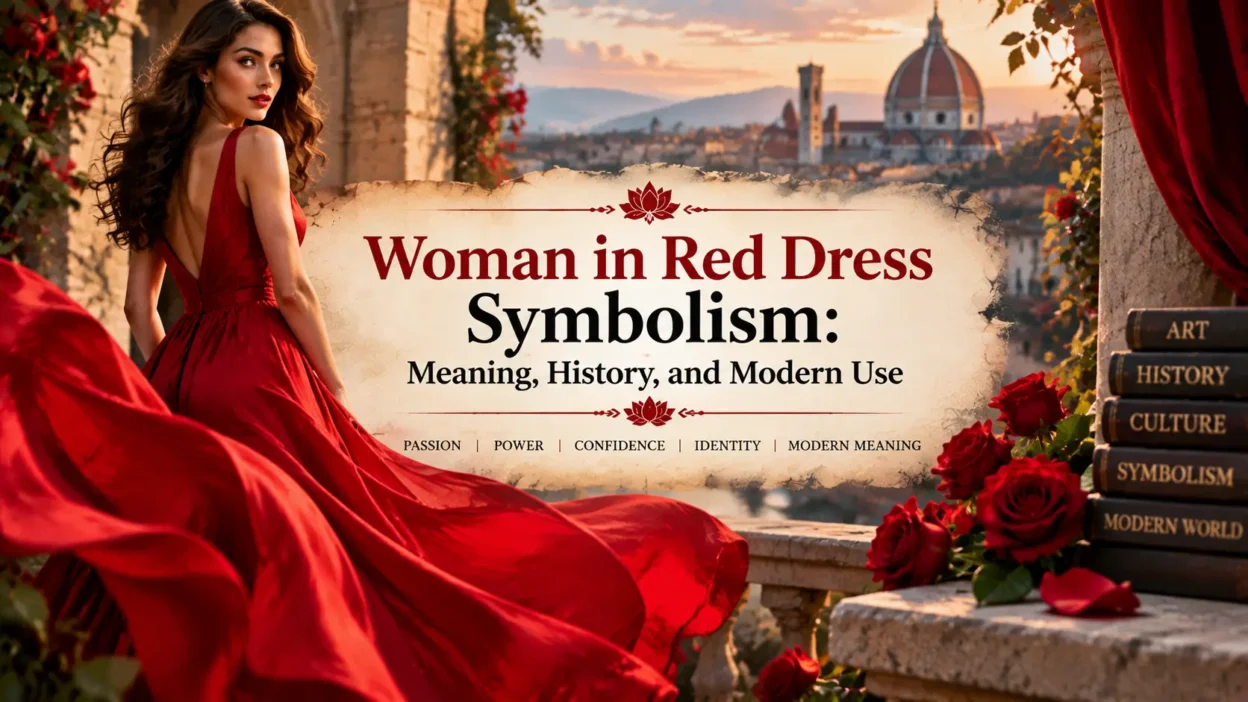
A woman in a red dress is a visual symbol often associated with confidence, attraction, individuality, and emotional expression. Woman in red dress symbolism appears in fashion, art, film, photography, literature, and cultural traditions because the color red naturally draws attention and carries different meanings across societies.
The image of a woman wearing red can suggest many ideas depending on the context. In modern American culture, it may represent self-assurance, celebration, romance, or personal style. In historical and artistic settings, it has also been connected with status, passion, courage, danger, and transformation.
Understanding this symbol requires looking beyond the color itself. The meaning comes from the relationship between the person, the clothing, the setting, and the cultural message being communicated.
Quick Answer
Woman in red dress symbolism commonly represents confidence, attraction, individuality, and emotional strength in modern American culture. Historically, red clothing has also been linked with status, passion, power, celebration, and important social roles.
TL;DR
- Red dresses often symbolize confidence and personal expression.
- Red clothing has historical links to wealth and status.
- American culture connects red dresses with romance and celebration.
- Fashion uses red to communicate visibility and identity.
- The symbol changes based on context and cultural setting.
What a Woman in a Red Dress Represents
The image of a woman wearing red is powerful because red is one of the most noticeable colors in human perception. A red dress can immediately become the central visual element in a scene, making the wearer appear bold or memorable.
In many modern interpretations, a woman in red represents:
| Context | Meaning in the USA | Common Associations | Notes |
|---|---|---|---|
| Fashion | Confidence and individuality | Style, elegance, attention | Often used for statement looks |
| Romance | Attraction and passion | Love, desire, celebration | Common in Valentine’s Day imagery |
| Entertainment | Strong personality | Confidence, drama, glamour | Frequently used in film and photography |
| Formal events | Celebration and sophistication | Beauty, confidence, luxury | Popular for evening wear |
| Personal identity | Self-expression | Independence, creativity | Depends on the wearer’s intention |
The symbol does not have one fixed meaning. A red dress can communicate confidence for one person and celebration or cultural tradition for another.
Why Red Has Strong Symbolic Meaning
Red has carried symbolic importance because it is connected to basic human experiences. It is associated with blood, fire, warmth, and energy, which are universal elements of human life.
Color psychology often links red with:
- excitement
- strength
- confidence
- urgency
- affection
- ambition
In fashion, red is considered a high-impact color because it attracts attention faster than many other colors. A person wearing red may appear more noticeable, expressive, or willing to stand out.
However, the meaning of red depends heavily on culture and situation. A red dress at a wedding, a political event, a stage performance, or a casual gathering may communicate different messages.
Historical Origins of Red Clothing Symbolism
The symbolic meaning of red clothing developed over thousands of years. In many ancient societies, producing bright red fabrics required rare dyes and specialized skills, making red garments expensive and socially important.
In ancient civilizations, red clothing often indicated:
- wealth
- authority
- social position
- religious importance
For example, certain red dyes were difficult to create, so people who could afford bright red clothing often belonged to wealthy or influential groups.
In European history, red garments appeared among royalty, military leaders, and religious figures. The color became connected with power because of its cost and visual impact.
Over time, red moved from being mainly a symbol of status to becoming a color associated with personal expression.
Red Dress Symbolism in American Culture
In the United States, a woman wearing a red dress is often viewed through the lens of fashion, entertainment, and personal identity.
American interpretations commonly include:
Confidence and Independence
A red dress can communicate that someone is comfortable being noticed. Many people choose red clothing when they want their appearance to feel memorable or expressive.
Romance and Attraction
Red is strongly connected with romantic imagery in American culture. Red roses, Valentine’s Day decorations, and romantic fashion often use the color because of its association with love and desire.
Celebration and Glamour
Red dresses frequently appear at:
- holiday parties
- award events
- weddings
- formal gatherings
- performances
In these settings, red often suggests excitement and elegance rather than rebellion.
Individual Style
Modern fashion has expanded the meaning of red clothing. A person wearing red may simply be expressing creativity, confidence, or personal taste.
The Role of Red Dresses in Fashion History
Fashion designers have used red dresses to create memorable visual statements. Unlike neutral colors that may blend into a background, red often becomes the focus of an outfit.
Throughout the 20th and 21st centuries, red dresses became associated with:
- Hollywood glamour
- evening fashion
- luxury design
- strong feminine style
The “woman in red” image appears frequently in photography and advertising because it creates immediate visual impact.
A red dress can communicate sophistication without requiring additional symbols or decoration.
Emotional and Psychological Meaning of the Symbol
The image of a woman in a red dress can create emotional reactions because color influences how people interpret visual information.
Common emotional associations include:
Confidence
Red is often connected with courage and self-assurance. Someone wearing red may appear comfortable expressing themselves.
Passion
Red has long been linked with intense emotions, including love and desire.
Strength
Because red is visually dominant, it can suggest determination and presence.
Attention
A red dress naturally attracts the eye, making the wearer appear more noticeable.
These interpretations are not universal rules. Personal experiences and cultural backgrounds influence how individuals understand the image.
Woman in Red Dress Symbolism in Art and Media
Artists and filmmakers often use red dresses as storytelling tools. A red dress can reveal something about a character without requiring dialogue.
In visual storytelling, red clothing may represent:
- a character’s confidence
- emotional change
- independence
- mystery
- importance within a scene
Filmmakers sometimes place a character in red to separate them from the surrounding environment. The color helps audiences focus on that person and consider their role in the story.
Photography also uses red dresses to create dramatic portraits because the color produces strong contrast and emotional impact.
Religious and Spiritual Associations of a Red Dress
Religious traditions do not share a universal interpretation of a woman wearing a red dress. Red itself, however, has acquired important meanings in several religious settings, and those associations can influence how red clothing is understood.
In Christianity, red can represent blood, sacrifice, martyrdom, divine love, and the fire associated with the Holy Spirit. These meanings belong primarily to the color rather than specifically to women’s dresses. A red dress should therefore not automatically be treated as a Christian symbol.
Biblical interpretation requires particular care. Modern popular culture sometimes associates women dressed in red with temptation or moral danger, but that stereotype should not be presented as a general biblical rule. Biblical passages involving scarlet use the color in several different contexts, so clothing, character, and narrative setting matter.
In religious art, red garments may instead communicate importance, sacrifice, authority, love, or spiritual intensity. The identity of the figure and the traditions surrounding the artwork provide more reliable clues than color alone.
Cross-Cultural Meanings of Women Wearing Red
Red does not communicate the same message everywhere. In some cultures, its strongest associations are celebration and good fortune rather than romance or seduction.
In Chinese culture, red has long been associated with happiness, prosperity, celebration, and favorable fortune. It appears prominently during major festivals and traditional wedding celebrations. Bridal red can therefore communicate joy and an auspicious beginning.
Red also has an important place in many South Asian wedding traditions. Brides may wear red or related shades in garments such as saris and lehengas. Depending on the community and ceremony, these colors can be associated with marriage, prosperity, fertility, celebration, and family tradition.
This differs noticeably from mainstream American bridal imagery, where white has historically dominated wedding fashion. A red bridal outfit that seems unconventional to one American viewer may be entirely traditional in another cultural setting.
That difference demonstrates a central principle of symbolism: context changes meaning.
Red Dresses in Weddings and Celebrations
A red dress can communicate very different ideas at a wedding depending on who wears it and where the ceremony takes place.
In mainstream American weddings, guests sometimes choose red simply because it is fashionable, festive, or appropriate for formal evening wear. There is no universal rule that assigns one symbolic meaning to every red dress worn by a guest.
In cultures where bridal red is traditional, the color carries a more established ceremonial role. It can mark the importance of marriage while expressing happiness, prosperity, and celebration.
Outside weddings, red clothing is also common at Christmas parties, Valentine’s Day events, dances, formal dinners, and other celebrations in the United States. Its visibility makes it especially suitable for occasions when people want their clothing to feel festive.
Why Red Became Closely Connected With Romance
The association between red and romantic love has several layers.
Red resembles the color of blood and is visually associated with physical intensity and warmth. Cultural traditions later reinforced those connections through red roses, hearts, Valentine’s Day imagery, cosmetics, fashion, advertising, and entertainment.
As these symbols became familiar, red developed a visual shorthand for romance in American popular culture.
A woman wearing a red dress may therefore be interpreted as romantic or attractive, particularly when the surrounding setting supports that reading. A red evening gown at a romantic dinner creates a different impression from the same color worn as an everyday summer dress.
This distinction matters. Red can contribute to a romantic message without defining the intentions or personality of the person wearing it.
Confidence, Visibility, and Personal Identity
One of the strongest contemporary meanings of a red dress is visibility.
A bright red garment can stand apart from neutral surroundings. Choosing it may therefore communicate a willingness to be seen rather than an attempt to disappear into a crowd.
For some wearers, that visibility becomes a form of confidence. The dress can represent a transition from feeling overlooked to feeling comfortable occupying space and expressing personal style.
This is why red clothing sometimes appears in stories about reinvention. A character who previously wore restrained colors may appear in red after becoming more independent or decisive.
Yet clothing symbolism should not become personality diagnosis. Someone can wear red simply because they enjoy the color. Symbolism describes cultural associations; it does not prove an individual’s motives.
The Woman in Red as a Film and Literary Device
Writers and filmmakers can turn clothing color into visual shorthand.
When most characters wear subdued colors and one woman appears in bright red, audiences notice her immediately. Directors and costume designers can use that contrast to direct attention without explicitly explaining why the character matters.
Depending on the story, a red dress may indicate:
- attraction
- confidence
- danger
- rebellion
- transformation
- celebration
- social visibility
The exact interpretation comes from the narrative.
For example, red worn during a character’s transformation might emphasize newfound confidence. In a thriller, the same color could contribute to tension. In a romance, it might strengthen themes of attraction.
This flexibility explains why the “woman in red” remains such an effective visual motif. The color attracts attention, while the story determines what that attention means.
Red Dress Symbolism in Tattoos and Personal Art
Some people use images of women in red dresses in tattoos, illustrations, posters, or other personal artwork. In these cases, the meaning is often more individual than traditional.
A tattoo featuring a woman in red might represent confidence, independence, beauty, passion, or an important memory. It could also depict a fictional character or someone meaningful to the wearer.
Additional details can change the interpretation dramatically. Roses may emphasize romance, flames can suggest danger or transformation, and a dancing figure might represent freedom or celebration.
Because there is no single standardized meaning for this tattoo design, personal context should take priority over generalized symbolism.
Modern Fashion and Social Media
Digital culture has made red clothing even more visually prominent.
On image-centered social platforms, red can stand out strongly against muted backgrounds. Fashion creators, photographers, performers, and brands may choose it because it produces an immediate focal point.
The red dress is especially common in:
- fashion photography
- formal-event posts
- romantic photo shoots
- holiday content
- music and performance imagery
- beauty campaigns
Its online popularity does not create a new universal symbolic definition. Instead, digital culture reinforces older associations with visibility, glamour, celebration, and confidence.
A red dress can consequently function both as clothing and as visual composition: it tells viewers where to look first.
Common Misunderstandings About a Woman in Red
One of the biggest mistakes is assuming that a woman wearing red must represent seduction.
That interpretation exists in Western popular culture, but it is only one possibility. Red can just as easily communicate celebration, cultural tradition, confidence, formal elegance, or personal preference.
Another mistake is treating every artistic use of red as a warning sign. Although red is commonly used for danger, alarms, and prohibition, that meaning does not automatically transfer to clothing.
It is also inaccurate to assume that red carries identical meanings around the world. Bridal traditions provide a clear counterexample: red may symbolize marriage and favorable fortune in settings where an American viewer might primarily associate it with romance.
Interpret the whole scene rather than relying on color alone.
Positive and Negative Meanings of the Red Dress
Red has an unusually broad symbolic range because many of its associations involve intensity.
Its positive meanings can include:
Confidence: willingness to be visible and expressive.
Love: romantic affection and emotional closeness.
Celebration: joy, festivity, and special occasions.
Courage: boldness and determination.
Individuality: choosing to stand apart visually.
Its more negative or cautionary meanings may include danger, aggression, temptation, jealousy, or conflict. These interpretations generally require support from the surrounding story or imagery.
This dual nature makes red useful in storytelling. The viewer recognizes that the color matters but must use context to decide why.
How the Meaning of the Red Dress Has Evolved
The symbolism surrounding red clothing has changed alongside technology, fashion, economics, and social expectations.
When strong red dyes were difficult or expensive to produce, vivid red garments could communicate wealth and social position. Improvements in textile manufacturing eventually made red clothing available to a much wider population.
Fashion and entertainment then expanded its associations.
Red became a familiar color for evening gowns, stage costumes, glamorous photography, romantic advertising, and statement clothing. By the modern era, wearing a red dress no longer required a specific social status or ceremonial purpose.
The meaning shifted toward personal choice.
Today, a red dress can be luxurious or inexpensive, ceremonial or casual, traditional or unconventional. What remains consistent is its ability to attract visual attention.
How to Interpret the Symbol in Context
A useful interpretation begins with the surrounding details rather than a predetermined definition.
Consider who is wearing the dress. A bride, performer, fictional villain, party guest, and fashion model occupy different symbolic settings.
Next, consider the occasion. A red dress at Valentine’s Day dinner naturally invites romantic associations, while traditional bridal clothing may point toward cultural celebration.
Then examine other visual elements. Lighting, flowers, facial expression, setting, jewelry, posture, and surrounding colors can all change the message.
Finally, consider cultural background. Meanings learned through American movies and advertising should not automatically be imposed on ceremonial clothing from another culture.
The dress provides one clue. The complete scene provides the meaning.
Why the Image Remains So Memorable
The woman in red remains recognizable partly because the symbol combines visual contrast with cultural associations.
Red is difficult to overlook. Fashion gives that color a human form, while cultural traditions supply possible meanings ranging from romance and confidence to celebration and warning.
That combination gives artists considerable flexibility. They can use a red dress to make someone appear central to a composition without explaining the character immediately.
Modern viewers may also bring their own associations to the image. One person may see glamour, another confidence, another romance, and another cultural celebration.
That openness is not a weakness in the symbol. It explains why the image works across so many different contexts.
Frequently Asked Questions
What does a woman wearing a red dress symbolize?
A woman wearing a red dress often symbolizes confidence, visibility, attraction, celebration, or personal expression in modern American culture. The exact meaning depends on the setting, cultural background, and intention of the wearer or artist.
Does a red dress always symbolize romance?
No. Romance is one common American association, but red clothing can also represent confidence, celebration, cultural tradition, status, or simply personal style. Context determines whether romance is relevant.
What does a red dress symbolize at a wedding?
The meaning depends heavily on cultural tradition. In some Chinese and South Asian wedding customs, red bridal clothing can be associated with celebration, prosperity, favorable fortune, or marriage, while an American wedding guest may wear red primarily as a fashion choice.
What does a woman in a red dress mean in a dream?
Dreams do not have scientifically established universal symbol dictionaries. A red dress in a dream may reflect the dreamer’s personal associations with attention, romance, confidence, danger, celebration, or a specific person, so the emotional context of the dream matters more than a fixed interpretation.
Is a woman in red a negative symbol?
Not inherently. Although stories sometimes connect women in red with danger or temptation, modern uses frequently emphasize confidence, glamour, romance, celebration, or individuality.
What does a red dress represent in art?
Artists may use a red dress to direct attention toward a figure or reinforce themes such as love, confidence, danger, transformation, or social importance. Composition and narrative context determine which interpretation fits.
Why are red dresses associated with confidence?
Red is visually prominent and difficult to ignore, so wearing it can make a person stand out in a crowd or image. Modern fashion culture has reinforced that visibility as an expression of boldness and self-assurance.
Conclusion
Woman in red dress symbolism centers on visibility, confidence, attraction, emotional intensity, celebration, and self-expression, but no single interpretation applies everywhere. Historical access to red dyes, cultural traditions, fashion, art, and popular entertainment have all contributed different layers of meaning.
In modern American culture, the red dress often functions as a statement of presence: it catches attention and can communicate confidence, glamour, romance, or individuality. Elsewhere, particularly in some wedding traditions, red clothing can carry established associations with celebration, prosperity, and marriage.
The most accurate interpretation therefore comes from combining color with context. A red dress tells viewers to notice the person wearing it; the surrounding culture, occasion, and story explain what that attention means.


