
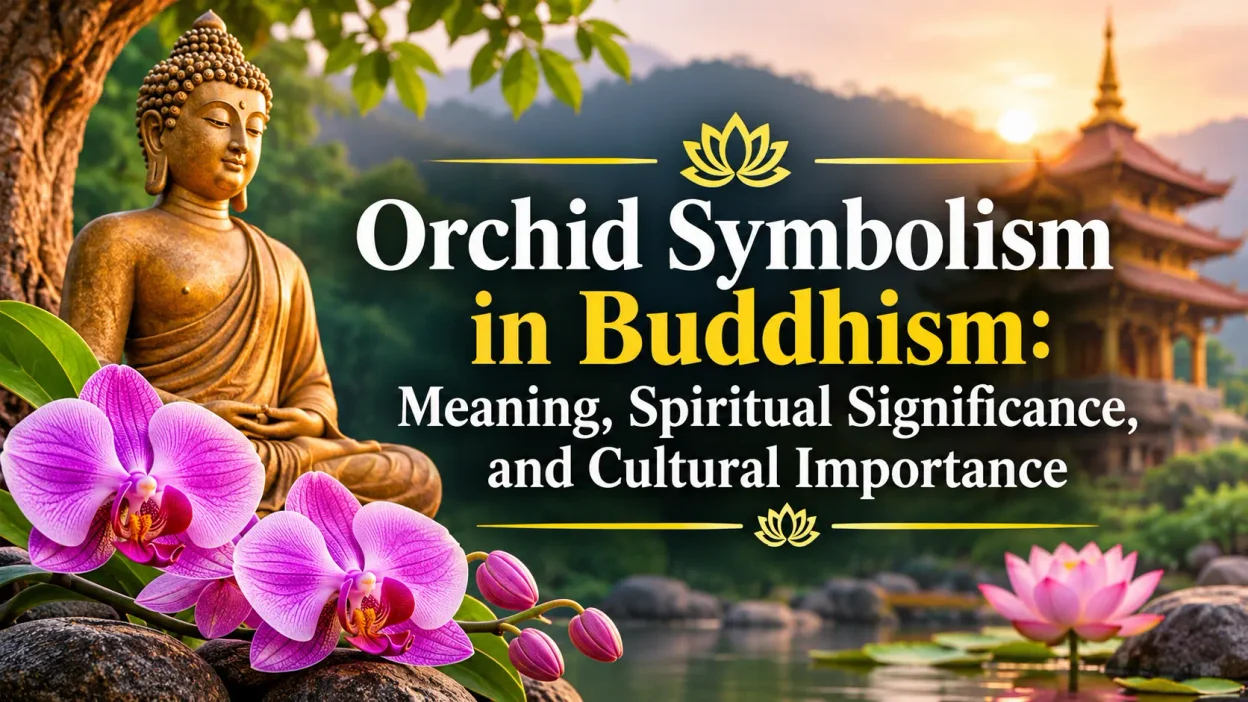
Orchids are admired for their delicate petals, graceful appearance, and ability to thrive in different environments. Across many cultures, these beautiful flowers have come to represent elegance, purity, strength, and spiritual development. In Buddhist-inspired interpretations, orchids can also serve as meaningful reminders of mindfulness, inner peace, compassion, and personal growth.
Although the lotus is the flower most directly associated with Buddhist teachings and enlightenment, orchids have their own place in the broader cultural and artistic traditions of Buddhist societies, particularly in East and Southeast Asia. Their beauty and resilience make them useful symbols for reflecting on the relationship between nature, simplicity, and spiritual awareness.
Understanding orchid symbolism in Buddhism requires distinguishing between established Buddhist teachings and broader cultural interpretations. Orchids are not universally recognized as a central Buddhist symbol, but their qualities can inspire reflections on important Buddhist values.
What Do Orchids Symbolize in Buddhism?
In Buddhist-inspired symbolism, orchids are commonly interpreted through ideas of purity, mindfulness, harmony, compassion, patience, and spiritual growth.
Their meanings can be understood through the qualities people associate with the flower:
- Purity: Their delicate appearance can represent the aspiration to develop a clear and peaceful mind.
- Mindfulness: Their intricate structure encourages appreciation of the present moment and the beauty of nature.
- Spiritual growth: Their development from a small plant into a flowering orchid can symbolize personal transformation.
- Harmony: Their graceful form can represent balance between the individual and the natural world.
- Patience: Their growth and flowering can remind people that meaningful development takes time.
- Compassion: Their beauty can inspire gentleness, appreciation, and kindness toward living things.
- Inner peace: Their calm and elegant appearance can serve as a reminder to cultivate mental stillness.
These are symbolic interpretations inspired by Buddhist values rather than a fixed list of meanings prescribed by Buddhist scripture.
1. Purity and Spiritual Clarity
Purity is an important theme in Buddhist philosophy. It often refers not simply to physical cleanliness but to the cultivation of a mind free from greed, hatred, and ignorance.
Orchids can symbolize this aspiration because of their delicate petals and refined appearance. Their beauty may remind observers to develop clarity, patience, and a thoughtful approach to life.
In a Buddhist-inspired interpretation, an orchid can represent the effort to move beyond negative thoughts and cultivate a more peaceful state of mind.
Spiritual lesson: True purity begins with the mind. Developing kindness, awareness, and understanding is more important than outward appearance.
2. Mindfulness and Awareness
Mindfulness is a central Buddhist practice involving awareness of the present moment without unnecessary judgment or distraction.
The intricate shapes, colors, and patterns of orchids can encourage people to pause and observe their surroundings carefully. Appreciating a flower’s details can become a simple opportunity to practice attention and gratitude.
An orchid may therefore symbolize the value of slowing down and noticing the present moment.
Spiritual lesson: Peace can begin with paying attention to ordinary experiences rather than constantly focusing on the past or future.
3. Spiritual Growth and Transformation
Orchids develop gradually, and their flowering often requires suitable conditions and patience. This natural process can be used as a metaphor for spiritual development.
In Buddhist-inspired symbolism, an orchid may represent the gradual cultivation of wisdom, compassion, and self-awareness.
Just as a plant needs appropriate care to grow, personal development requires consistent effort and thoughtful choices.
Spiritual lesson: Spiritual growth is a process. Small, repeated efforts can gradually lead to meaningful change.
4. Harmony and Balance
Buddhist teachings often emphasize balance, particularly through the Middle Way, which avoids the extremes of excessive indulgence and unnecessary self-denial.
The graceful appearance of an orchid can represent harmony and balance in modern symbolic interpretations. Its delicate flowers and strong ability to adapt to different environments also provide a useful image of balancing sensitivity with resilience.
Spiritual lesson: A balanced life involves caring for the mind and body while developing wisdom and compassion.
5. Compassion and Gentleness
Compassion, known in Buddhism as karuna, is the wish to relieve the suffering of others.
Orchids can symbolize gentleness because of their delicate appearance and the care often required to grow them. Their beauty may encourage people to approach themselves and others with patience and kindness.
This interpretation connects the flower with the broader Buddhist emphasis on compassion toward living beings.
Spiritual lesson: Kindness is an important part of spiritual development. Treating others with understanding can help reduce suffering.
6. Patience and Perseverance
Many orchid varieties require particular growing conditions and careful attention. Some take considerable time to flower, making them natural symbols of patience in broader floral symbolism.
This quality can be connected with Buddhist ideas about disciplined practice and gradual progress.
The path toward greater awareness and wisdom is not usually understood as an instant achievement. It involves repeated effort, reflection, and learning.
Spiritual lesson: Progress takes time. Patience and consistent practice are valuable parts of personal and spiritual development.
7. Inner Peace and Tranquility
Orchids are often used in gardens, meditation spaces, and decorative arrangements because of their elegant appearance.
In Buddhist-inspired settings, they can contribute to an atmosphere that encourages calmness and reflection. Their presence may remind people to create peaceful surroundings and cultivate a less distracted mind.
However, the flower itself is not considered a guaranteed source of spiritual energy or enlightenment.
Spiritual lesson: Inner peace develops through awareness, understanding, and the gradual release of unnecessary attachment.
Orchid Symbolism in Buddhist Culture
Buddhism has developed across many regions, including China, Japan, Korea, Thailand, and other parts of Asia. Each region has its own artistic and cultural traditions.
Orchids may appear in Buddhist-influenced gardens, paintings, temples, and decorative arrangements, but their meanings can differ depending on the cultural setting.
Orchids in Chinese Buddhist Culture
In Chinese culture, orchids have a long history as symbols of refinement, elegance, integrity, and noble character.
Traditional Chinese art and literature frequently use orchids to represent quiet virtue and inner dignity. These cultural associations can complement Buddhist values such as humility, self-discipline, and harmony.
However, these meanings belong primarily to broader Chinese cultural traditions rather than a specific universal Buddhist doctrine.
Orchids in Japanese Buddhist Settings
In Japan, orchids are appreciated for their beauty and are sometimes included in gardens and floral arrangements associated with temples and contemplative spaces.
Their presence can encourage appreciation of nature, simplicity, and the changing character of life.
These associations may overlap with Buddhist-inspired reflections on impermanence and mindfulness, although orchids are not a central symbol in Japanese Buddhist teachings.
Orchids in Southeast Asian Buddhist Traditions
Orchids grow naturally in many parts of Southeast Asia, where Buddhist traditions have a significant cultural presence.
They may be used as decorative flowers in homes, gardens, and religious or cultural settings. Their meanings depend on local customs and the context in which they are presented.
It is important not to assume that every orchid offering or decoration carries a specific Buddhist meaning.
Orchid vs. Lotus: Understanding Their Buddhist Symbolism
The orchid and lotus are both beautiful flowers, but their roles in Buddhist symbolism are different.
The lotus has a much stronger and more established connection with Buddhist teachings. It is widely associated with purity, awakening, and the possibility of rising above suffering.
Orchids, on the other hand, are more commonly connected with broader cultural ideas of elegance, refinement, harmony, and resilience.
| Symbolic theme | Orchid | Lotus |
|---|---|---|
| Purity | Cultural and modern spiritual interpretation | Strong traditional Buddhist association |
| Enlightenment | Indirect or personal interpretation | Established Buddhist symbolism |
| Mindfulness | Inspired by appreciation of nature | Connected with spiritual awakening |
| Resilience | Associated with adaptability and growth | Represents rising above difficult conditions |
| Elegance | Strong cultural association | Represents spiritual beauty and purity |
| Spiritual growth | Modern symbolic interpretation | Established Buddhist symbolism |
The lotus is the more appropriate choice when discussing a flower with a direct and widely recognized role in Buddhist teachings. Orchids offer a complementary way to reflect on qualities such as patience, harmony, and personal development.
Different Orchid Colors and Their Symbolic Meanings
Orchid colors have different meanings in floral traditions and modern symbolic interpretations. These associations are not universal Buddhist teachings.
White Orchid Symbolism
White orchids are commonly associated with purity, peace, sincerity, and spiritual clarity.
In a Buddhist-inspired interpretation, they may represent the aspiration to develop a calm and compassionate mind.
Purple Orchid Symbolism
Purple orchids are often connected with dignity, wisdom, admiration, and spiritual depth.
Their rich color can represent the value of knowledge, thoughtful reflection, and personal development.
Pink Orchid Symbolism
Pink orchids commonly symbolize affection, gentleness, gratitude, and compassion.
They can serve as reminders of kindness and the importance of caring relationships.
Yellow Orchid Symbolism
Yellow orchids are often associated with happiness, friendship, optimism, and new beginnings.
Their bright appearance can symbolize positive attitudes and appreciation for life’s opportunities.
Blue Orchid Symbolism
Blue orchids are often associated with rarity, calmness, mystery, and individuality.
In modern spiritual interpretations, they may represent peaceful reflection and the search for deeper understanding.
Red Orchid Symbolism
Red orchids are commonly connected with passion, strength, admiration, and courage.
They can symbolize determination and the energy required to overcome personal challenges.
Orchids and the Buddhist Concept of Impermanence
Impermanence, known as anicca in Buddhism, is the teaching that all conditioned things change.
Flowers provide a natural illustration of this idea. An orchid grows, blooms, and eventually fades. Its beauty is temporary, even when it is carefully maintained.
Observing this natural cycle can encourage reflection on the changing nature of life, relationships, emotions, and experiences.
In this sense, an orchid can become a personal reminder of impermanence.
Spiritual lesson: Appreciating beauty does not require trying to hold on to it forever. Recognizing change can encourage gratitude and a deeper understanding of life.
Using Orchids in Meditation and Mindfulness
Orchids can be used as simple visual reminders during personal reflection or meditation.
Their presence does not create enlightenment or replace Buddhist meditation practices. Instead, they can provide a natural focal point for developing attention and appreciation.
Here are a few ways to incorporate orchids into a mindfulness routine:
- Observe the flower: Notice its shape, color, texture, and natural details.
- Practice mindful breathing: Take slow, comfortable breaths while remaining aware of the present moment.
- Reflect on growth: Consider how patience and consistent effort support personal development.
- Appreciate impermanence: Remember that flowers change and eventually fade.
- Cultivate compassion: Use the moment to reflect on kindness toward yourself and other living beings.
These simple activities can make an orchid a meaningful part of a peaceful environment without assigning it supernatural powers.
What Does an Orchid Represent as a Buddhist Gift?
Giving an orchid can communicate appreciation, respect, admiration, and goodwill.
In a Buddhist-inspired context, the flower may also serve as a reminder of qualities such as patience, harmony, mindfulness, and compassion.
An orchid can be an appropriate gift for:
- Someone beginning a meditation or mindfulness practice.
- A person celebrating a new chapter in life.
- Someone who appreciates nature and traditional floral art.
- A friend or family member who values peace and personal growth.
- A person being honored for patience or dedication.
The meaning depends on the giver, recipient, and cultural context. An orchid should not automatically be interpreted as a religious offering or formal Buddhist symbol.
Frequently Asked Questions
1. What does an orchid symbolize in Buddhism?
In Buddhist-inspired interpretations, orchids can represent purity, mindfulness, harmony, compassion, patience, and spiritual growth. However, orchids are not a central or universally established symbol in Buddhist scripture.
2. Are orchids considered sacred in Buddhism?
Orchids may appear in Buddhist-influenced gardens and cultural settings, but they do not have the same widely recognized sacred status as the lotus. Their significance often comes from broader cultural traditions.
3. Is the orchid a symbol of enlightenment?
The orchid is not traditionally recognized as a primary Buddhist symbol of enlightenment. The lotus has a much stronger connection with awakening and spiritual purity. Orchids may represent personal growth in modern interpretations.
4. What does a white orchid mean in Buddhist symbolism?
A white orchid can represent purity, peace, sincerity, and spiritual clarity in modern Buddhist-inspired interpretations. These meanings are symbolic rather than formal Buddhist teachings.
5. What is the difference between orchid and lotus symbolism in Buddhism?
The lotus is an established Buddhist symbol associated with purity and enlightenment. Orchids are more commonly connected with cultural meanings such as elegance, refinement, patience, and harmony.
6. Do orchids represent mindfulness?
Orchids can serve as reminders of mindfulness because observing their natural details encourages attention to the present moment. This is a personal symbolic interpretation rather than a specific Buddhist doctrine.
7. What do orchids symbolize in Chinese Buddhist culture?
Orchids are associated with refinement, integrity, elegance, and noble character in broader Chinese cultural traditions. These qualities can complement Buddhist values, but they are not exclusively Buddhist meanings.
8. Can orchids be used during Buddhist meditation?
An orchid can be placed in a meditation space as a natural focal point or reminder of mindfulness. However, the flower is not required for meditation and does not replace established Buddhist practices.
9. Do orchids symbolize impermanence?
Orchids can be used as a reminder of impermanence because their flowers grow, bloom, and eventually fade. This natural cycle reflects the Buddhist understanding that changing conditions are part of life.
10. What does giving an orchid mean in a Buddhist-inspired setting?
Giving an orchid may express respect, appreciation, peace, and goodwill. Depending on the cultural context, it can also represent patience, harmony, and personal growth.
Conclusion
Orchid symbolism in Buddhism is best understood through a combination of broader Buddhist values and cultural floral traditions. Although orchids are not as directly associated with Buddhist teachings as the lotus, they can still inspire meaningful reflections on purity, mindfulness, compassion, patience, and harmony.
Their delicate beauty and gradual growth offer useful reminders of spiritual development and the importance of appreciating the present moment. Their changing flowers can also encourage reflection on impermanence, one of Buddhism’s central teachings.
Ultimately, orchids can serve as meaningful symbols of a thoughtful and balanced life. Their greatest spiritual value comes not from supernatural powers but from the lessons people choose to draw from nature.