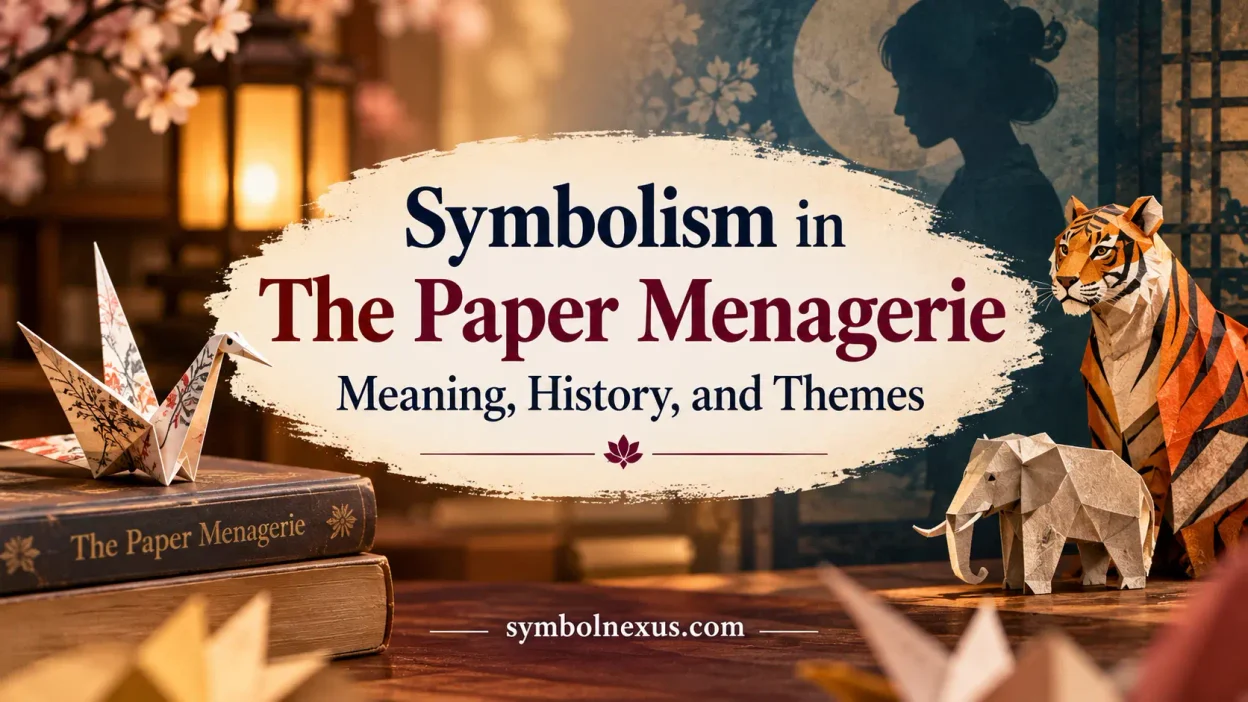
The symbolism in The Paper Menagerie centers on cultural identity, a mother’s love, family memory, and the painful cost of rejecting one’s heritage. Written by Ken Liu, the short story follows Jack, a Chinese American boy whose mother creates paper animals that appear to come alive. These handmade creatures begin as sources of childhood wonder, but their meaning changes as Jack grows older and struggles to fit into American society.
The story uses an unusual combination of origami, magical realism, and family history to explore a familiar experience: feeling pressured to hide part of yourself to gain acceptance. Jack’s relationship with his mother’s paper animals reflects his changing attitude toward his Chinese background and the language, traditions, and memories that connect him to her.
For American readers, the story also raises questions about assimilation, racism, immigration, and the meaning of belonging. Its symbols matter because they turn these broad issues into personal experiences that readers can understand through a family’s changing relationship.
Quick Answer: What Does Symbolism in The Paper Menagerie Mean?
Symbolism in The Paper Menagerie primarily represents cultural identity, maternal love, family memory, and the struggle between assimilation and belonging. The paper animals embody Jack’s connection to his Chinese heritage, while his rejection and eventual rediscovery of them reveal how prejudice, language barriers, and loss can shape a person’s understanding of family and identity.
TL;DR
- Paper animals represent Chinese heritage, maternal love, and intergenerational connection.
- Jack’s rejection of the animals reflects pressure to assimilate into American society.
- The paper tiger, Laohu, preserves his mother’s voice and family history.
- Language barriers show how cultural distance can weaken family relationships.
- The ending connects grief with renewed understanding and acceptance.
- The story challenges the idea that belonging requires abandoning one’s roots.
1. What the Paper Menagerie Represents
A menagerie is a collection of animals, traditionally kept for display or study. In Liu’s story, the term describes the collection of handmade paper creatures that Jack’s mother folds and animates through a fictional act of breathing life into them.
The animals are not ordinary toys. Each one connects Jack to his mother, her childhood in China, and a cultural tradition passed from one generation to another. Their movement gives an imaginative form to the emotional connection between mother and son.
The central symbol changes as Jack’s life changes. During childhood, the animals represent wonder, affection, and comfort. As he experiences prejudice and becomes ashamed of appearing different, they become reminders of a background he wants to conceal. Later, they help him recognize the value of the relationship and heritage he rejected.
This progression makes the paper menagerie more than a single symbol with one fixed meaning. It reflects the changing relationship between personal identity, family history, and social acceptance.
2. Paper Animals as Symbols of Chinese Heritage
Jack’s mother learned to fold the animals from her own mother in China. This detail connects the creatures to family tradition rather than presenting them as an isolated artistic hobby.
The animals carry cultural knowledge across generations. Even after Jack’s mother leaves China and builds a life in the United States, the folding tradition allows her to preserve a connection to the place and family she left behind. When she teaches Jack through the animals, she passes on more than a craft. She shares a piece of her childhood and cultural inheritance.
For Jack, however, this inheritance becomes complicated. He grows up in the United States and faces pressure to identify with the culture around him. Once classmates treat his mother’s creations as strange or inferior, he begins to view his heritage through their judgment.
His changing attitude shows how cultural identity can become a source of both pride and discomfort. The animals do not lose their cultural meaning when Jack rejects them. Instead, his rejection reveals how strongly social pressure can influence the way a person sees their own background.
3. The Paper Tiger Laohu and a Mother’s Love
Laohu, Jack’s paper tiger, is one of the story’s most important symbols. The tiger represents his mother’s affection, creativity, and continuing effort to maintain a bond with her son.
The creature’s name also connects it to Chinese language and culture. As a young boy, Jack accepts Laohu naturally. He enjoys the animal without worrying about what it might reveal about his family or how other people might judge it.
That changes as Jack grows older. His attempts to distance himself from Chinese culture turn Laohu from a treasured companion into an unwanted reminder of his difference. When he puts the animals away, he also pushes away the relationship they represent.
Laohu’s importance returns near the end of the story, when Jack discovers his mother’s letter associated with the paper tiger. The creature becomes a container for her personal history and her feelings about their relationship.
The tiger therefore links several stages of Jack’s life. It represents childhood affection, later estrangement, and the possibility of understanding his mother after her death.
4. Origami as a Symbol of Cultural Continuity
Origami is widely associated with Japanese paper-folding traditions, while paper folding and paper-cutting practices also exist in China and many other cultures. In Liu’s fictional story, the mother’s particular animal-folding tradition belongs to her family’s cultural background and childhood community.
This distinction matters because the story does not simply use paper animals as generic Asian decorations. It gives them a personal history: Jack’s maternal grandmother taught his mother, and his mother carries the practice into her new life in America.
The folded paper becomes a physical record of cultural continuity. The shapes may look small and fragile, but they preserve knowledge that might otherwise disappear from a family when its members move across countries or generations.
The story also shows that traditions survive through relationships. Jack’s mother cannot ensure that he will value her language or customs, but she can introduce him to them through a shared activity. Her animals offer a way to communicate affection before Jack fully understands the history behind them.
Origami thus represents the practical work of preserving culture: learning, making, teaching, and passing something on.
5. The Meaning of Paper: Fragility, Creativity, and Memory
Paper is an ordinary material, often inexpensive and easy to discard. In the story, however, it becomes the foundation of something irreplaceable.
Its fragility reflects the vulnerability of family relationships. A paper animal can be torn, crushed, or hidden away, just as a relationship can be damaged by shame, silence, and neglect. The material also suggests how easily a person’s cultural traditions can be dismissed when others do not understand their value.
Yet paper is not merely a sign of weakness. It can be folded into complex forms, repaired, and transformed. The mother’s ability to create living animals from ordinary paper shows how imagination and care can give new meaning to overlooked materials.
This contrast is central to the story’s emotional effect. What appears disposable to one person may carry years of memory for another. Jack initially fails to recognize the value of the animals because he judges them through the social attitudes he encounters.
The paper therefore represents both the vulnerability of cultural memory and the creativity that helps it survive.
6. Jack’s Rejection of the Animals and Assimilation
Assimilation occurs when people adopt aspects of a dominant culture, sometimes because they want to participate fully in society and sometimes because they feel pressure to abandon their original customs.
Jack’s experience illustrates the painful side of that process. After facing ridicule, he begins distancing himself from the Chinese language, food, and traditions associated with his mother. He wants to avoid being marked as different.
Putting the paper animals away gives this conflict a visible form. Instead of openly discussing his embarrassment or the prejudice he experiences, Jack hides the objects that connect him to his heritage.
His decision is not simply a rejection of toys. It reflects his belief that acceptance requires separating himself from the parts of his identity that others criticize. The more he tries to fit in, the more distance grows between him and his mother.
The story does not suggest that learning American customs or identifying as American is inherently harmful. Jack’s conflict arises because he treats cultural belonging as an either-or choice. He believes he must reject one part of himself to gain acceptance from others.
His experience reveals the emotional cost of that belief, particularly for children who grow up between cultures.
7. Racism and the Pressure to Fit In
The paper animals become a target when Jack’s peers compare them unfavorably with familiar commercial toys and insult the culture they represent. Their reaction exposes the difference between personal preference and prejudice.
A child may prefer an action figure to a handmade toy without making a statement about an entire culture. In Jack’s experience, however, the criticism moves beyond the objects themselves and becomes an attack on his family and background.
This social pressure shapes how he interprets his own heritage. Rather than recognizing the unfairness of the insults, he begins to associate his mother’s traditions with embarrassment. He tries to make his home life appear more acceptable to the people around him.
For readers in the United States, the episode connects the story to broader discussions of anti-Asian prejudice and the expectations placed on immigrant families. People can face pressure to change their names, suppress their languages, or minimize cultural practices to avoid standing out.
The story presents this pressure through Jack’s personal choices rather than through a political argument. His changing relationship with the animals shows how prejudice can affect a person’s private life long after a hurtful encounter ends.
8. Language as a Symbol of Connection and Separation
Language plays a central role in the distance between Jack and his mother. When he is young, Chinese is a natural part of their relationship. As he grows older, he becomes unwilling to speak it and increasingly critical of his mother’s English.
Their communication becomes strained not because they lack affection, but because Jack begins to treat his mother’s language as an obstacle to acceptance. He wants their household to conform to the expectations he associates with being American.
The language barrier also affects how Jack understands his mother’s life. He cannot fully access the memories and experiences she carries from China, and his impatience prevents him from asking questions that might help him understand her.
After her death, the letter she leaves becomes essential to his understanding of their shared history. Because Jack cannot read it himself, he must seek help from a Chinese-speaking stranger. This moment makes the separation between generations especially clear: the language his mother tried to preserve is the language he needs to understand her final message.
Language therefore symbolizes both inheritance and access. It can connect people to family history, but losing the ability or willingness to use it can make that history harder to reach.
9. The Shoebox as a Symbol of Suppressed Identity
When Jack hides the paper animals in a box, he tries to put his uncomfortable feelings about his heritage out of sight. The shoebox becomes a physical representation of emotional suppression.
Its ordinary appearance makes the gesture easy to overlook. A child putting toys away might seem insignificant, but the action carries greater meaning because Jack is deliberately separating himself from objects associated with his mother and Chinese background.
The box also suggests the limits of avoidance. Hiding a reminder does not erase the history behind it. Jack can prevent himself from seeing the animals, but he cannot change the circumstances of his birth, the identity of his mother, or the experiences that shaped their relationship.
As time passes, his distance from the animals becomes part of a larger pattern of estrangement. He stops engaging with the cultural traditions they represent, and his mother loses an important way of sharing her affection.
The shoebox thus symbolizes an attempt to control identity by concealing it. The story ultimately shows that meaningful reconciliation requires understanding what has been hidden rather than pretending it never existed.
10. The Mother’s Letter as a Symbol of Memory and Understanding
The letter connected to Laohu changes Jack’s understanding of his mother. Until this point, he has viewed much of their relationship through his own embarrassment and his desire to fit in. Her letter gives him access to the experiences that shaped her life before and after immigration.
Her history includes hardship, family loss, and the circumstances that brought her to the United States. These experiences help explain why Chinese language and family traditions matter so much to her. They are not arbitrary habits she refuses to change; they preserve connections to people and places that have shaped her identity.
The letter also reveals the emotional consequences of Jack’s rejection. His mother has experienced his silence and distance as a loss of connection, even while continuing to care for him.
The letter does not undo the harm between them, nor does it give Jack an opportunity to repair the relationship in person. Instead, it changes what he understands about their past.
Memory becomes a form of communication across a boundary that can no longer be crossed. Through the letter, Jack begins to see his mother as a person with her own history, rather than only as someone whose culture makes him feel different.
11. Death, Grief, and the Possibility of Reconciliation
The story’s emotional resolution depends on loss. Jack does not fully understand his mother’s experiences while she is alive, and her death makes that missed opportunity irreversible.
His grief is complicated by regret. He must confront not only the absence of someone he loved, but also the ways he withdrew from her when she was trying to maintain their bond. The paper animals become reminders of both affection and missed understanding.
When Jack reconnects with Laohu and reads the letter, he begins to approach his mother’s memory differently. Instead of treating the animals as embarrassing objects from childhood, he recognizes the care and cultural history they preserve.
The ending does not suggest that grief automatically heals every conflict. Jack’s recognition arrives after his mother can no longer respond, and his regret remains part of the story’s meaning.
What changes is his relationship to the past. He can no longer repair the years of estrangement, but he can acknowledge his mother’s humanity and choose not to reject the heritage she passed on to him.
12. Symbolism in The Paper Menagerie and the Chinese American Experience
The story’s symbols have particular significance within the Chinese American experience, although its themes can also speak to other immigrant communities.
Jack’s family represents a life shaped by movement between countries, languages, and cultural expectations. His mother carries memories of China into her American household, while Jack grows up surrounded by American institutions and social norms. Their different experiences influence what each person considers familiar, embarrassing, or worth preserving.
For second-generation Americans, cultural identity can involve competing pressures. Family members may expect children to retain language and traditions, while schools and peer groups may reward conformity to the dominant culture. Some children embrace their heritage, others distance themselves from it, and many move between those responses at different stages of life.
The story does not treat Chinese American identity as a single experience shared by everyone. Jack’s circumstances are specific to his family, and other people may respond to similar pressures differently.
Its broader point is that belonging should not require cultural erasure. A person can participate in American life while maintaining connections to family traditions, languages, and histories. The paper animals make that possibility visible through one family’s struggle to understand itself.
13. Cross-Cultural Meaning: Paper Animals, Family Traditions, and Ancestry
Paper folding appears in different cultural settings, and its meanings depend on the tradition and context in which it is practiced. Origami is strongly associated with Japan, while Chinese paper arts include folding, cutting, and other forms of decorative and ceremonial craft.
In many families, handmade objects carry meanings that extend beyond their physical form. A garment, recipe book, carved ornament, or piece of embroidery may preserve the memory of a relative or a place of origin. Such objects can help descendants maintain a connection to a history they did not experience directly.
Family traditions also differ in how they are passed down. Some are taught through formal instruction; others emerge through everyday activities, such as preparing food together or making toys for children. Their importance often becomes clearer when family members move away or when older generations are no longer present.
Liu’s story draws on this familiar role of cultural objects while adding a fantastical element: the paper creatures come alive. Their movement gives a visible form to the mother’s love and the persistence of cultural memory.
The story should not be taken as evidence that all Chinese families share the same traditions or that paper animals have one universal meaning. Their symbolism comes from the specific family history Liu creates.
14. How the Story’s Symbols Are Understood in Modern America
In contemporary American culture, The Paper Menagerie offers a way to discuss identity without reducing it to abstract ideas. Its objects, family relationships, and language conflicts give readers concrete examples of how cultural pressure can influence private choices.
The symbols can be understood in several related contexts:
| Symbol or detail | Meaning in the story | Broader American context |
|---|---|---|
| Paper animals | Chinese heritage and maternal love | Preserving family traditions |
| Laohu the tiger | A lasting bond with Jack’s mother | Objects that carry personal memories |
| The shoebox | Concealed identity and rejection | Pressure to hide cultural differences |
| The mother’s letter | Family history and belated understanding | Recovering stories across generations |
| Language barriers | Distance between mother and son | Challenges of intergenerational communication |
The story is especially relevant to conversations about multicultural identity. It questions the assumption that cultural adaptation must involve abandoning family history.
It also encourages readers to think about how they judge traditions they do not understand. An object that appears unusual or outdated to an outsider may hold considerable meaning for the person who made it.
For teachers, book clubs, and readers discussing Asian American literature, the story can open conversations about immigration, racism, memory, and the emotional consequences of assimilation. Its symbols invite discussion because their meanings develop through the characters’ decisions rather than through simple definitions.
15. Common Misunderstandings About the Story’s Symbolism
One common misunderstanding is that the paper animals represent only Chinese culture. They do symbolize Jack’s heritage, but they also represent his mother’s affection, family continuity, and the possibility of reconnecting after estrangement.
Another mistake is to treat the story as an argument against American identity. Jack’s struggle is not caused by being American. It emerges from the belief that he must reject his Chinese background to be accepted. The story allows for a more inclusive understanding of identity, in which cultural connections can coexist.
The paper animals should not be interpreted as a universal symbol of Chinese culture, either. Their meaning comes from the fictional family’s specific tradition and the emotional history attached to it. Different Chinese communities and families have their own customs and experiences.
Finally, the ending is not a simple promise that love erases regret. Jack gains a better understanding of his mother, but he cannot recover the time they lost. The story’s emotional force comes partly from that limitation.
Reading these distinctions carefully keeps the symbolism grounded in the story rather than turning it into a collection of broad cultural claims.
FAQ: Symbolism in The Paper Menagerie
What is the main symbol in The Paper Menagerie?
The paper animals are the story’s central symbol. They represent Jack’s Chinese heritage, his mother’s love, and the family connection he first accepts, later rejects, and eventually begins to understand.
What does Laohu the paper tiger symbolize?
Laohu represents the continuing bond between Jack and his mother. The tiger’s connection to her letter also makes it a symbol of family memory and the possibility of understanding someone after their death.
Why does Jack reject the paper animals?
Jack rejects the animals after experiencing social pressure and prejudice related to his Chinese background. He believes that hiding his mother’s cultural traditions will help him fit into American society.
What does the shoebox symbolize in the story?
The shoebox represents Jack’s attempt to conceal the part of his identity associated with his mother and Chinese heritage. It shows how hiding cultural reminders can reflect emotional distance rather than resolve an internal conflict.
How does language contribute to the symbolism?
Language represents both family connection and separation. Jack’s refusal to speak Chinese increases the distance between him and his mother, while his inability to read her letter after her death reveals how much cultural knowledge he has lost access to.
Is The Paper Menagerie about immigration or cultural identity?
It explores both through the relationship between an immigrant mother and her American-born son. Immigration shapes the mother’s memories and circumstances, while Jack’s struggle focuses on belonging, prejudice, and the pressure to assimilate.
What is the message of the story’s ending?
The ending suggests that understanding family history can change how people interpret their past. Jack cannot undo his estrangement from his mother, but he can recognize the love and cultural inheritance he previously dismissed.
Conclusion
The symbolism in The Paper Menagerie grows out of the changing relationship between Jack, his mother, and the paper animals she creates. The creatures represent Chinese heritage, maternal affection, cultural continuity, and the memories that remain even when family relationships become strained. The shoebox and the mother’s letter deepen these meanings by showing the consequences of rejection and the possibility of belated understanding.
For American readers, the story offers a grounded reflection on immigration, racism, and the pressure to fit in. It does not suggest that people must choose between their heritage and their place in society. Instead, it shows what can be lost when acceptance seems to require cultural erasure.
The paper animals endure as reminders that family traditions often carry stories larger than their physical form. Recognizing their value means recognizing the people, histories, and relationships that give them meaning.