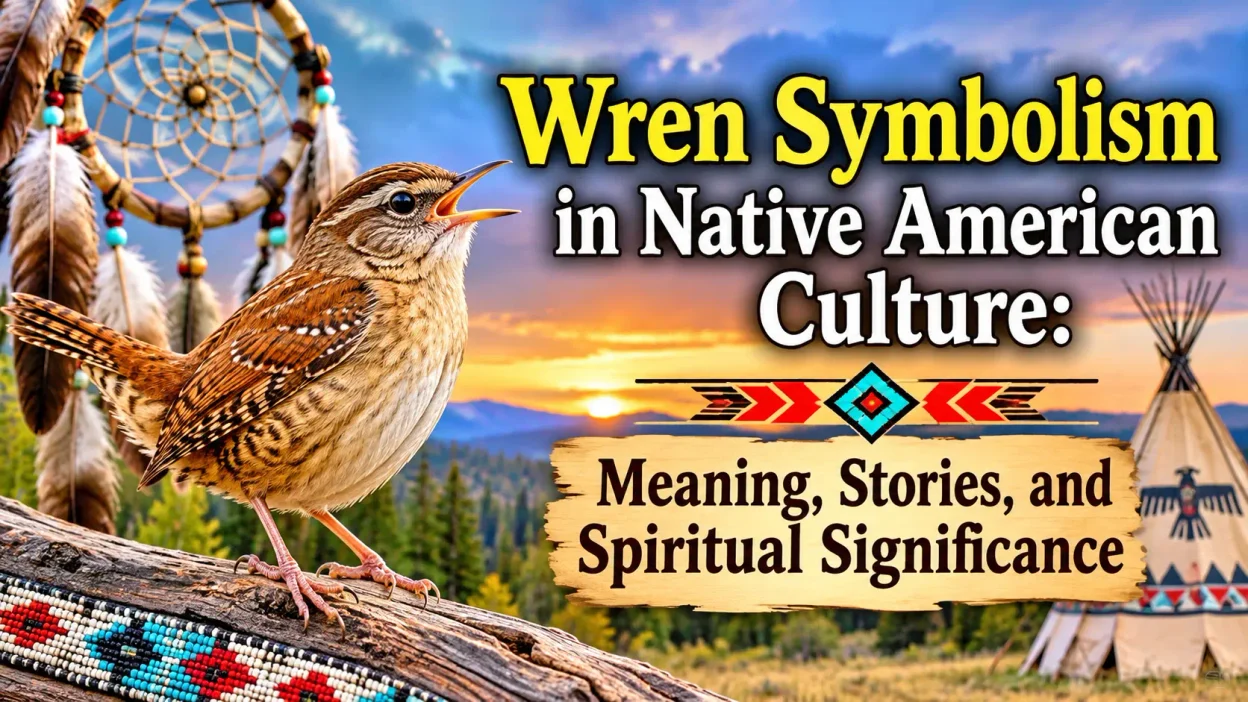
The wren is a small bird with a surprisingly powerful voice. Although it may appear ordinary because of its size and brown feathers, its behavior, alertness, and energetic song have made it a memorable figure in several Native American stories and cultural traditions.
Wren symbolism in Native American culture does not have one universal meaning. Different Indigenous nations have their own histories, languages, beliefs, and relationships with the natural world. In some traditions, the wren represents happiness and gratitude. In others, it is connected with courage, cleverness, mystery, or unusual spiritual power.
Pawnee storytelling offers an especially meaningful lesson about the wren’s joyful song, while certain Pueblo traditions connect particular wrens with warfare and ceremonial life. Seneca and other Indigenous stories also portray the bird as more mysterious and capable than its small appearance might suggest.
Understanding these traditions requires looking at individual stories rather than treating all Native American cultures as though they share the same beliefs. The wren’s symbolism becomes richer when its different cultural roles are considered in their own contexts.
Quick Answer: What Does a Wren Symbolize in Native American Culture?
In documented Native American stories and traditions, the wren can represent happiness, gratitude, courage, cleverness, mystery, and unexpected strength. A Pawnee teaching presents the tiny bird as an example of how even the smallest creature can express joy and thankfulness. Certain Pueblo traditions associate specific wrens with warfare and ceremonial roles, while Seneca storytelling gives the bird a mysterious, supernatural quality.
Its meaning depends on the Indigenous nation, the particular wren species, and the story in which it appears.
TL;DR: Wren Symbolism in Native American Culture
- Happiness: A Pawnee story uses the wren’s joyful song to teach that happiness is possible for everyone.
- Gratitude: The bird’s singing offers a lesson about appreciating life and expressing thankfulness.
- Courage: Some Pueblo traditions associate seeing a wren with increased courage, particularly for warriors.
- Cleverness: Indigenous animal stories sometimes portray the small wren as capable of overcoming larger or more powerful opponents.
- Mystery: A Seneca legend describes the wren as a bird with unusual abilities and a mysterious nature.
- Spiritual lessons: The wren can encourage people to recognize the value of seemingly insignificant creatures.
- Cultural diversity: There is no single wren meaning shared by every Native American nation.
1. The Cultural Importance of the Wren in Native American Traditions
Birds have important places in many Indigenous North American traditions. They may appear in creation stories, ceremonial practices, oral histories, and teachings about the relationship between humans and the natural world.
Their ability to move between the ground, trees, and sky can make them meaningful figures in stories about different parts of existence. Their calls and movements may also be observed as part of a community’s understanding of its environment.
The wren is an interesting example because it is small but active, alert, and remarkably vocal. Its behavior provides storytellers with opportunities to explore ideas such as intelligence, courage, happiness, and the unexpected abilities of modest creatures.
However, the cultural importance of the wren differs between communities. It would be inaccurate to suggest that every Indigenous nation considers the bird sacred or assigns it the same spiritual meaning.
Instead, particular stories reveal how individual communities have understood and represented this bird.
2. The Pawnee Wren: A Symbol of Happiness and Gratitude
One of the most memorable accounts of wren symbolism comes from a Pawnee story recorded by Alice C. Fletcher in Indian Story and Song from North America.
The story describes a priest walking outside in the early morning. He hears many birds singing, but one particularly clear and joyful song catches his attention. Following the sound, he discovers a tiny wren singing with remarkable enthusiasm.
The priest observes that the bird is among the smallest and least powerful of the creatures around it. Nevertheless, it seems especially happy and expresses its joy through its beautiful song.
He recognizes a lesson in the scene: even someone who appears insignificant can experience happiness and offer thanks for life.
The story became associated with a Pawnee ceremonial song of the wren.
This account gives the bird a meaningful symbolic role. Its importance does not come from physical strength, impressive appearance, or high status. Instead, its song demonstrates that happiness is not limited by size or circumstances.
The central lesson: A person does not need to be powerful or important in the eyes of others to find joy and express gratitude.
3. The Wren as a Symbol of Gratitude
The Pawnee story makes gratitude one of the clearest themes associated with the wren in the documented material.
The bird does not wait for a special occasion to sing. It expresses its apparent happiness simply by being alive and responding to the morning.
This provides a lesson about recognizing the value of ordinary experiences.
In a symbolic interpretation, the wren’s song can remind people to appreciate:
- The beginning of a new day.
- The beauty of the natural world.
- Small moments of happiness.
- The support of family and community.
- Opportunities to learn and grow.
The story does not suggest that every person must feel happy all the time. Rather, it presents the wren as an example of how even a small creature can express joy.
Its symbolism can therefore encourage a more appreciative attitude toward everyday life.
4. Pueblo Wren Symbolism: Courage and Warfare
Some Pueblo traditions give particular wrens a very different symbolic role.
According to accounts of Pueblo bird traditions, the wren may be associated with warfare, courage, and ceremonial responsibilities. These associations are especially connected with specific species rather than every bird commonly called a wren.
One reported belief holds that seeing a wren can increase a person’s courage, particularly for a warrior. In this context, the bird becomes associated with confidence and the ability to face danger.
The Hopi war kachina Tuposkwa, also spelled Turposkwa in some accounts, is associated with a canyon wren.
This connection is important because it shows that the wren’s cultural meaning is not limited to happiness and gratitude. Depending on the community and species, the bird can also have a role connected with bravery and ceremonial life.
It is important not to turn these specific traditions into a general claim about all Pueblo communities. Pueblo peoples include distinct communities with their own histories and ceremonial practices.
5. Canyon Wren Symbolism: The Power of a Strong Voice
The canyon wren is known for its distinctive song, which can echo through rocky landscapes and canyon walls.
In accounts of Pueblo traditions, this bird has been associated with ceremonial roles and communication. Some descriptions connect its loud, clear call with the responsibility of announcing important information.
This makes the canyon wren an interesting symbol of voice and communication.
Its song can inspire broader reflections about:
- Speaking clearly when something matters.
- Sharing important information.
- Making one’s presence known.
- Communicating with confidence.
- Using one’s abilities to contribute to a community.
These are modern symbolic interpretations inspired by the bird’s behavior and reported cultural associations. They should not be mistaken for a single traditional belief shared by all Pueblo peoples.
6. The Wren as a Symbol of Courage Despite Small Size
A wren is physically small compared with many other birds. Yet its energetic behavior and strong voice can make it seem much more impressive than its size suggests.
This contrast is useful in understanding why the bird appears in stories about unexpected strength.
In certain Native American traditions, the wren’s connection with courage suggests that physical size does not necessarily determine a creature’s importance or abilities.
The bird can inspire people to:
- Face challenges even when they feel unprepared.
- Trust their abilities.
- Avoid judging others by appearance.
- Stand firm during difficult situations.
- Recognize that courage can come from unexpected places.
The wren’s symbolism is especially meaningful when courage is understood as determination rather than physical power.
7. Seneca Wren Legend: Mystery and Unusual Powers
A Seneca story titled “The Wren” presents the bird as a mysterious creature with unusual abilities.
In the story, a boy is warned not to shoot wrens because they are difficult to hit and mysterious in their ways. Despite the warning, he attempts to shoot one.
The bird repeatedly avoids his arrows. Eventually, one arrow appears to graze its head, and the wren flies away.
When the boy approaches the place where the bird disappeared, he discovers what seems to be an injured man. The story reveals that the wren has transformed itself into a human figure to escape capture.
The account explains the traditional name given to the bird in the story: “the bird without a scalp.”
This legend presents the wren as more than an ordinary animal. It becomes a figure associated with mystery, transformation, and abilities beyond human expectations.
The story also communicates a warning about underestimating creatures whose true nature may not be immediately visible.
8. The Wren as a Symbol of Cleverness and Intelligence
Small animals frequently play important roles in Indigenous storytelling because their intelligence can challenge assumptions about physical strength.
Some North American Indigenous animal stories portray the wren as clever enough to defeat larger opponents through planning rather than force.
A Stillaguamish story collected in Nels Bruseth’s Indian Stories and Legends of the Stillaguamish and Allied Tribes describes a wren competing with a water ouzel, also known as a dipper.
The larger bird repeatedly challenges the wren to a wrestling contest. The wren eventually agrees but secretly prepares a clever plan involving hot coals hidden beneath ashes.
When the contest begins, the larger bird is caught by the wren’s strategy and loses the encounter.
The story illustrates how intelligence and preparation can overcome an opponent who depends too heavily on apparent strength.
As a symbolic interpretation, the wren can represent:
- Strategic thinking.
- Resourcefulness.
- Patience.
- Awareness of one’s surroundings.
- The ability to solve problems creatively.
The lesson is not simply that being clever means defeating others. It also highlights the importance of thinking carefully before acting.
9. The Wren and the Lesson of Humility
Another meaningful interpretation of the wren’s role in Indigenous storytelling is humility.
The bird is small and does not appear especially powerful. Nevertheless, it can become the central figure in a story with an important lesson.
The Pawnee account demonstrates this particularly well. The wren does not need to compete with larger birds to prove its worth. Its song is meaningful because of the happiness it expresses.
The Seneca legend offers a related but different lesson: a person should not assume that a small creature is powerless or ordinary.
Together, these stories can encourage people to reconsider how they judge others.
The wren may therefore inspire humility by reminding us that:
- Greatness does not always look impressive.
- Every creature has its own abilities.
- Appearances can be misleading.
- Small contributions can have meaningful effects.
- Respect should not depend entirely on size or status.
10. Wren Symbolism and the Natural World
The wren’s symbolism is closely connected to its natural behavior.
Wrens are active birds that frequently move through vegetation, search for insects, and use their voices to communicate. Their energetic movements and distinctive calls make them noticeable even when their bodies are difficult to see.
These characteristics provide a natural foundation for symbolic interpretations.
| Natural characteristic | Possible symbolic interpretation |
|---|---|
| Small body | Humility and unexpected strength |
| Strong song | Happiness and communication |
| Quick movements | Alertness and adaptability |
| Active behavior | Energy and determination |
| Hidden or difficult-to-see presence | Mystery and awareness |
| Persistent calling | Confidence and expression |
These interpretations are not all traditional Native American teachings. They are broader symbolic readings of the bird’s observable characteristics.
Keeping this distinction clear helps readers appreciate cultural stories without presenting modern interpretations as historical facts.
11. Wren Symbolism in Native American Spiritual Interpretations
The wren’s place in particular Indigenous stories can inspire several spiritual reflections.
However, there is no single Native American wren spirit-animal tradition that applies to all nations. Modern spiritual interpretations should be distinguished from specific Indigenous teachings and ceremonies.
Some meaningful reflections inspired by the documented stories include:
Appreciating life: The Pawnee account encourages people to recognize happiness in ordinary experiences.
Respecting small creatures: The wren’s role in several stories shows why appearances should not determine how a creature is valued.
Finding courage: Certain Pueblo associations connect particular wrens with bravery and warfare.
Recognizing hidden abilities: The Seneca legend presents the bird as mysterious and capable of unexpected transformation.
Using intelligence: Stories about the wren overcoming larger opponents highlight the importance of resourcefulness.
Together, these themes make the wren a meaningful subject for reflection on gratitude, courage, humility, and awareness.
12. Wren Symbolism Compared with Other Native American Bird Traditions
Different birds have different roles in Indigenous North American storytelling. The wren should be understood within this wider variety rather than assigned meanings borrowed from unrelated bird traditions.
| Bird | Commonly documented cultural themes in selected traditions |
|---|---|
| Wren | Happiness, gratitude, courage, mystery, and cleverness |
| Raven | Creation, transformation, and trickster stories in some Northwest Coast traditions |
| Eagle | Power, spiritual significance, and ceremonial importance in various Indigenous cultures |
| Owl | Knowledge, mystery, or associations with the night, depending on the nation |
| Thunderbird | Powerful supernatural being associated with storms in several Indigenous traditions |
These are broad summaries, not universal definitions. Each bird’s meaning depends on the specific nation, story, and cultural context.
The wren stands out in the Pawnee account because its importance comes from its joyful song rather than physical power.
13. What Does Seeing a Wren Mean in a Modern Spiritual Context?
Some modern spiritual traditions interpret seeing a wren as a reminder to appreciate life, express oneself, and remain courageous during difficult situations.
These interpretations can be inspired by the bird’s natural behavior and by selected historical stories.
For example, someone who sees a wren singing in the morning might take the experience as an opportunity to reflect on gratitude and the simple pleasures of everyday life.
A wren appearing during a difficult period might inspire thoughts about courage and persistence.
However, there is no reliable basis for claiming that all Native American nations interpret a wren sighting as a particular omen or prediction.
It is more respectful to describe these ideas as modern personal interpretations rather than traditional Indigenous beliefs.
14. What the Wren Teaches About Community and Everyday Life
The Pawnee wren story offers a lesson that can extend beyond individual happiness.
The bird’s song becomes meaningful because someone takes the time to listen and learn from it. The priest recognizes that even a small creature can offer something valuable to the wider world.
This can inspire reflections about the importance of every member of a community.
A person’s contribution does not need to be large or impressive to matter. A kind word, a small act of support, or a moment of encouragement can improve someone else’s day.
The wren can therefore serve as a reminder to:
- Listen carefully to others.
- Appreciate contributions that might go unnoticed.
- Share happiness with the people around you.
- Respect the natural world.
- Recognize value beyond outward appearances.
These are contemporary lessons drawn from the story, not claims that every Indigenous community teaches the same interpretation.
15. Positive and Cautionary Meanings of the Wren
The wren appears in stories with different tones and lessons. Some accounts emphasize joy and gratitude, while others highlight mystery, danger, or the consequences of underestimating a creature.
| Positive meanings | Cautionary or challenging themes |
|---|---|
| Happiness | Hidden danger |
| Gratitude | Uncertainty |
| Courage | Fear of the unknown |
| Intelligence | Overconfidence |
| Humility | Misjudging appearances |
| Resourcefulness | The consequences of careless actions |
The Seneca legend, for example, encourages caution toward a creature whose abilities are not easily understood. The Pawnee story, on the other hand, emphasizes happiness and thankfulness.
These different roles show that the wren is not limited to one symbolic meaning.
16. Lessons We Can Learn from Wren Symbolism in Native American Culture
The documented stories about the wren offer several valuable lessons for modern readers.
1. Happiness is not determined by status. The Pawnee story shows that even the smallest creature can express joy.
2. Gratitude can begin with ordinary experiences. The wren’s morning song encourages appreciation for life.
3. Courage does not depend on size. Particular Pueblo traditions connect the bird with bravery.
4. Intelligence can overcome physical limitations. Stories featuring the wren and larger opponents highlight the value of clever thinking.
5. Appearances can be misleading. The Seneca legend portrays the wren as a mysterious creature with unexpected abilities.
6. Every creature deserves respect. The bird’s role in these stories encourages people to look beyond outward appearance.
The most important lesson is that something small can have a meaningful presence in the world.
Frequently Asked Questions
1. What does the wren symbolize in Native American culture?
The wren has different meanings in different Indigenous traditions. Documented stories associate it with happiness, gratitude, courage, cleverness, and mystery. The Pawnee story particularly emphasizes joy and thankfulness.
2. What does the wren mean in Pawnee culture?
A Pawnee story recorded by Alice C. Fletcher presents the wren as an example of happiness and gratitude. Although it is a small and seemingly insignificant bird, its joyful song teaches that everyone can experience happiness and express thanks.
3. Is the wren a sacred bird in Native American culture?
There is no single answer for all Native American nations. Certain traditions give particular wrens ceremonial or symbolic importance, but it would be inaccurate to describe the bird as universally sacred across Indigenous cultures.
4. Why is the wren associated with courage in some Pueblo traditions?
Some accounts of Pueblo traditions describe the wren as a bird connected with warfare and bravery. Seeing one was reportedly considered encouraging for a warrior. These associations are specific to certain traditions and should not be generalized to every Pueblo community.
5. What does the Seneca legend say about the wren?
The Seneca story portrays the wren as a mysterious creature that can transform into a human figure. It emphasizes the bird’s unusual nature and warns against assuming that a small creature is powerless.
6. Does the wren symbolize intelligence?
In some Indigenous animal stories, the wren is portrayed as clever and resourceful. A Stillaguamish story describes it overcoming a larger bird through planning and strategy rather than physical strength.
7. What is the spiritual meaning of hearing a wren sing?
In a modern personal interpretation, hearing a wren sing may inspire thoughts about gratitude, happiness, communication, and appreciation for everyday life. The Pawnee wren story offers a historical example of the bird’s song being used to communicate a lesson about joy.
8. Do all Native American tribes believe the wren has the same meaning?
No. Indigenous North American nations have distinct cultural traditions and stories. The wren may represent happiness in one account, courage in another, and mystery or cleverness in others. Its meaning should always be understood within its specific cultural context.
Conclusion
Wren symbolism in Native American culture reveals how a small bird can carry meaningful lessons about happiness, gratitude, courage, intelligence, and mystery.
The Pawnee story of the wren offers one of the clearest teachings: even the smallest creature can express joy and remind others to appreciate life. Certain Pueblo traditions connect particular wrens with courage and ceremonial roles, while Seneca and Stillaguamish stories reveal the bird’s mysterious and clever qualities.
These accounts should not be combined into a single belief shared by all Indigenous nations. Each story belongs to its own cultural setting and deserves to be understood with care.
Ultimately, the wren reminds readers that importance is not measured by size or outward appearance. Sometimes the smallest voice can communicate one of life’s most meaningful lessons.