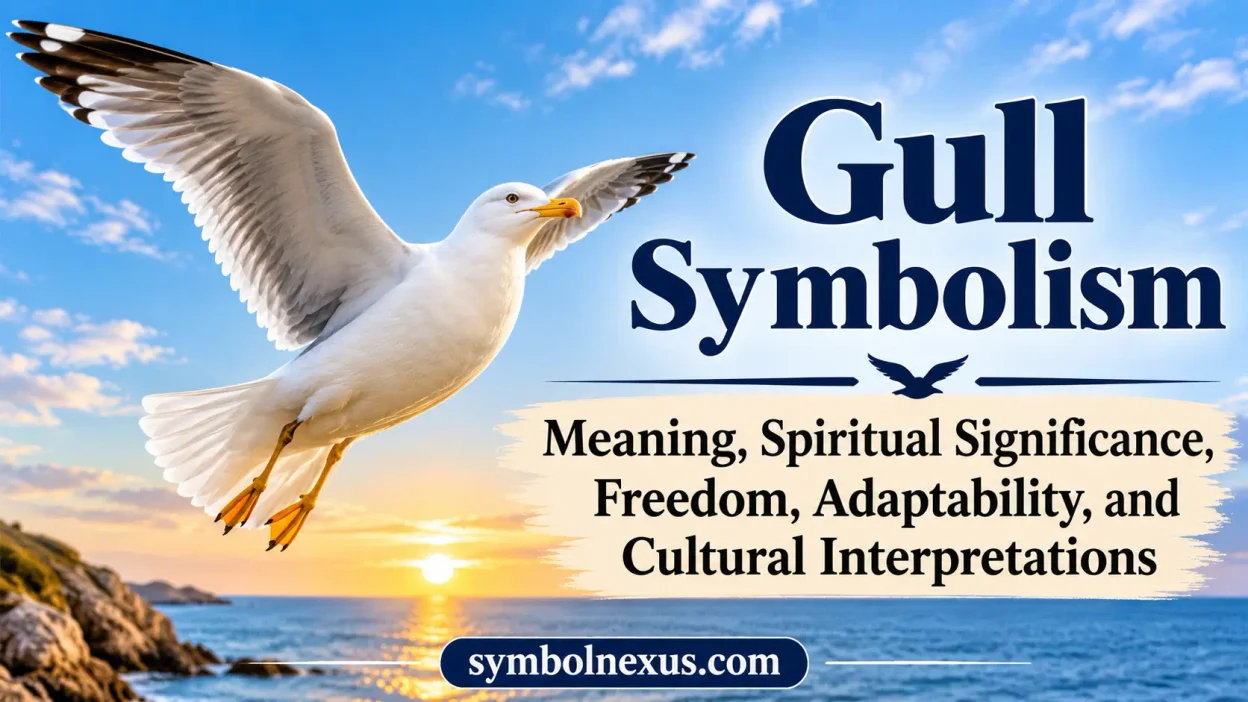
Gulls are familiar birds of coastlines, beaches, harbors, lakes, and even busy cities. Known for their graceful flight, distinctive calls, intelligence, and ability to survive in changing environments, they have become meaningful symbols in nature, folklore, literature, and modern spirituality.
Gull symbolism is commonly associated with freedom, adaptability, independence, resourcefulness, communication, and resilience. Their ability to travel between land, water, and sky makes them powerful representations of movement, exploration, and the connection between different environments.
In spiritual interpretations, gulls may symbolize the freedom to follow your own path, the courage to adapt to change, and the importance of recognizing opportunities. Their presence near the ocean also connects them with emotional depth, intuition, and the unknown.
Whether appearing in dreams, coastal landscapes, artwork, or personal experiences, gulls can represent the ability to remain flexible while moving toward new possibilities.
What Does a Gull Symbolize?
A gull generally symbolizes freedom, adaptability, intelligence, independence, survival, and communication. Its natural behavior provides inspiration for many of these meanings.
Gulls can fly long distances, search for food in different environments, and adjust their behavior according to changing conditions. These characteristics make them symbols of flexibility and resourcefulness.
Common symbolic meanings include:
- Freedom: The ability to explore, travel, and live independently.
- Adaptability: Adjusting to unfamiliar environments and circumstances.
- Resourcefulness: Finding solutions and making use of available opportunities.
- Intelligence: Learning, observing, and responding to challenges.
- Independence: Trusting your abilities and following your own direction.
- Communication: Expressing yourself and connecting with others.
- Resilience: Continuing through difficult or uncertain situations.
- Opportunity: Recognizing possibilities and being willing to pursue them.
- Emotional balance: Finding harmony between feelings and practical decisions.
These meanings are symbolic interpretations rather than universal cultural beliefs.
Spiritual Meaning of Gulls
In modern spiritual interpretations, gulls are often connected with freedom, emotional awareness, personal growth, and the ability to navigate life’s changes.
Their relationship with the sea and sky creates a powerful symbolic image of movement between emotional depth and personal independence.
1. Freedom and Independence
Gulls spend much of their lives moving between different environments. Their ability to fly over oceans, beaches, and cities makes them symbols of freedom and independence.
Spiritually, a gull may represent the desire to make your own decisions, explore new opportunities, and release unnecessary limitations.
2. Adaptability and Personal Growth
Gulls are highly adaptable birds. Many species can find food in coastal areas, wetlands, inland lakes, and urban environments.
This behavior can symbolize the importance of remaining flexible when life changes. A gull may serve as a reminder that personal growth often requires adjusting your expectations and learning new ways to move forward.
3. Emotional Awareness
Because gulls are commonly associated with coastal environments, modern spiritual interpretations sometimes connect them with emotions, intuition, and inner reflection.
The sea can represent deep feelings, while the gull flying above it may symbolize the ability to observe emotions without becoming overwhelmed by them.
4. Resourcefulness and Survival
Gulls are opportunistic feeders and can use different strategies to find food. Symbolically, this behavior represents creativity, practical intelligence, and the ability to make the best of difficult circumstances.
5. Communication and Expression
Gulls are vocal birds that use different calls and behaviors to communicate. In modern symbolism, they can represent speaking honestly, expressing needs, and paying attention to the messages of others.
Gull Symbolism Across Different Cultures
Gulls have appeared in coastal folklore, maritime traditions, literature, and artistic representations. Their meanings vary depending on the communities that live alongside them.
Celtic Gull Symbolism
In modern Celtic-inspired interpretations, seabirds and coastal birds are sometimes associated with freedom, travel, nature, and the relationship between the physical and spiritual worlds.
Gulls may be interpreted as symbols of movement between different realms because they travel between sea, land, and sky.
However, specific meanings attributed to gulls should not automatically be treated as universal ancient Celtic beliefs. Many contemporary interpretations combine broader seabird imagery with modern spiritual ideas.
Norse and Scandinavian Gull Symbolism
In northern European coastal traditions, seabirds have long been familiar parts of maritime life. Their presence around fishing grounds, shorelines, and boats made them important features of everyday observation.
Gulls can be interpreted in modern Scandinavian-inspired symbolism as representations of survival, coastal freedom, and the relationship between people and the sea.
They should not be confused with the ravens associated with Odin in Norse mythology, which have a much more clearly documented mythological role.
Japanese Gull Symbolism
In Japanese coastal environments, gulls are familiar seabirds that appear in nature photography, poetry, and seasonal imagery.
Modern interpretations may connect them with freedom, peaceful coastal landscapes, movement, and the changing seasons.
However, there is no single traditional Japanese symbolic meaning that applies to every gull species.
Indigenous Coastal Traditions
Different Indigenous communities have distinct relationships with seabirds and coastal ecosystems. Birds may appear in local stories, artwork, ecological knowledge, and traditional teachings.
However, Indigenous beliefs are diverse. There is no single Native American or Indigenous interpretation of gull symbolism.
Any specific cultural meaning should be connected to the particular nation, community, and tradition in which it appears.
Maritime Folklore
Gulls are strongly connected with maritime life. Sailors and coastal communities have historically observed their movements, calls, and feeding behavior as part of their relationship with the ocean.
In maritime folklore, seabirds sometimes appear as symbols of navigation, survival, weather, or the relationship between people and the sea.
Gulls may also be associated with returning to shore and finding safety after traveling over open water. These associations vary across local traditions.
Gull Symbolism in Different Situations
The symbolic meaning of a gull can depend on how and where it appears.
Seeing a Gull
Seeing a gull is often interpreted in modern spirituality as a reminder to embrace freedom, remain adaptable, and explore new possibilities.
Its appearance may encourage you to consider whether you are holding yourself back or avoiding an opportunity for change.
From a natural perspective, gulls are commonly seen near water because many species depend on aquatic and coastal environments for food.
A Gull Flying Over the Ocean
A gull flying over the ocean can symbolize freedom, exploration, and emotional independence.
The ocean often represents deep feelings and the unknown, while the bird represents the ability to move through uncertainty.
Together, these images can suggest courage, trust, and a willingness to explore unfamiliar experiences.
A Gull Landing Near You
A gull landing nearby may be interpreted as a symbol of awareness, adaptability, and connection with nature.
In a personal or spiritual context, the encounter might encourage you to pay attention to your surroundings and appreciate opportunities that are easy to overlook.
However, gulls often approach people because they associate human environments with food or convenient resting places.
Hearing a Gull Calling
The distinctive call of a gull can symbolize communication, self-expression, and the importance of paying attention.
Some modern interpretations connect hearing a gull with speaking honestly or reconnecting with someone important.
In nature, gull calls serve practical communication purposes, including signaling, social interaction, and territorial behavior.
Seeing a Flock of Gulls
A flock of gulls may symbolize community, cooperation, social connection, and shared opportunities.
Although gulls are often seen gathering in large groups, their social behavior can vary according to species, season, and circumstances.
Symbolically, a flock may remind you that independence and community can exist together.
Seeing a Dead Gull
A dead gull may be interpreted symbolically as an ending, a change in direction, or the need to release an old attachment.
However, the death of a bird is a natural event and does not predict misfortune. Its personal meaning depends on the circumstances and the feelings associated with the encounter.
Gull Symbolism by Color
Gulls are often recognized by their white and gray plumage, although some species have darker feathers, distinctive markings, or seasonal changes in appearance.
Modern symbolic interpretations may connect different colors with particular emotions and qualities.
| Gull Color or MarkingCommon Symbolic Meaning | |
|---|---|
| White | Peace, purity, freedom, and clarity |
| Gray | Balance, adaptability, patience, and wisdom |
| Black | Mystery, independence, protection, and strength |
| Brown | Grounding, survival, stability, and practicality |
| White and Gray | Emotional balance, flexibility, and harmony |
| Black and White | Duality, contrast, and finding balance |
These color associations are modern symbolic interpretations, not established meanings shared by all cultures.
White Gull Symbolism
White gulls are commonly associated with peace, freedom, purity, and spiritual clarity.
Their bright feathers against the blue ocean or sky create a striking image of openness and tranquility.
In modern spiritual interpretations, a white gull may represent a fresh beginning, emotional calmness, or the desire to move forward without unnecessary burdens.
Gray Gull Symbolism
Gray gulls can symbolize balance, patience, adaptability, and practical wisdom.
Gray is often associated with neutrality and the ability to understand different perspectives. A gray gull may therefore represent the importance of remaining calm when dealing with complicated circumstances.
Its symbolism can also reflect the ability to find stability during uncertain periods.
Black-Headed Gull Symbolism
Some gull species, including the black-headed gull, develop dark markings on their heads during the breeding season. Despite its common name, this species usually has a chocolate-brown hood rather than a completely black one.
In modern symbolic interpretations, its contrasting appearance may represent individuality, change, and the ability to adapt to different stages of life.
Because the bird’s markings change seasonally, it can also inspire symbolism connected with transformation and renewal.
Gull Symbolism in Dreams
Dreams about gulls can be interpreted in different ways depending on the dreamer’s emotions, experiences, and the details of the dream.
In symbolic dream interpretation, gulls often represent freedom, independence, adaptability, communication, and emotional awareness.
| Gull Dream | Possible Symbolic Interpretation |
|---|---|
| Seeing a gull | Freedom, awareness, or a new perspective |
| A gull flying | Independence and personal growth |
| A gull over the ocean | Emotional freedom and exploration |
| A flock of gulls | Community and social connections |
| A gull calling loudly | Communication or the need to express yourself |
| Feeding a gull | Generosity, opportunity, or resourcefulness |
| A gull landing on you | Personal awareness or an unexpected experience |
| An injured gull | Vulnerability or a need for care |
| A dead gull | Endings, change, or letting go |
| A white gull | Peace, hope, and clarity |
Dream interpretation is subjective and is not scientifically established as a way to predict the future. Consider how the dream connects with your own experiences rather than treating it as a fixed message.
Gull Symbolism in Love and Relationships
In love and relationships, gulls are often associated with freedom, independence, communication, and emotional balance.
Their symbolism can represent the importance of maintaining individuality while building meaningful connections with others.
Common interpretations include:
- Freedom in love: Allowing each partner to maintain personal interests and independence.
- Communication: Expressing feelings openly and honestly.
- Adaptability: Adjusting to changes within a relationship.
- Loyalty: Supporting one another through different circumstances.
- Emotional balance: Respecting personal needs while nurturing a shared connection.
- Exploration: Building new experiences and memories together.
A gull can also represent the idea that healthy relationships should provide both connection and room for personal growth.
Gull Symbolism in Christianity
Gulls are not specifically identified as symbols in the Bible. Therefore, Christianity does not establish a direct biblical meaning for these birds.
However, some Christians may interpret gulls through broader biblical themes involving freedom, God’s creation, trust, and spiritual awareness.
Several Bible passages can be connected with these themes:
- Matthew 6:26: Jesus refers to the birds of the air as an example of God’s provision.
- Psalm 104:12: Describes birds living and singing near bodies of water.
- Isaiah 40:31: Uses the image of rising on wings like eagles to express renewed strength.
- Psalm 139:9–10: Uses the imagery of wings and distant places to describe God’s presence.
These passages do not specifically mention gulls. Their connection with gull symbolism is a personal or thematic interpretation rather than an explicit biblical teaching.
Gull as a Spirit Animal
In contemporary spiritual practices, the gull spirit animal is often associated with freedom, adaptability, intelligence, and resourcefulness.
People who identify with gull symbolism may connect with qualities such as:
- Independence and self-confidence.
- Curiosity and a desire to explore.
- The ability to adapt to unfamiliar situations.
- Strong communication skills.
- Practical problem-solving.
- Emotional flexibility.
- Appreciation of nature and open spaces.
The gull spirit animal can serve as a personal metaphor for someone who values freedom but also understands the importance of community and cooperation.
This interpretation belongs to modern spiritual language and should not be confused with the specific animal traditions of Indigenous cultures.
Gull Symbolism in Art and Literature
Gulls frequently appear in coastal paintings, maritime photography, poetry, novels, and other creative works.
Their presence can help artists communicate ideas about freedom, loneliness, travel, nature, and the relationship between humans and the sea.
Common meanings include:
- Freedom and escape: A gull flying above the ocean can represent independence and the desire to explore.
- Solitude: A single gull on a quiet beach may symbolize loneliness or reflection.
- Survival: Gulls can represent the ability to adapt to challenging environments.
- Coastal life: Their presence can establish a strong sense of place and maritime identity.
- Communication: Their calls may represent messages, memories, or emotional expression.
- The unknown: A gull disappearing toward the horizon can symbolize possibility and uncertainty.
Gulls are also important in literary works that explore the natural world, human ambition, and the desire to move beyond ordinary limitations.
Gull Symbolism in Jonathan Livingston Seagull
One of the most recognizable literary associations involving a gull appears in Jonathan Livingston Seagull by Richard Bach.
Published in 1970, the book tells the story of a seagull who wants to improve his flying abilities rather than simply follow the ordinary routines of his flock.
In the story, the gull becomes a symbol of:
- Individuality: Having the courage to be different.
- Self-improvement: Working toward personal excellence.
- Freedom: Moving beyond limitations imposed by others.
- Persistence: Continuing to practice despite difficulties.
- Spiritual development: Seeking a deeper understanding of life.
- Purpose: Discovering what makes life meaningful.
Jonathan’s journey makes the gull a powerful literary representation of independence, ambition, and personal transformation.
Gull Symbolism in Tattoos
Gull tattoos are often chosen to represent freedom, independence, travel, and a deep connection with the sea.
Their simple silhouettes and recognizable flying shapes make them popular choices for minimalist and coastal-inspired tattoo designs.
Common gull tattoo designs include:
- Flying gull: Represents freedom, independence, and new opportunities.
- Gull over ocean waves: Symbolizes emotional strength and connection with nature.
- Single gull silhouette: Represents simplicity, solitude, and personal freedom.
- Flock of gulls: Symbolizes community, friendship, and shared experiences.
- Gull with a sunset: Represents hope, reflection, and new beginnings.
- Gull with an anchor: Connects freedom with stability and maritime identity.
- Gull with a compass: Represents travel, exploration, and finding direction.
A gull tattoo may also commemorate a memorable coastal location, a love of the ocean, or an important period of personal change.
Types of Gulls and Their Symbolic Associations
There are many gull species around the world. Although they share certain characteristics, their appearances, habitats, and behaviors differ.
The following symbolic associations are modern interpretations inspired by their characteristics rather than established cultural meanings.
| Gull Species | Possible Symbolic Association |
|---|---|
| Herring Gull | Resourcefulness, resilience, and adaptability |
| Black-Headed Gull | Transformation, individuality, and seasonal change |
| Ring-Billed Gull | Cooperation, balance, and adaptability |
| Great Black-Backed Gull | Strength, confidence, and independence |
| Laughing Gull | Communication, expression, and social connection |
| Little Gull | Simplicity, flexibility, and freedom |
| Glaucous Gull | Endurance, patience, and survival |
| California Gull | Exploration, movement, and resourcefulness |
Species identification matters because not every gull looks or behaves the same way. These symbolic associations should be understood as creative interpretations rather than traditional beliefs.
Gull vs. Seagull: Is There a Difference?
The words gull and seagull are often used interchangeably in everyday conversation. However, gull is the more accurate general term used in bird classification.
Not all gulls live exclusively near the sea. Many species also inhabit inland lakes, rivers, wetlands, agricultural areas, and urban environments.
| Term | Meaning |
|---|---|
| Gull | The general name for birds in the gull family, Laridae |
| Seagull | An informal name commonly used for gulls, especially coastal species |
Both terms usually refer to the same group of birds, but gull is the preferred scientific and general birding term.
What Can Gulls Teach Us Symbolically?
Gulls offer several useful lessons through their natural behavior and adaptability.
- Embrace change: Learn to adjust when circumstances become unfamiliar.
- Value independence: Develop confidence in your ability to make decisions.
- Stay resourceful: Look for practical solutions instead of giving up.
- Communicate clearly: Express your needs and pay attention to others.
- Explore new opportunities: Do not remain limited by familiar surroundings.
- Balance freedom and connection: Maintain your individuality while appreciating relationships.
- Respect nature: Recognize the importance of coastal and aquatic ecosystems.
These lessons are symbolic reflections inspired by gull behavior, not claims that birds intentionally communicate human messages.
Conclusion
Gull symbolism is closely connected with freedom, adaptability, independence, intelligence, communication, and resilience. Their ability to move between land, water, and sky has made them meaningful representations of exploration, flexibility, and the desire to live beyond limitations.
In modern spiritual interpretations, gulls can symbolize emotional awareness, personal growth, and the courage to embrace change. In literature, they often represent individuality and the pursuit of freedom, particularly in works such as Jonathan Livingston Seagull.
Whether you encounter a gull flying over the ocean, hear its distinctive call, or see one in a dream, its symbolism can offer a reminder to remain adaptable, trust your abilities, and appreciate the opportunities that come with change.
Frequently Asked Questions (FAQs)
1. What does a gull symbolize spiritually?
A gull commonly symbolizes freedom, adaptability, independence, communication, resilience, and emotional awareness in modern spiritual interpretations.
2. What does seeing a gull mean?
Seeing a gull may symbolically represent new opportunities, personal freedom, and the ability to adapt to change. It can also simply be an ordinary wildlife encounter.
3. What does a gull symbolize in love?
In love, gulls are often associated with independence, communication, emotional balance, and the freedom to grow within a relationship.
4. What does a gull symbolize in dreams?
A gull in a dream may represent freedom, exploration, independence, or emotional development. Its interpretation depends on the dream’s details and the dreamer’s personal experiences.
5. What does a white gull symbolize?
A white gull is commonly associated with peace, purity, hope, clarity, and freedom in modern symbolic interpretations.
6. What does a flock of gulls symbolize?
A flock of gulls may represent community, cooperation, friendship, and shared opportunities. It can also symbolize the balance between independence and belonging.
7. What does a gull symbolize in Christianity?
The Bible does not assign gulls a specific symbolic meaning. Some Christians connect them with broader themes of God’s creation, freedom, and divine provision.
8. Are gulls a symbol of good luck?
Gulls may be considered positive symbols of freedom, opportunity, and resilience in modern spiritual interpretations. However, there is no universal belief that seeing one guarantees good luck.
9. What does a flying gull symbolize?
A flying gull commonly symbolizes independence, exploration, freedom, and the desire to move beyond limitations.
10. What does a gull tattoo mean?
A gull tattoo often represents freedom, travel, independence, resilience, and a connection with coastal life or the ocean.
11. What does a gull symbolize in Jonathan Livingston Seagull?
In Richard Bach’s Jonathan Livingston Seagull, the gull represents individuality, self-improvement, freedom, persistence, and the pursuit of personal purpose.
12. Is a gull the same as a seagull?
Yes, in everyday language, the terms are generally used for the same birds. However, gull is the more accurate general term because many gull species live inland as well as along coastlines.