Diamonds have fascinated people for centuries because of their extraordinary brilliance, rarity, and remarkable hardness. Valued as gemstones, symbols of status, and expressions of affection, diamonds carry meanings that extend far beyond their physical beauty. Across different cultures and historical periods, they have represented strength, purity, wealth, commitment, wisdom, and eternity.
The symbolism of diamonds is especially powerful because of their ability to withstand scratching and retain their brilliance when properly cared for. These qualities have made diamonds popular metaphors for emotional resilience, lasting relationships, and the ability to remain strong through difficult experiences.
In modern culture, diamonds are closely associated with engagement rings, marriage, luxury, and success. In spiritual interpretations, they may represent clarity, inner strength, enlightenment, and protection. Their meaning, however, depends on the historical, cultural, and personal context in which they appear.
What Do Diamonds Symbolize?
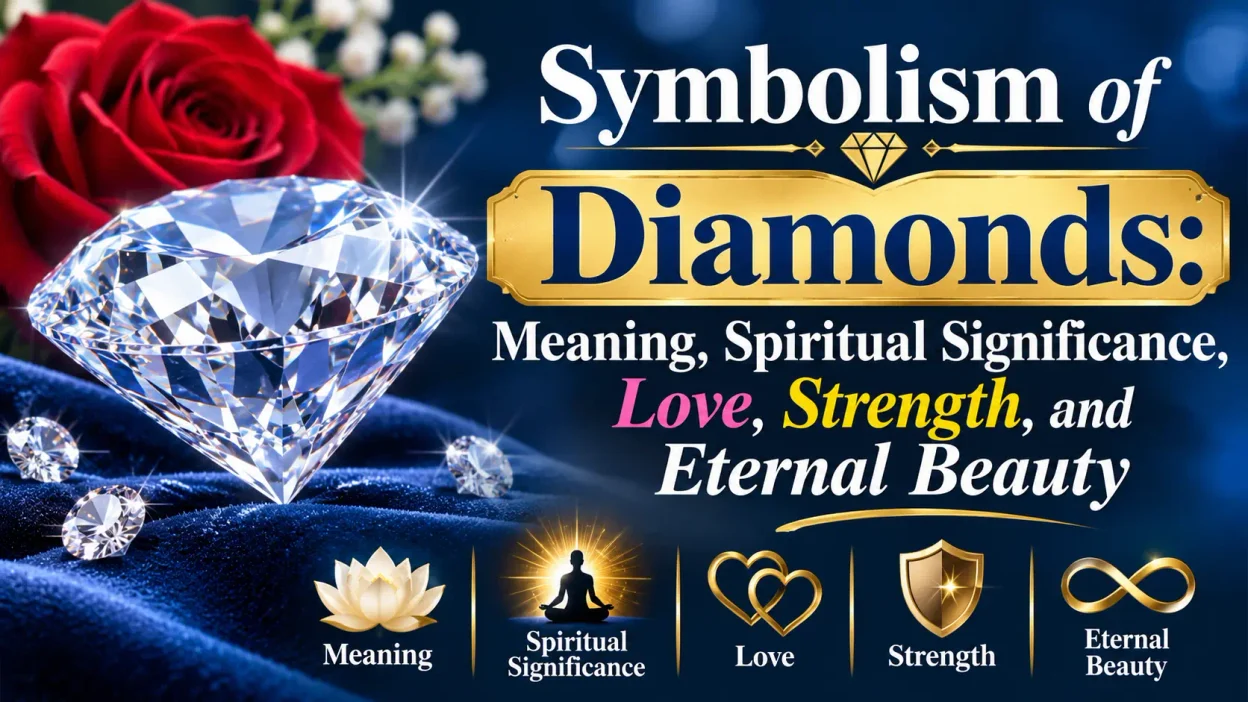
Diamonds commonly symbolize strength, purity, eternal love, clarity, wealth, and resilience. Their exceptional hardness makes them a natural metaphor for endurance, while their sparkling appearance connects them with light, beauty, and spiritual awareness.
Some of the most common symbolic meanings include:
- Strength: The ability to withstand pressure and overcome challenges.
- Eternal love: Commitment, loyalty, and lasting relationships.
- Purity: Clarity, innocence, and sincerity.
- Wealth: Luxury, prosperity, and social status.
- Wisdom: Mental clarity, understanding, and good judgment.
- Resilience: Remaining strong during difficult experiences.
- Eternity: Lasting beauty and enduring connections.
- Spiritual enlightenment: Awareness, insight, and personal growth.
These meanings are symbolic interpretations rather than universal beliefs. Different cultures and individuals may associate diamonds with different qualities.
1. Diamond Symbolism and Strength
Strength is one of the most recognizable meanings associated with diamonds.
Diamond is the hardest naturally occurring mineral on the Mohs hardness scale, ranking 10. Its exceptional resistance to scratching has made it a powerful symbol of endurance and inner strength.
In symbolic interpretations, a diamond can represent the ability to remain steady when life becomes difficult.
Diamond symbolism related to strength includes:
- Overcoming personal challenges.
- Developing emotional resilience.
- Staying committed to important goals.
- Maintaining confidence during uncertainty.
- Learning from difficult experiences.
The diamond can remind people that strength does not always mean avoiding hardship. Sometimes, it means continuing forward while facing challenges with patience and determination.
2. Diamond Symbolism and Eternal Love
Diamonds are among the most recognizable symbols of romantic commitment.
Their association with lasting love is especially visible in engagement rings and wedding jewelry. A diamond’s durability makes it a fitting metaphor for a relationship built on trust, loyalty, and long-term dedication.
Diamond symbolism in love can represent:
- Eternal commitment.
- Faithfulness and loyalty.
- Emotional connection.
- Trust and honesty.
- Shared goals and lasting partnership.
The tradition of diamond engagement rings became particularly influential in modern Western culture after a major advertising campaign by De Beers in 1947 popularized the phrase “A Diamond Is Forever.”
Although diamonds are widely used to celebrate romantic relationships, genuine love is not measured by the size or price of a gemstone. The symbolic meaning comes from the commitment and personal significance attached to it.
3. Diamond Symbolism and Purity
Diamonds are often associated with purity, clarity, and sincerity.
Their transparent appearance has made them symbols of honesty and truth in various modern interpretations. A clear diamond can represent an uncomplicated intention, while its brilliant light may symbolize the desire to see situations more clearly.
Spiritually, diamond symbolism related to purity may include:
- Honest communication.
- Sincere intentions.
- Emotional clarity.
- Integrity and truthfulness.
- Freedom from unnecessary confusion.
This symbolism is particularly common in jewelry, ceremonial gifts, and modern spiritual discussions.
However, the idea that a diamond represents purity is a cultural and symbolic association, not a scientific property of every diamond.
4. Diamond Symbolism and Wealth
Diamonds have long been associated with wealth, luxury, and prestige.
Their rarity, beauty, and high market value have made them important objects of trade and displays of social status. Historically, diamonds were particularly associated with royalty, wealthy families, and powerful rulers.
In modern culture, diamond jewelry often represents:
- Financial success.
- Luxury and elegance.
- Achievement and recognition.
- Prosperity and abundance.
- Personal accomplishment.
A diamond can also symbolize the value of something precious that cannot easily be replaced. This meaning may extend beyond money to include family, friendship, experiences, and personal achievements.
5. Diamond Symbolism and Spiritual Enlightenment
In contemporary spiritual interpretations, diamonds are sometimes associated with enlightenment, awareness, and higher understanding.
Their ability to reflect and refract light provides a metaphor for discovering knowledge and recognizing different perspectives.
A diamond may symbolize:
- Greater self-awareness.
- Mental clarity.
- Wisdom and insight.
- Personal transformation.
- A deeper understanding of life’s experiences.
Some modern spiritual traditions also associate diamonds with the crown chakra, which is commonly connected with consciousness, spiritual awareness, and connection with the divine.
These chakra associations are part of modern spiritual interpretations and should not be presented as universal historical beliefs.
6. Diamond Symbolism and Resilience
A diamond’s formation offers another interesting layer of symbolism.
Natural diamonds form deep within Earth’s mantle under extremely high pressure and temperature conditions. Over geological periods, they can reach the surface through volcanic processes.
This process has inspired the familiar metaphor that pressure can produce something beautiful and valuable.
Symbolically, diamonds may represent:
- Growth through difficult experiences.
- The ability to recover from setbacks.
- Patience during personal development.
- Confidence after overcoming hardship.
- Discovering inner value.
However, this is a metaphor rather than a literal rule of life. Difficult experiences do not automatically make people stronger, and everyone deserves support when facing hardship.
7. Diamond Symbolism and Protection
Throughout history, diamonds have sometimes been believed to offer protection against danger, illness, or negative forces.
Ancient and medieval traditions included various beliefs about the protective powers of gemstones. Some historical writers associated diamonds with courage, invincibility, and protection during conflict.
In modern spiritual interpretations, diamonds may represent:
- Emotional protection.
- Confidence and courage.
- Personal boundaries.
- Inner stability.
- Protection from negativity.
These beliefs belong to folklore and spiritual traditions. There is no reliable scientific evidence that wearing a diamond provides supernatural protection or prevents harm.
8. Diamond Symbolism in Different Cultures
Diamonds have played important roles in different societies, particularly in traditions involving royalty, religion, wealth, and ceremonial jewelry.
Ancient Indian Culture
India has a particularly important place in diamond history. For centuries, it was one of the world’s major sources of diamonds, and gemstones played significant roles in royal collections, trade, and religious traditions.
In some Indian traditions, diamonds are associated with the planet Venus, known in Sanskrit as Shukra, within certain systems of Vedic astrology.
Diamonds are also discussed in traditional gemological literature, including the Ratna Shastra tradition. Their symbolic and astrological significance varies according to the specific text and belief system.
Ancient Greek Culture
The word diamond comes from the Greek word adamas, often translated as “unconquerable” or “invincible.”
This linguistic connection reflects the gemstone’s remarkable hardness and helps explain its long-standing association with strength and endurance.
Ancient Greek traditions also included beliefs about precious stones and their relationship with divine or supernatural forces.
Roman Culture
In ancient Rome, precious gemstones were valued for their beauty, status, and decorative use. Diamonds were known, although they were not as widely available or extensively used as they became in later periods.
Some ancient beliefs connected gemstones with protection and strength, but these ideas varied and should not be treated as a single Roman diamond tradition.
European Royal Traditions
Diamonds became increasingly important in European royal jewelry and court culture.
Their rarity, brilliance, and expense made them symbols of authority, wealth, and prestige. Royal collections and ceremonial jewelry helped establish the diamond’s association with power and social status.
Modern Western Culture
Today, diamonds are strongly associated with engagement rings, anniversaries, luxury, and romantic commitment.
The diamond engagement ring became especially popular during the twentieth century, supported by advertising and changing social traditions.
9. Diamond Symbolism in Christianity and the Bible
The Bible does not establish one simple, universal symbolic meaning for diamonds. However, precious stones appear in several biblical passages and are sometimes associated with beauty, value, divine glory, and spiritual significance.
For example:
- Exodus 28:18: A diamond or related precious stone appears in some translations and interpretations of the high priest’s breastpiece, although gemstone identification varies.
- Ezekiel 28:13: Precious stones are mentioned in a description of splendor and adornment. The exact mineral translations differ.
- Revelation 21:19–20: Precious stones decorate the foundations of the New Jerusalem, representing the city’s magnificent imagery.
The original Hebrew and Greek gemstone terms do not always correspond neatly to modern mineral classifications. Therefore, a stone translated as diamond in one version may be identified differently in another.
In Christian symbolism, diamonds may be used as personal metaphors for:
- Faith that remains strong through difficulty.
- Spiritual purity.
- The enduring nature of God’s promises.
- The beauty of divine creation.
- Truth and integrity.
These are interpretive associations rather than a single meaning explicitly assigned to diamonds throughout the Bible.
10. Diamond Symbolism by Color
Although colorless diamonds are the most familiar, natural diamonds can appear in several colors because of differences in their chemical composition, crystal structure, and geological history.
In modern color symbolism, each shade may carry its own associations.
| Diamond ColorCommon Symbolic Meaning | |
|---|---|
| White or Colorless | Purity, clarity, innocence, and truth |
| Blue | Peace, wisdom, loyalty, and communication |
| Pink | Romance, tenderness, compassion, and affection |
| Yellow | Happiness, optimism, confidence, and abundance |
| Black | Mystery, strength, independence, and protection |
| Green | Renewal, growth, harmony, and prosperity |
| Red | Passion, courage, energy, and desire |
| Champagne or Brown | Stability, warmth, grounding, and elegance |
| Orange | Creativity, enthusiasm, and vitality |
These meanings are primarily based on modern color symbolism and personal interpretation. They are not fixed meanings recognized by every culture.
11. Diamond Symbolism in Dreams
Dreaming about diamonds can have several possible interpretations depending on the situation and emotions involved.
In modern dream symbolism, diamonds may represent self-worth, success, commitment, clarity, or something valuable in your life.
| Diamond Dream | Possible Symbolic Interpretation |
|---|---|
| Finding a diamond | Discovering an opportunity or recognizing personal value |
| Receiving a diamond | Appreciation, affection, or commitment |
| Losing a diamond | Fear of losing something important |
| Wearing a diamond ring | Commitment, relationships, or personal promises |
| A broken diamond | Disappointment or changing expectations |
| A sparkling diamond | Confidence, achievement, or clarity |
| A large diamond | Ambition, success, or something highly valued |
| A black diamond | Mystery, strength, or uncertainty |
Dream interpretations are subjective and depend on personal experiences. A diamond dream does not reliably predict wealth, marriage, or future events.
12. Diamond Symbolism in Relationships and Marriage
Diamonds have become powerful symbols of romantic relationships because of their association with durability and lasting commitment.
An engagement ring containing a diamond often represents a promise to build a future together. Wedding and anniversary jewelry may also use diamonds to celebrate important milestones.
In relationships, diamonds can symbolize:
- Loyalty and faithfulness.
- Long-term commitment.
- Trust and mutual respect.
- Emotional strength.
- Shared memories and experiences.
The circular shape of many engagement rings adds another symbolic element. A circle has no visible beginning or end, making it a traditional metaphor for continuity and enduring connection.
Nevertheless, a successful relationship depends on care, communication, respect, and trust rather than the presence of expensive jewelry.
13. Diamond Symbolism in Tattoos
Diamond tattoos are popular because they combine a simple geometric shape with powerful symbolic meanings.
People choose diamond designs to represent personal strength, confidence, independence, and the ability to overcome challenges.
Common diamond tattoo interpretations include:
- Simple diamond outline: Clarity, elegance, and self-worth.
- Sparkling diamond: Success, ambition, and personal achievement.
- Black diamond: Strength, mystery, and individuality.
- Diamond with flowers: Beauty, growth, and resilience.
- Diamond with a crown: Confidence, authority, and self-respect.
- Diamond with a heart: Love, commitment, and emotional strength.
Some people also choose diamond tattoos to remember a loved one or celebrate an important life experience.
14. Diamond Symbolism in Art and Literature
Diamonds have appeared in art, literature, poetry, and popular culture as symbols of wealth, beauty, power, and desire.
Their brilliant appearance makes them useful visual representations of something rare or extraordinary.
In literature and storytelling, diamonds can symbolize:
- Wealth and social ambition.
- Temptation and material desire.
- Emotional strength.
- Beauty and perfection.
- Something valuable that is difficult to obtain.
Diamonds can also represent the contrast between external appearance and inner character. A person may possess great material wealth but lack kindness, honesty, or wisdom.
This contrast makes diamonds effective symbols in stories about greed, ambition, identity, and human values.
15. Diamond Symbolism and Personal Growth
Diamonds can also represent the process of discovering your own value.
Their natural formation takes place over extremely long periods under intense geological conditions. This has inspired the metaphor of becoming stronger through patience, experience, and personal development.
In this context, diamond symbolism may encourage you to:
- Recognize your individual worth.
- Remain patient with personal growth.
- Develop confidence and resilience.
- Learn from difficult experiences.
- Avoid comparing your progress with others.
- Value qualities that cannot be measured financially.
The diamond serves as a reminder that personal worth is not determined by appearance, status, or material possessions.
Diamond Symbolism: Quick Meaning Guide
| Symbolic Theme | Meaning |
|---|---|
| Strength | Endurance and inner resilience |
| Love | Commitment and lasting affection |
| Purity | Honesty, clarity, and sincerity |
| Wealth | Luxury, prosperity, and status |
| Wisdom | Insight and understanding |
| Protection | Courage and emotional security |
| Eternity | Lasting bonds and continuity |
| Enlightenment | Awareness and spiritual growth |
| Beauty | Rarity and brilliance |
| Personal growth | Patience and discovering inner value |
Conclusion
The symbolism of diamonds is deeply connected with strength, eternal love, purity, wealth, resilience, and spiritual awareness. Their exceptional hardness makes them powerful representations of endurance, while their brilliance has connected them with beauty, clarity, and enlightenment.
Across history, diamonds have represented royal authority, social status, romantic commitment, and personal achievement. In modern spiritual interpretations, they can also symbolize inner strength, self-discovery, and the ability to remain true to yourself during challenging times.
Whether worn as jewelry, used in a tattoo, given as a meaningful gift, or encountered in a dream, a diamond can represent something precious and lasting. Ultimately, its deepest meaning comes from the values, memories, and personal significance people attach to it.
Frequently Asked Questions (FAQs)
1. What do diamonds symbolize spiritually?
Diamonds commonly symbolize strength, clarity, purity, wisdom, protection, and spiritual awareness. In modern spiritual interpretations, they may also represent enlightenment and personal transformation.
2. What is the spiritual meaning of a diamond?
The spiritual meaning of a diamond is often connected with inner strength, truth, emotional resilience, and clarity. Some modern traditions also associate diamonds with higher consciousness and the crown chakra.
3. Why are diamonds a symbol of eternal love?
Diamonds are associated with eternal love because of their exceptional hardness and durability. These qualities make them a metaphor for lasting commitment, loyalty, and enduring relationships.
4. What does a diamond symbolize in Christianity?
Diamonds are not assigned one universal meaning in the Bible. Christians may interpret them as symbols of faith, purity, divine beauty, and spiritual strength, although these are interpretive associations.
5. What does a diamond symbolize in a dream?
A diamond in a dream may represent self-worth, success, love, commitment, or something valuable in your life. The meaning depends on the dream’s details and your personal circumstances.
6. What does a black diamond symbolize?
A black diamond is commonly associated with strength, mystery, independence, protection, and individuality in modern symbolic interpretations.
7. What does a white diamond symbolize?
A white or colorless diamond often symbolizes purity, innocence, honesty, clarity, and sincerity.
8. What does a diamond ring symbolize?
A diamond ring commonly represents love, loyalty, commitment, and lasting partnership. In engagement and wedding traditions, it is often used to express a promise of enduring affection.
9. Are diamonds symbols of strength?
Yes. Diamonds are widely associated with strength because they rank 10 on the Mohs hardness scale, making them the hardest naturally occurring mineral commonly recognized in mineralogy.
10. What does a diamond symbolize in different cultures?
Diamond symbolism varies across cultures. It may represent wealth, royal authority, protection, strength, beauty, or spiritual significance, depending on the historical and cultural tradition.
11. What does a pink diamond symbolize?
A pink diamond is commonly associated with romance, affection, tenderness, compassion, and emotional connection in modern color symbolism.
12. What does it mean to give someone a diamond?
Giving someone a diamond can express love, appreciation, commitment, celebration, or recognition of an important relationship. Its meaning depends on the occasion and the intentions behind the gift.